QUESTION IMAGE
Question
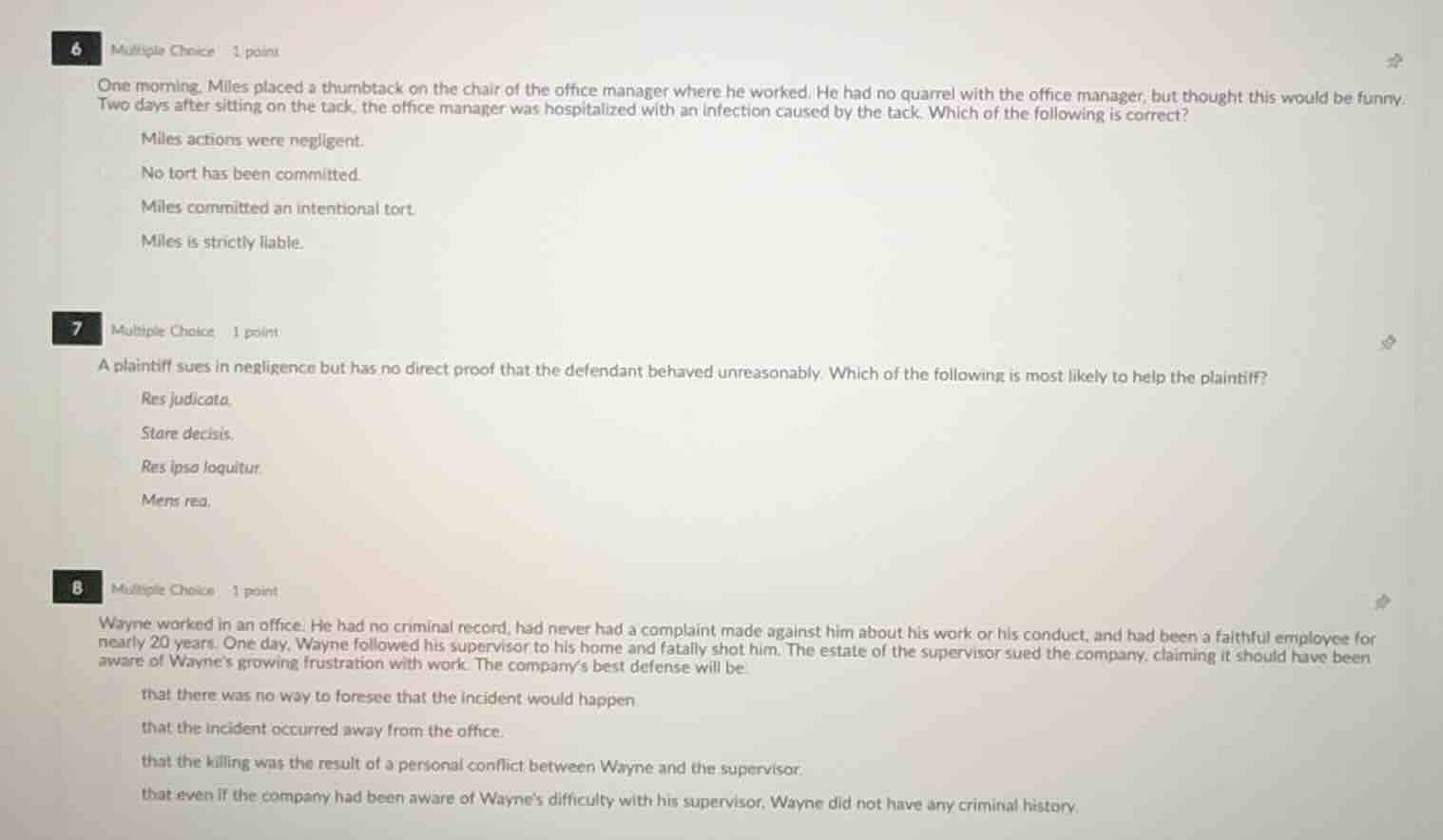
6 multiple choice 1 point one morning, miles placed a thumbtack on the chair of the office manager where he worked. he had no quarrel with the office manager, but thought this would be funny. two days after sitting on the tack, the office manager was hospitalized with an infection caused by the tack. which of the following is correct? miles actions were negligent. no tort has been committed. miles committed an intentional tort miles is strictly liable. 7 multiple choice 1 point a plaintiff sues in negligence but has no direct proof that the defendant behaved unreasonably. which of the following is most likely to help the plaintiff? res judicata. stare decisis. res ipsa loquitur. mens rea. 8 multiple choice 1 point wayne worked in an office. he had no criminal record, had never had a complaint made against him about his work or his conduct, and had been a faithful employee for nearly 20 years. one day, wayne followed his supervisor to his home and fatally shot him. the estate of the supervisor sued the company, claiming it should have been aware of waynes growing frustration with work. the companys best defense will be: that there was no way to foresee that the incident would happen that the incident occurred away from the office. that the killing was the result of a personal conflict between wayne and the supervisor that even if the company had been aware of waynes difficulty with his supervisor, wayne did not have any criminal history.
Question 6:
Miles intentionally placed the tack as a prank, knowing it would cause contact with the manager's body, which meets the criteria for an intentional tort (intent to commit the act that leads to harm, even if not intent to cause the specific severe injury). Negligence involves careless conduct (not intentional action), strict liability applies to specific activities like dangerous products, and a tort was clearly committed here.
Question 7:
Res ipsa loquitur is a legal doctrine that allows a plaintiff to establish a presumption of negligence without direct proof, by showing the harm would not normally occur without negligence, the defendant had control over the situation, and the plaintiff did not cause the harm. Res judicata bars re-litigating a settled case, stare decisis is following precedent, and mens rea is a criminal intent standard not relevant to negligence suits.
Question 8:
The core of negligence claims against employers for employee acts is foreseeability of harm. If the company can show it had no way to predict the violent incident, it breaks the chain of required duty and foreseeability for liability. The other options are weaker defenses compared to lack of foreseeability as a foundational element of such claims.

Snap & solve any problem in the app
Get step-by-step solutions on Sovi AI
Photo-based solutions with guided steps
Explore more problems and detailed explanations
- Miles committed an intentional tort.
- Res ipsa loquitur.
- that there was no way to foresee that the incident would happen