QUESTION IMAGE
Question
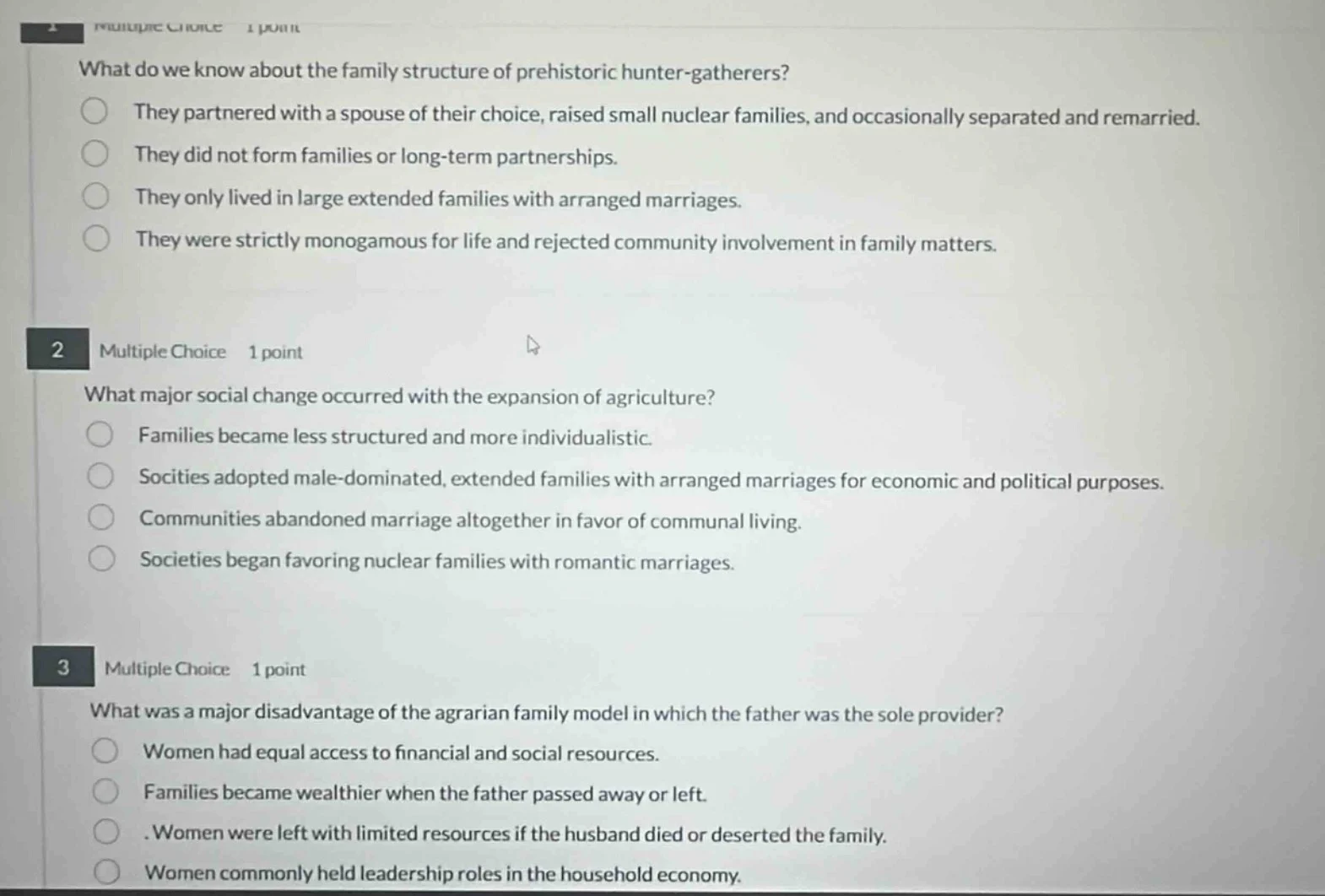
1 multiple choice 1 point
what do we know about the family structure of prehistoric hunter-gatherers?
they partnered with a spouse of their choice, raised small nuclear families, and occasionally separated and remarried.
they did not form families or long-term partnerships.
they only lived in large extended families with arranged marriages.
they were strictly monogamous for life and rejected community involvement in family matters.
2 multiple choice 1 point
what major social change occurred with the expansion of agriculture?
families became less structured and more individualistic.
socities adopted male-dominated, extended families with arranged marriages for economic and political purposes.
communities abandoned marriage altogether in favor of communal living.
societies began favoring nuclear families with romantic marriages.
3 multiple choice 1 point
what was a major disadvantage of the agrarian family model in which the father was the sole provider?
women had equal access to financial and social resources.
families became wealthier when the father passed away or left.
. women were left with limited resources if the husband died or deserted the family.
women commonly held leadership roles in the household economy.
- For prehistoric hunter-gatherers, anthropological and archaeological evidence shows they typically formed small nuclear families, chose their own partners, and had flexibility in relationships including separation and remarriage, rather than strict lifelong monogamy, only extended families, or no family structures.
- The rise of agriculture led to settled societies, where property and inheritance became important. This resulted in male-dominated extended families with arranged marriages to solidify economic and political ties, moving away from the more flexible structures of hunter-gatherers.
- In the agrarian model where the father was the sole provider, women had limited access to independent resources. If the husband died or left, they often faced scarcity of financial and social support, as they were not the primary economic actors.

Snap & solve any problem in the app
Get step-by-step solutions on Sovi AI
Photo-based solutions with guided steps
Explore more problems and detailed explanations
- They partnered with a spouse of their choice, raised small nuclear families, and occasionally separated and remarried.
- Socities adopted male-dominated, extended families with arranged marriages for economic and political purposes.
- Women were left with limited resources if the husband died or deserted the family.