QUESTION IMAGE
Question
multiple-choice question
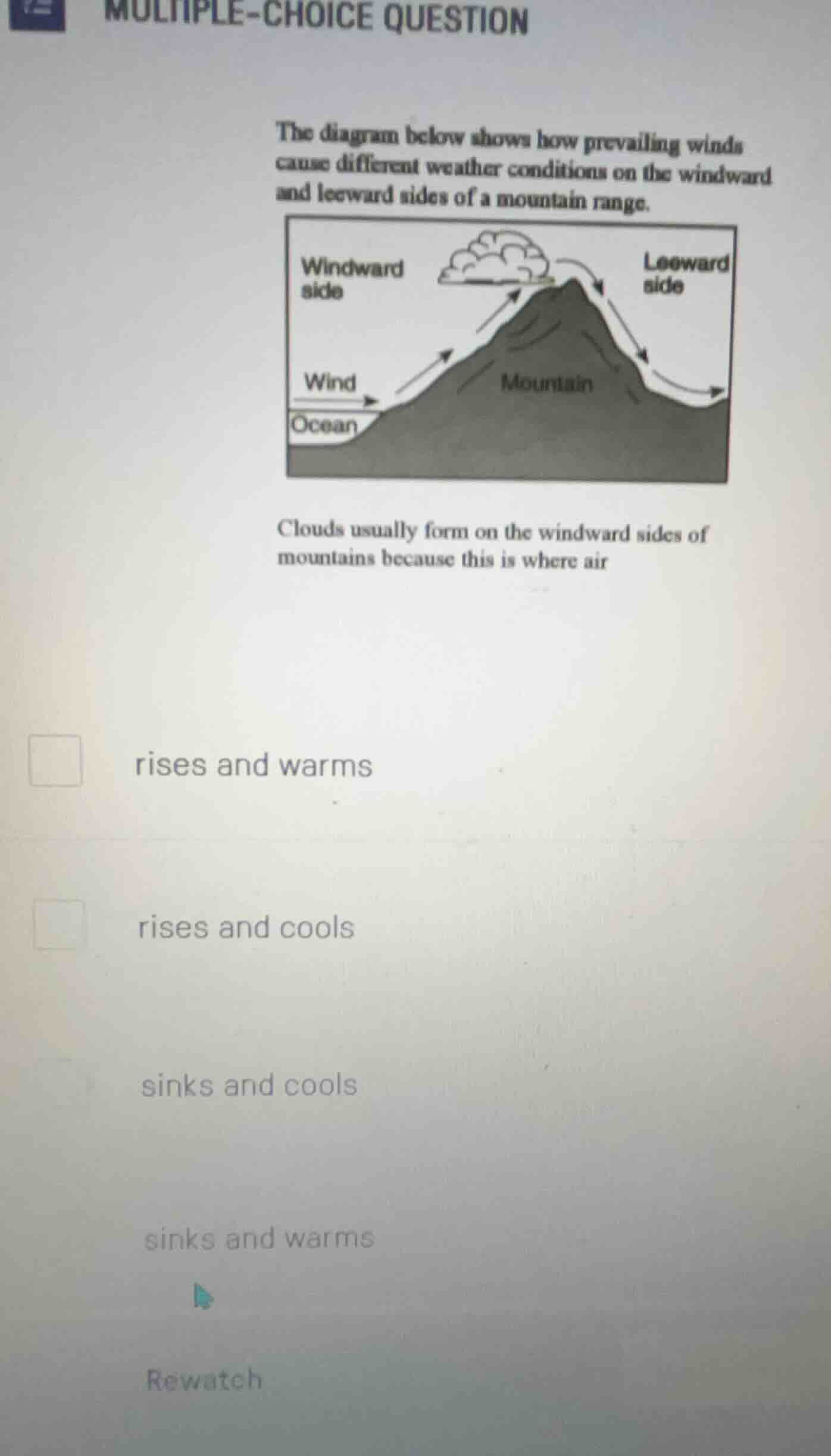
the diagram below shows how prevailing winds cause different weather conditions on the windward and leeward sides of a mountain range.
diagram of mountain with windward, leeward, wind, ocean, and clouds
clouds usually form on the windward sides of mountains because this is where air
- rises and warms
- rises and cools
- sinks and cools
- sinks and warms
rewatch
Brief Explanations
To determine why clouds form on the windward side of mountains, we analyze the air movement:
- Wind from the ocean hits the mountain, forcing the air to rise (windward side).
- As air rises, atmospheric pressure decreases, causing the air to cool (adiabatic cooling).
- Cooler air can hold less moisture, leading to condensation and cloud formation.
Now, evaluate the options:
- "rises and warms": Rising air expands and cools, not warms. Eliminate.
- "rises and cools": Matches the process of air rising, cooling, and condensing to form clouds. Correct.
- "sinks and cools": Sinking air compresses and warms, not cools. Eliminate.
- "sinks and warms": Sinking air warms, but windward air rises, not sinks. Eliminate.

Snap & solve any problem in the app
Get step-by-step solutions on Sovi AI
Photo-based solutions with guided steps
Explore more problems and detailed explanations
B. rises and cools (assuming the second option is labeled B; if the original labels differ, adjust to the correct identifier with the text "rises and cools")