QUESTION IMAGE
Question
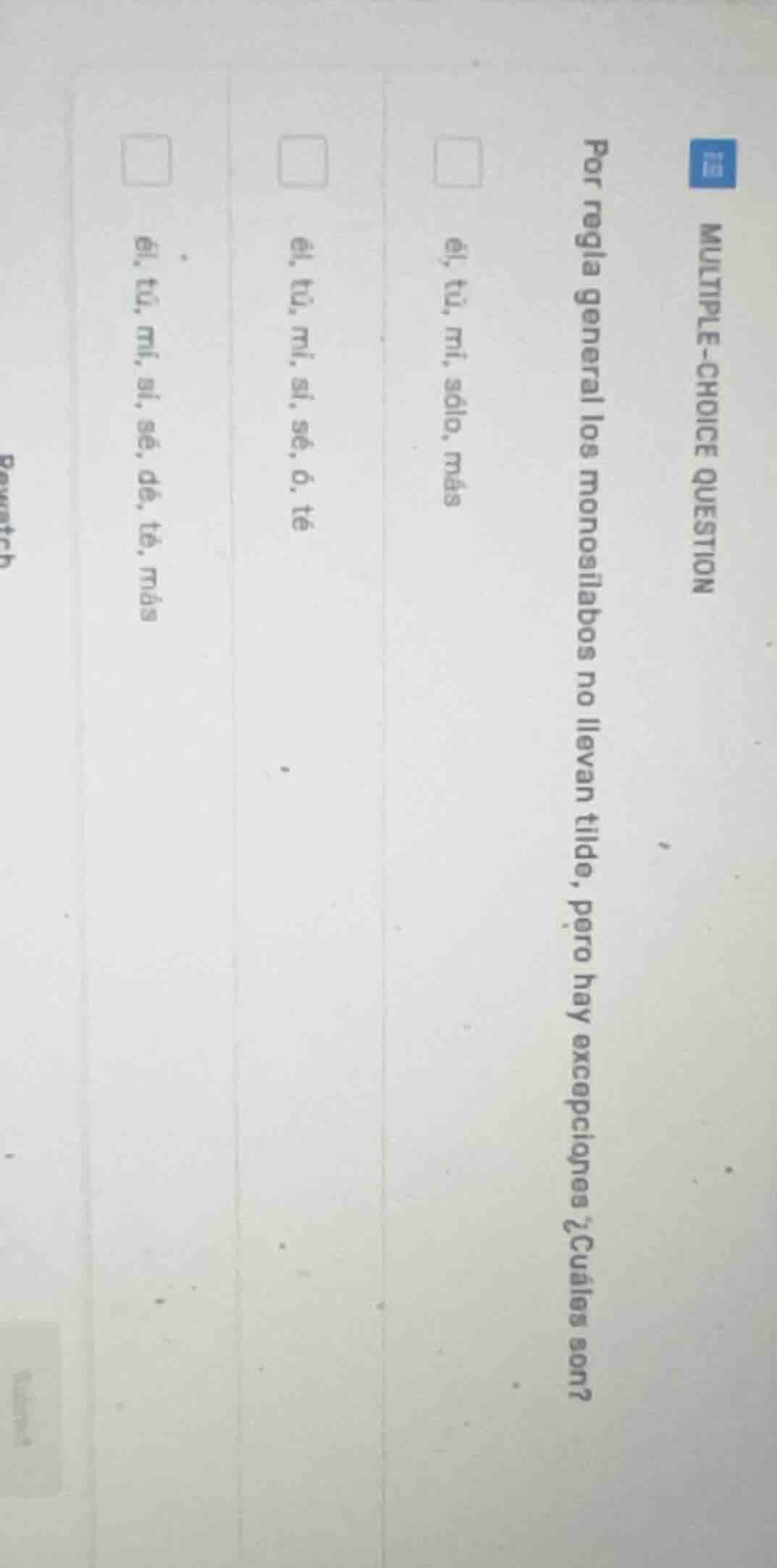
multiple-choice question por regla general los monosilabos no llevan tilde, pero hay excepciones ¿cuáles son? □ él, tú, mí, sólo, más □ él, tú, mí, sí, sé, ó, té □ él, tú, mí, sí, sé, dé, té, más
In Spanish orthography, monosyllables typically do not take accents, but exceptions are monosyllables that need accent marks to distinguish them from homophones or are stressed for clarification. The correct set includes all the standard accented monosyllabic exceptions: él (he, to distinguish from el the article), tú (you, to distinguish from tu possessive), mí (me, to distinguish from mi possessive), sí (yes, to distinguish from si if), sé (I know, to distinguish from se reflexive), dé (give, subjunctive, to distinguish from de preposition), té (tea, to distinguish from te object pronoun), and más (more, to distinguish from mas but). The other options are missing some of these key exceptions.

Snap & solve any problem in the app
Get step-by-step solutions on Sovi AI
Photo-based solutions with guided steps
Explore more problems and detailed explanations
C. él, tú, mí, sí, sé, dé, té, más