QUESTION IMAGE
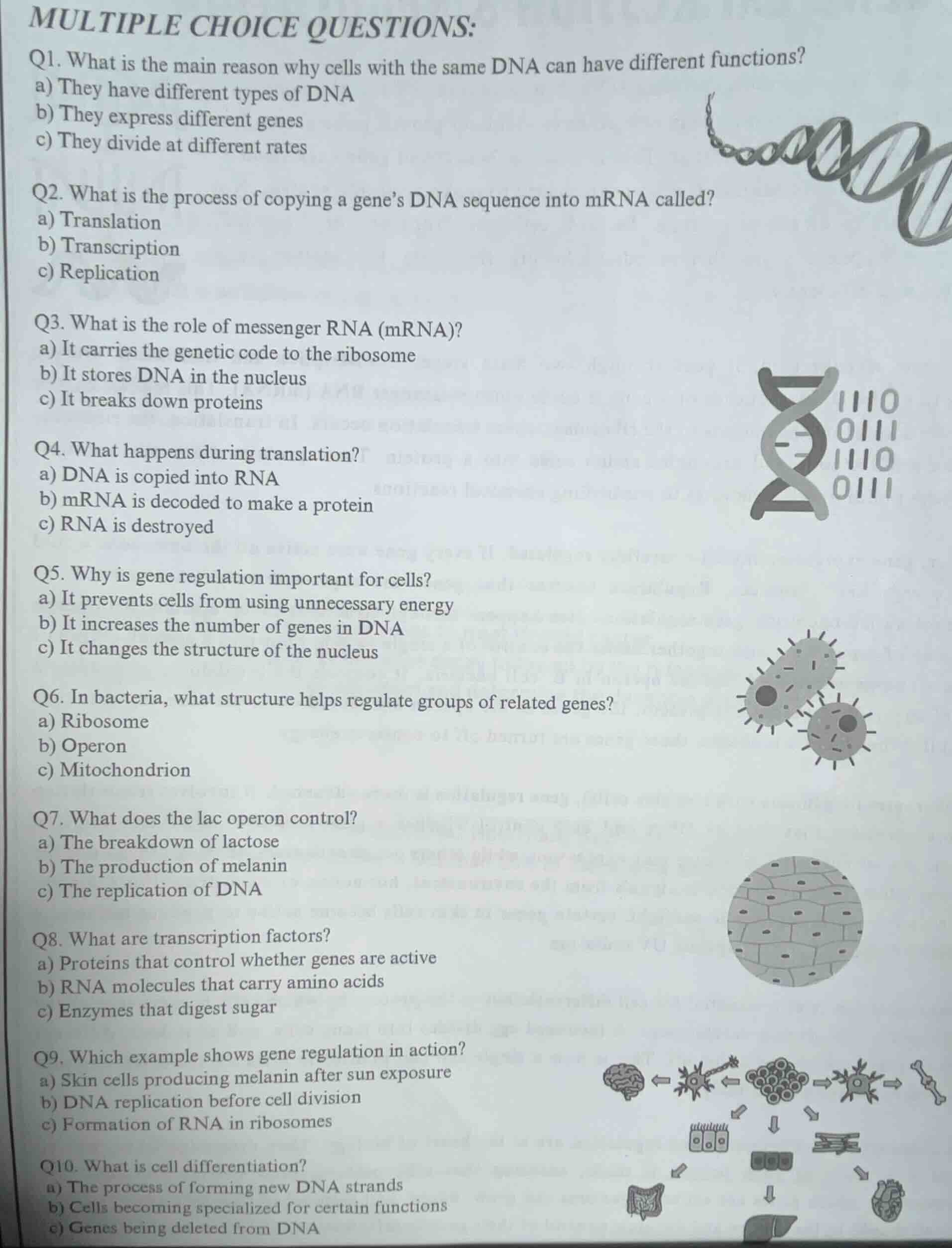
Question
multiple choice questions:
q1. what is the main reason why cells with the same dna can have different functions?
a) they have different types of dna
b) they express different genes
c) they divide at different rates
q2. what is the process of copying a genes dna sequence into mrna called?
a) translation
b) transcription
c) replication
q3. what is the role of messenger rna (mrna)?
a) it carries the genetic code to the ribosome
b) it stores dna in the nucleus
c) it breaks down proteins
q4. what happens during translation?
a) dna is copied into rna
b) mrna is decoded to make a protein
c) rna is destroyed
q5. why is gene regulation important for cells?
a) it prevents cells from using unnecessary energy
b) it increases the number of genes in dna
c) it changes the structure of the nucleus
q6. in bacteria, what structure helps regulate groups of related genes?
a) ribosome
b) operon
c) mitochondrion
q7. what does the lac operon control?
a) the breakdown of lactose
b) the production of melanin
c) the replication of dna
q8. what are transcription factors?
a) proteins that control whether genes are active
b) rna molecules that carry amino acids
c) enzymes that digest sugar
q9. which example shows gene regulation in action?
a) skin cells producing melanin after sun exposure
b) dna replication before cell division
c) formation of rna in ribosomes
q10. what is cell differentiation?
a) the process of forming new dna strands
b) cells becoming specialized for certain functions
c) genes being deleted from dna
- Q1: All body cells share identical DNA; functional differences arise from selective gene expression, where only specific genes are activated in each cell type.
- Q2: Transcription is the biological process that copies DNA genetic information into a complementary mRNA strand.
- Q3: mRNA acts as a molecular messenger, transporting the genetic code from DNA in the nucleus to ribosomes in the cytoplasm for protein synthesis.
- Q4: Translation is the step where ribosomes decode the mRNA sequence to assemble amino acids into a functional protein.
- Q5: Gene regulation ensures cells only activate genes when needed, avoiding waste of energy and resources on unnecessary protein production.
- Q6: In bacteria, operons are structural and functional units that coordinate the regulation of clusters of related genes.
- Q7: The lac operon in E. coli controls the expression of genes responsible for breaking down lactose into usable sugars.
- Q8: Transcription factors are regulatory proteins that bind to DNA to either promote or inhibit the transcription of specific genes.
- Q9: Sun exposure triggers the activation of genes for melanin production in skin cells, a direct example of gene regulation responding to an environmental signal.
- Q10: Cell differentiation is the developmental process where unspecialized cells acquire distinct structures and functions by activating specific gene sets.

Snap & solve any problem in the app
Get step-by-step solutions on Sovi AI
Photo-based solutions with guided steps
Explore more problems and detailed explanations
- Q1: b) They express different genes
- Q2: b) Transcription
- Q3: a) It carries the genetic code to the ribosome
- Q4: b) mRNA is decoded to make a protein
- Q5: a) It prevents cells from using unnecessary energy
- Q6: b) Operon
- Q7: a) The breakdown of lactose
- Q8: a) Proteins that control whether genes are active
- Q9: a) Skin cells producing melanin after sun exposure
- Q10: b) Cells becoming specialized for certain functions