QUESTION IMAGE
Question
mystery message
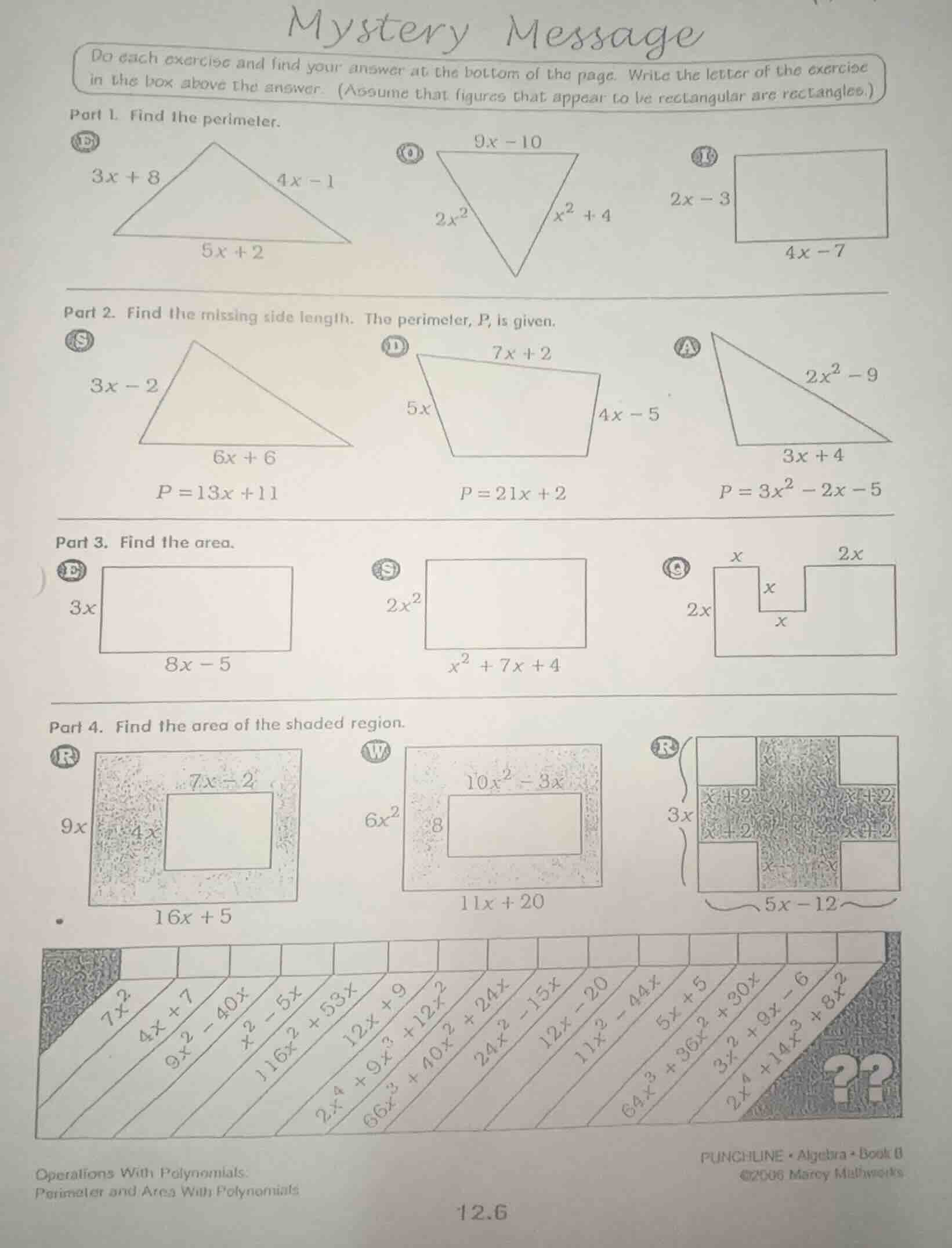
do each exercise and find your answer at the bottom of the page. write the letter of the exercise in the box above the answer. (assume that figures that appear to be rectangular are rectangles.)
part 1. find the perimeter.
(15) a triangle with sides (3x + 8), (4x - 1), (5x + 2); (9) a triangle with sides (9x - 10), (2x^2), (x^2 + 4); (i) a rectangle with length (4x - 7) and width (2x - 3)
part 2. find the missing side length. the perimeter, (p), is given.
(s) a triangle with two sides (3x - 2), (6x + 6) and (p = 13x + 11); (d) a quadrilateral with three sides (7x + 2), (5x), (4x - 5) and (p = 21x + 2); (a) a triangle with two sides (2x^2 - 9), (3x + 4) and (p = 3x^2 - 2x - 5)
part 3. find the area.
(e) a rectangle with length (8x - 5) and width (3x); (s) a rectangle with length (x^2 + 7x + 4) and width (2x^2); (e) a composite figure with a large rectangle and a missing square of side (x), large rectangle length (x + 2x) (wait, original: (x) and (2x) on top, height (2x), missing square of side (x))
part 4. find the area of the shaded region.
(r) a large rectangle with length (16x + 5) and width (9x), with a smaller rectangle inside with length (7x - 2) and width (4x); (w) a large rectangle with length (11x + 20) and width (6x^2), with a smaller rectangle inside with length (10x^2 - 3x) and width (8); (r) a composite figure with a cross - like shaded region, with overall length (5x - 12) and height (3x), with some square and rectangular parts labeled (x) and (x + 2)
at the bottom, there are slanted boxes with expressions like (7x^2), (4x + 7), (9x^2 - 40x), etc., and two shaded corner boxes with?? in one.
operations with polynomials: perimeter and area with polynomials
punchline·algebra·book b
©2006 marcy mathworks
12.6
To solve these problems, we'll handle each part (perimeter, missing side, area, shaded region) by applying the relevant formulas for polygons and polynomials. Here's a step - by - step breakdown for a few representative problems:
Part 1: Find the Perimeter
Problem (Triangle with sides \(3x + 8\), \(4x-1\), \(5x + 2\))
Step 1: Recall the perimeter formula for a triangle
The perimeter \(P\) of a triangle is the sum of its three side lengths. So, \(P=(3x + 8)+(4x-1)+(5x + 2)\)
Step 2: Combine like terms
First, remove the parentheses: \(3x+8 + 4x-1+5x + 2\). Then, combine the \(x\) - terms: \((3x + 4x+5x)+(8 - 1+2)\). We know that \(3x+4x + 5x=12x\) and \(8-1 + 2 = 9\). So, the perimeter is \(12x + 9\)
Problem (Rectangle with length \(4x-7\) and width \(2x-3\))
Step 1: Recall the perimeter formula for a rectangle
The perimeter \(P\) of a rectangle is given by \(P = 2\times(\text{length}+\text{width})\). Here, length \(l = 4x-7\) and width \(w=2x - 3\). So, \(P=2\times((4x-7)+(2x-3))\)
Step 2: Simplify the expression inside the parentheses first
\((4x-7)+(2x-3)=4x-7 + 2x-3=6x-10\)
Step 3: Multiply by 2
\(P = 2\times(6x-10)=12x-20\)
Part 2: Find the Missing Side Length
Problem (Triangle with two sides \(3x-2\), \(6x + 6\) and perimeter \(P = 13x+11\))
Step 1: Let the missing side be \(s\)
We know that the perimeter of a triangle is the sum of its three sides. So, \(P=(3x-2)+(6x + 6)+s\)
Step 2: Substitute \(P = 13x+11\) and solve for \(s\)
\(13x+11=(3x-2)+(6x + 6)+s\)
First, simplify the right - hand side: \((3x-2)+(6x + 6)=3x-2+6x + 6 = 9x+4\)
Then, we have the equation \(13x+11=9x + 4+s\)
Subtract \(9x + 4\) from both sides: \(s=(13x+11)-(9x + 4)=13x+11-9x - 4 = 4x+7\)
Part 3: Find the Area
Problem (Rectangle with length \(8x-5\) and width \(3x\))
Step 1: Recall the area formula for a rectangle
The area \(A\) of a rectangle is given by \(A=\text{length}\times\text{width}\). So, \(A=(8x-5)\times(3x)\)
Step 2: Use the distributive property
\(A = 8x\times3x-5\times3x=24x^{2}-15x\)
Part 4: Find the Area of the Shaded Region
Problem (Shaded region is the area of the large rectangle minus the area of the small rectangle. Large rectangle: length \(16x + 5\), width \(9x\); Small rectangle: length \(7x-2\), width \(4x\))
Step 1: Find the area of the large rectangle \(A_{1}\)
\(A_{1}=\text{length}\times\text{width}=(16x + 5)\times(9x)=144x^{2}+45x\)
Step 2: Find the area of the small rectangle \(A_{2}\)
\(A_{2}=\text{length}\times\text{width}=(7x-2)\times(4x)=28x^{2}-8x\)
Step 3: Find the area of the shaded region \(A\)
\(A=A_{1}-A_{2}=(144x^{2}+45x)-(28x^{2}-8x)=144x^{2}+45x-28x^{2}+8x = 116x^{2}+53x\)
After calculating each problem, we can match the answers with the mystery message at the bottom of the page. For example, if one of our calculated answers is \(116x^{2}+53x\), we would find the box at the bottom of the page with this answer and write the letter of the corresponding exercise above it.
(Note: Since the full set of answers at the bottom is not fully visible, the above is a general method to solve each type of problem in the worksheet. You would continue this process for all problems and then use the matching to reveal the mystery message.)

Snap & solve any problem in the app
Get step-by-step solutions on Sovi AI
Photo-based solutions with guided steps
Explore more problems and detailed explanations
To solve these problems, we'll handle each part (perimeter, missing side, area, shaded region) by applying the relevant formulas for polygons and polynomials. Here's a step - by - step breakdown for a few representative problems:
Part 1: Find the Perimeter
Problem (Triangle with sides \(3x + 8\), \(4x-1\), \(5x + 2\))
Step 1: Recall the perimeter formula for a triangle
The perimeter \(P\) of a triangle is the sum of its three side lengths. So, \(P=(3x + 8)+(4x-1)+(5x + 2)\)
Step 2: Combine like terms
First, remove the parentheses: \(3x+8 + 4x-1+5x + 2\). Then, combine the \(x\) - terms: \((3x + 4x+5x)+(8 - 1+2)\). We know that \(3x+4x + 5x=12x\) and \(8-1 + 2 = 9\). So, the perimeter is \(12x + 9\)
Problem (Rectangle with length \(4x-7\) and width \(2x-3\))
Step 1: Recall the perimeter formula for a rectangle
The perimeter \(P\) of a rectangle is given by \(P = 2\times(\text{length}+\text{width})\). Here, length \(l = 4x-7\) and width \(w=2x - 3\). So, \(P=2\times((4x-7)+(2x-3))\)
Step 2: Simplify the expression inside the parentheses first
\((4x-7)+(2x-3)=4x-7 + 2x-3=6x-10\)
Step 3: Multiply by 2
\(P = 2\times(6x-10)=12x-20\)
Part 2: Find the Missing Side Length
Problem (Triangle with two sides \(3x-2\), \(6x + 6\) and perimeter \(P = 13x+11\))
Step 1: Let the missing side be \(s\)
We know that the perimeter of a triangle is the sum of its three sides. So, \(P=(3x-2)+(6x + 6)+s\)
Step 2: Substitute \(P = 13x+11\) and solve for \(s\)
\(13x+11=(3x-2)+(6x + 6)+s\)
First, simplify the right - hand side: \((3x-2)+(6x + 6)=3x-2+6x + 6 = 9x+4\)
Then, we have the equation \(13x+11=9x + 4+s\)
Subtract \(9x + 4\) from both sides: \(s=(13x+11)-(9x + 4)=13x+11-9x - 4 = 4x+7\)
Part 3: Find the Area
Problem (Rectangle with length \(8x-5\) and width \(3x\))
Step 1: Recall the area formula for a rectangle
The area \(A\) of a rectangle is given by \(A=\text{length}\times\text{width}\). So, \(A=(8x-5)\times(3x)\)
Step 2: Use the distributive property
\(A = 8x\times3x-5\times3x=24x^{2}-15x\)
Part 4: Find the Area of the Shaded Region
Problem (Shaded region is the area of the large rectangle minus the area of the small rectangle. Large rectangle: length \(16x + 5\), width \(9x\); Small rectangle: length \(7x-2\), width \(4x\))
Step 1: Find the area of the large rectangle \(A_{1}\)
\(A_{1}=\text{length}\times\text{width}=(16x + 5)\times(9x)=144x^{2}+45x\)
Step 2: Find the area of the small rectangle \(A_{2}\)
\(A_{2}=\text{length}\times\text{width}=(7x-2)\times(4x)=28x^{2}-8x\)
Step 3: Find the area of the shaded region \(A\)
\(A=A_{1}-A_{2}=(144x^{2}+45x)-(28x^{2}-8x)=144x^{2}+45x-28x^{2}+8x = 116x^{2}+53x\)
After calculating each problem, we can match the answers with the mystery message at the bottom of the page. For example, if one of our calculated answers is \(116x^{2}+53x\), we would find the box at the bottom of the page with this answer and write the letter of the corresponding exercise above it.
(Note: Since the full set of answers at the bottom is not fully visible, the above is a general method to solve each type of problem in the worksheet. You would continue this process for all problems and then use the matching to reveal the mystery message.)