QUESTION IMAGE
Question
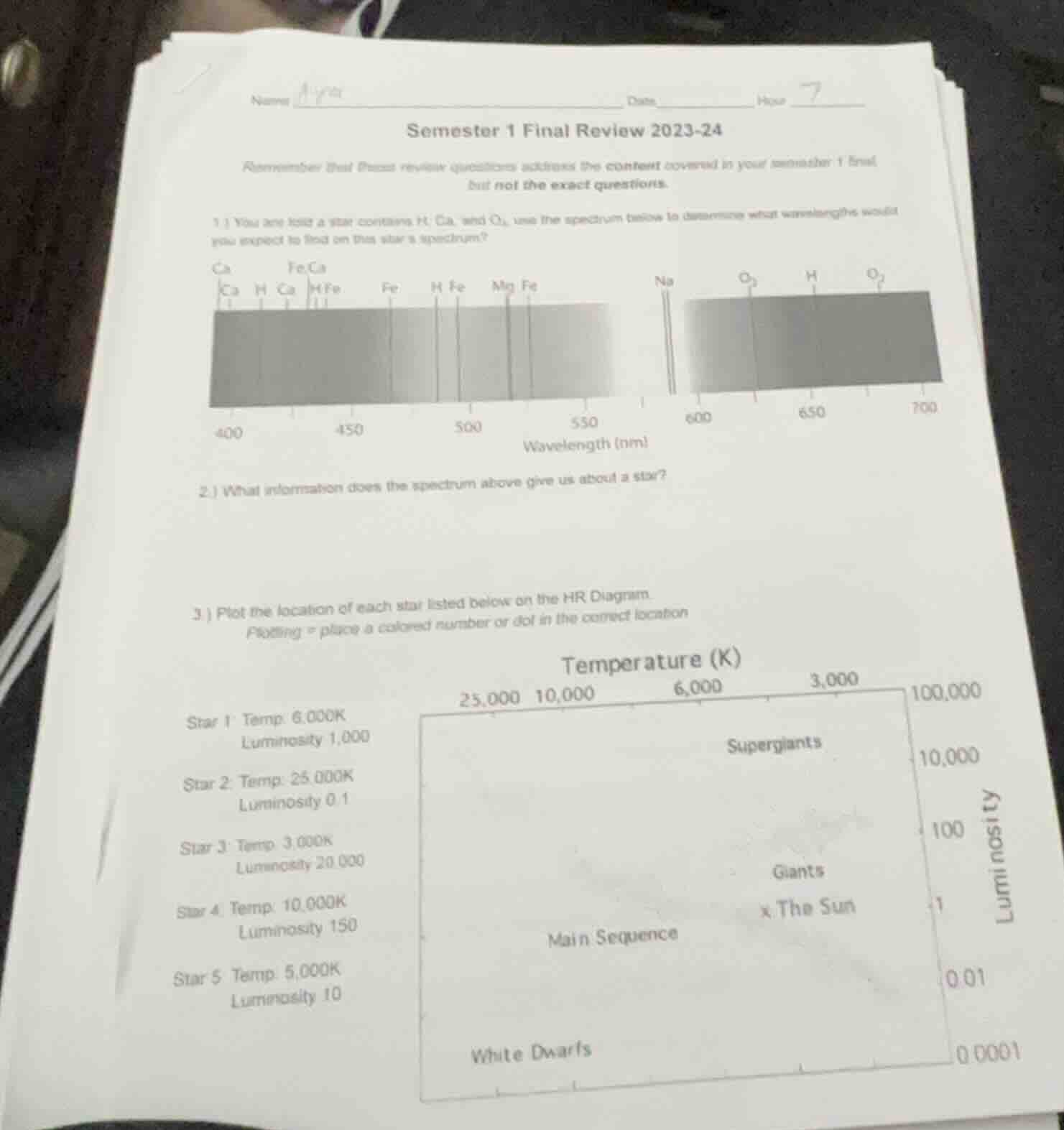
name alyssa date hour 7 semester 1 final review 2023-24 remember that these review questions address the content covered in your semester 1 final but not the exact questions. 1.) you are told a star contains h, ca, and o₂, use the spectrum below to determine what wavelengths would you expect to find on this star’s spectrum? (spectrum image with elements ca, fe, h, mg, na, o₂, h, o₂ labeled at various wavelengths) 2.) what information does the spectrum above give us about a star? 3.) plot the location of each star listed below on the hr diagram. plotting = place a colored number or dot in the correct location. star 1: temp: 6,000k luminosity 1,000 star 2: temp: 25,000k luminosity 0.1 star 3: temp: 3,000k luminosity 20,000 star 4: temp: 10,000k luminosity 150 star 5: temp: 5,000k luminosity 10 (hr diagram image with temperature (k) axis: 25,000, 10,000, 6,000, 3,000, 100,000 and luminosity axis: 100,000, 10,000, 100, 1, 0.01, 0.0001; regions: supergiants, giants, main sequence, white dwarfs; “x the sun” marked)
Question 1
Step1: Identify elements' spectral lines
Each element (H, Ca, O₂) has characteristic spectral lines. From the given spectrum, find the wavelengths marked for H, Ca, and O₂. For H, look at the H - marked lines; for Ca, the Ca - marked lines; for O₂, the O₂ - marked lines.
Step2: List expected wavelengths
From the spectrum: H has lines around (e.g., from the graph, H is marked around 400 - 500 nm and 650 nm? Wait, the x - axis is wavelength (nm) with 400, 450, 500, 550, 600, 650, 700. Looking at the labels: H is marked at some positions, Ca at others, O₂ at ~600 - 650? Wait, the spectrum has H, Ca, O₂ labels. So we expect the wavelengths where H, Ca, O₂ have absorption (or emission) lines. From the graph, H lines: maybe around 400 - 500 (the H - marked lines) and 650 nm (the H at 650). Ca lines: around 400 (Ca label) and 450? O₂ lines: around 600 - 650 (O₂ labels). So we extract the wavelengths corresponding to H, Ca, O₂ in the spectrum.
A star’s spectrum (like the one provided) reveals its chemical composition (by identifying which elements’ spectral lines are present, e.g., H, Ca, O₂ here), and can also hint at temperature (via the shape/intensity of the spectrum) or other properties. The key information here is the star’s elemental makeup (which elements it contains) from the observed spectral lines.
Step1: Understand HR Diagram Axes
The HR Diagram has:
- X - axis (Temperature, K): Left = hotter (higher K), Right = cooler (lower K).
- Y - axis (Luminosity): Bottom = lower luminosity, Top = higher luminosity (log scale: 0.0001, 0.01, 0.1, 1, 100, 10,000, 100,000).
Step2: Plot Star 1
Star 1: Temp = 6,000 K, Luminosity = 1,000.
- Find 6,000 K on the x - axis (right of 10,000 K, left of 3,000 K? Wait, x - axis labels: 25,000, 10,000, 6,000, 3,000, 100,000? Wait, the x - axis is labeled 25,000, 10,000, 6,000, 3,000 (left to right? Wait, no—temperature in HR Diagram is usually decreasing to the right (hotter on left, cooler on right). So 25,000 K (hottest) is left, 3,000 K (coolest) is right.
- Luminosity 1,000: On the y - axis, 1,000 is between 100 and 10,000 (since y - axis is log: 0.0001, 0.01, 0.1, 1, 100, 10,000, 100,000).
- So Star 1 (6,000 K, L = 1,000) is in the Supergiants region (since supergiants have high luminosity and mid - temperature).
Step3: Plot Star 2
Star 2: Temp = 25,000 K, Luminosity = 0.1.
- 25,000 K is far left (hottest).
- Luminosity 0.1: Between 0.01 and 1 (log scale).
- This is in the Main Sequence or White Dwarfs? Wait, White Dwarfs are low luminosity, hot. But 0.1 luminosity is low, 25,000 K is hot. Wait, Main Sequence stars: hot, high luminosity? No—Main Sequence has a range. Wait, 25,000 K, L = 0.1: Let's check axes. Y - axis: 0.1 is between 0.01 and 1. X - axis: 25,000 K (leftmost). So this is a White Dwarf? No, White Dwarfs are low luminosity, hot, but usually L < 1. Wait, the HR Diagram labels: White Dwarfs at bottom, Main Sequence in the middle, Giants/Supergiants at top. So 25,000 K (hot), L = 0.1 (low) → Main Sequence? Wait, no—Main Sequence stars with 25,000 K are O - type, which have high luminosity. Wait, maybe a typo? Wait, Star 2: Temp 25,000 K, Luminosity 0.1. That seems like a White Dwarf (hot, low luminosity), but White Dwarfs are usually <10,000 K? No, some White Dwarfs are hot. Wait, the diagram has White Dwarfs at the bottom. So plot Star 2 at (25,000 K, L = 0.1) → bottom - left, near White Dwarfs? Wait, no—Main Sequence: from hot, high L to cool, low L. So 25,000 K, L = 0.1 is not Main Sequence. Maybe it’s a White Dwarf.
Step4: Plot Star 3
Star 3: Temp = 3,000 K, Luminosity = 20,000.
- 3,000 K is far right (coolest).
- Luminosity 20,000: Between 10,000 and 100,000 (log scale).
- This is in the Supergiants region (cool, very high luminosity—like red supergiants).
Step5: Plot Star 4
Star 4: Temp = 10,000 K, Luminosity = 150.
- 10,000 K: Left of 6,000 K, right of 25,000 K.
- Luminosity 150: Between 100 and 10,000 (log scale).
- This is in the Main Sequence (hot, high luminosity—like B - type stars) or **Giants? Wait, 10,000 K, L = 150: Main Sequence? Wait, the Sun is at 6,000 K, L = 1. So 10,000 K, L = 150 is above the Sun, so Main Sequence (since Main Sequence includes stars from hot, high L to cool, low L).
Step6: Plot Star 5
Star 5: Temp = 5,000 K, Luminosity = 10.
- 5,000 K: Between 6,000 K (left) and 3,000 K (right).
- Luminosity 10: Between 1 and 100 (log scale).
- This is in the Main Sequence (similar to the Sun’s region but higher L? Wait, Sun is 6,000 K, L = 1. So 5,000 K, L = 10 is a bit cooler than Sun, higher L → Main Sequence.

Snap & solve any problem in the app
Get step-by-step solutions on Sovi AI
Photo-based solutions with guided steps
Explore more problems and detailed explanations
To determine the wavelengths, we identify the spectral lines for H, Ca, and O₂ from the given spectrum:
- Hydrogen (H): Wavelengths at the positions marked "H" (e.g., ~400–500 nm range and ~650 nm).
- Calcium (Ca): Wavelengths at the positions marked "Ca" (e.g., ~400 nm and ~450 nm range).
- Oxygen (O₂): Wavelengths at the positions marked "O₂" (e.g., ~600–650 nm range).