QUESTION IMAGE
Question
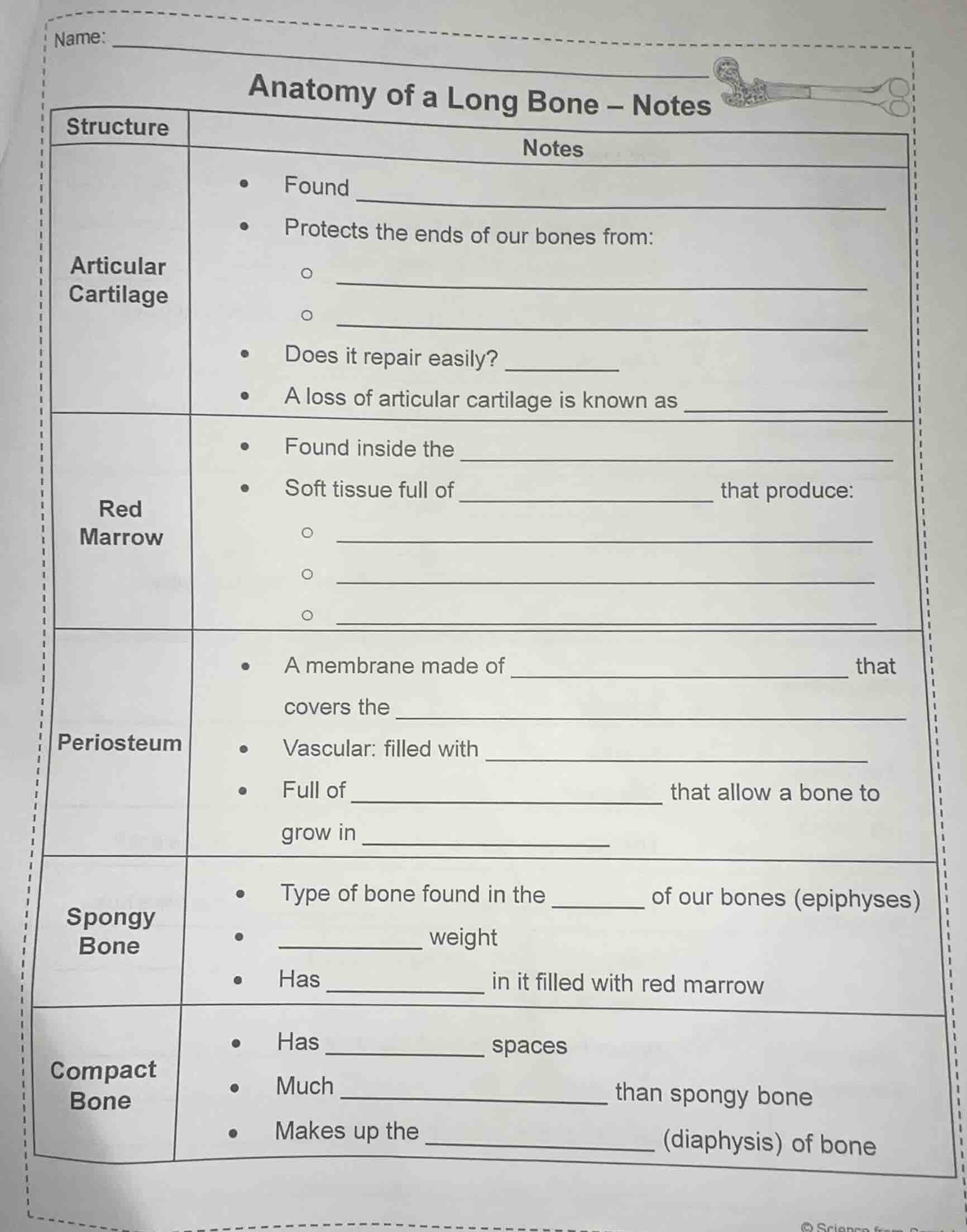
name:
anatomy of a long bone – notes
structure\tnotes
articular cartilage\t- found
- protects the ends of our bones from:
-
-
- does it repair easily?
- a loss of articular cartilage is known as
red marrow\t- found inside the
- soft tissue full of that produce:
-
-
-
periosteum\t- a membrane made of that covers the
- vascular: filled with
- full of that allow a bone to grow in
spongy bone\t- type of bone found in the of our bones (epiphyses)
- weight
- has in it filled with red marrow
compact bone\t- has spaces
- much than spongy bone
- makes up the (diaphysis) of bone
To fill in the "Anatomy of a Long Bone – Notes" table, we use knowledge of bone anatomy (from the subfield of Biology, specifically Anatomy/Physiology):
Articular Cartilage
- Found: At the ends of long bones (covering the epiphyses).
- Protects from: Friction (during movement) and damage (to the underlying bone).
- Does it repair easily?: No (it has limited blood supply, so repair is slow/rare).
- Loss is known as: Osteoarthritis (or articular cartilage degeneration).
Red Marrow
- Found inside the: Spongy bone (and central cavities of some bones, like the sternum).
- Soft tissue full of: Stem cells (hematopoietic stem cells) that produce:
- Red blood cells (erythrocytes),
- White blood cells (leukocytes),
- Platelets (thrombocytes).
Periosteum
- A membrane made of: Dense connective tissue (collagen) that covers the outer surface of the bone (except at joints).
- Vascular: filled with: Blood vessels (to nourish the bone).
- Full of: Osteoblasts/osteoclasts (cells for bone growth/remodeling) that allow a bone to grow in length and width (or “diameter”/“thickness”).
Spongy Bone
- Type of bone found in the: Ends (epiphyses) of our bones.
- Weight: Lightens (reduces) weight (to make movement easier).
- Has: Spaces (trabecular cavities) in it filled with red marrow.
Compact Bone
- Has: Few (or no) spaces (dense structure).
- Much: Harder (or denser) than spongy bone.
- Makes up the: Shaft (diaphysis) of the bone.
These answers align with standard anatomical descriptions of long bones.

Snap & solve any problem in the app
Get step-by-step solutions on Sovi AI
Photo-based solutions with guided steps
Explore more problems and detailed explanations
To fill in the "Anatomy of a Long Bone – Notes" table, we use knowledge of bone anatomy (from the subfield of Biology, specifically Anatomy/Physiology):
Articular Cartilage
- Found: At the ends of long bones (covering the epiphyses).
- Protects from: Friction (during movement) and damage (to the underlying bone).
- Does it repair easily?: No (it has limited blood supply, so repair is slow/rare).
- Loss is known as: Osteoarthritis (or articular cartilage degeneration).
Red Marrow
- Found inside the: Spongy bone (and central cavities of some bones, like the sternum).
- Soft tissue full of: Stem cells (hematopoietic stem cells) that produce:
- Red blood cells (erythrocytes),
- White blood cells (leukocytes),
- Platelets (thrombocytes).
Periosteum
- A membrane made of: Dense connective tissue (collagen) that covers the outer surface of the bone (except at joints).
- Vascular: filled with: Blood vessels (to nourish the bone).
- Full of: Osteoblasts/osteoclasts (cells for bone growth/remodeling) that allow a bone to grow in length and width (or “diameter”/“thickness”).
Spongy Bone
- Type of bone found in the: Ends (epiphyses) of our bones.
- Weight: Lightens (reduces) weight (to make movement easier).
- Has: Spaces (trabecular cavities) in it filled with red marrow.
Compact Bone
- Has: Few (or no) spaces (dense structure).
- Much: Harder (or denser) than spongy bone.
- Makes up the: Shaft (diaphysis) of the bone.
These answers align with standard anatomical descriptions of long bones.