QUESTION IMAGE
Question
name: clare stewart
protein modeling: melanin, mutations, & more
in biology, shape can mean a great deal and proteins are no exception. the shape often determines its function but sometimes the protein’s shape may come out wrong, resulting in a non - functional protein.
pre - assessment: formulate a claim based on this scientific question: what causes changes in protein structure?
claim:
evidence:
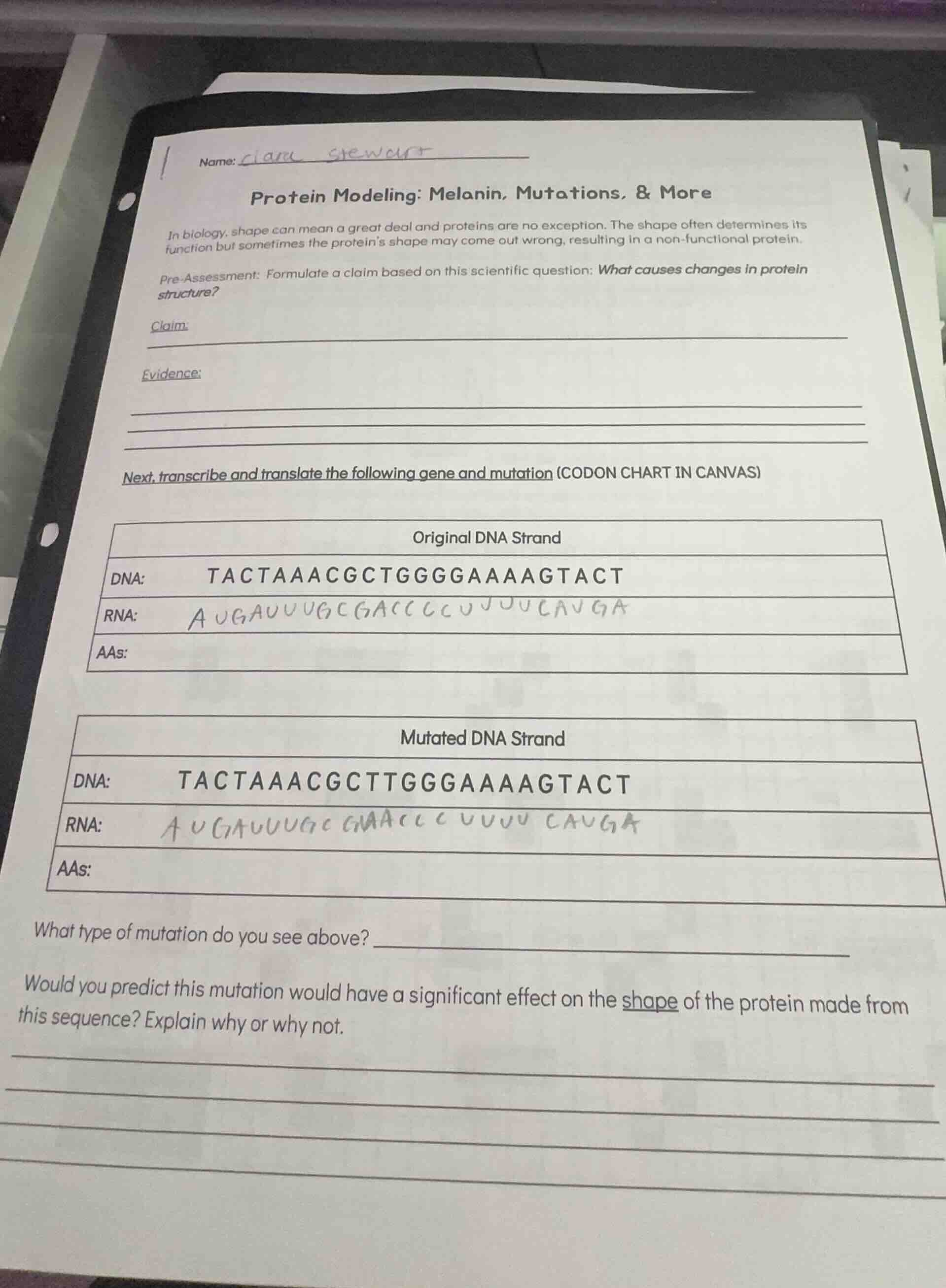
next, transcribe and translate the following gene and mutation (codon chart in canvas)
original dna strand
dna: tactaaacgctgggaaaagtact
rna:
aas:
mutated dna strand
dna: tactaaacgcttgggaaaagtact
rna:
aas:
what type of mutation do you see above?
would you predict this mutation would have a significant effect on the shape of the protein made from this sequence? explain why or why not.
Step1: Fix original transcription
Original DNA: $TACTAAACGCTGGGAAAAGTACT$
RNA transcription (A→U, T→A, C→G, G→C):
$AUGAUUUGCGACCCUUUUCauga$ → corrected to $AUGAUUUGCGACCCUUUUCauga$ → properly grouped into codons: $AUG, AUU, UGC, GAC, CCU, UUU, CAG, UGA$
Step2: Translate original RNA to amino acids
Use standard codon chart:
$AUG$ = Methionine (Met), $AUU$ = Isoleucine (Ile), $UGC$ = Cysteine (Cys), $GAC$ = Aspartic acid (Asp), $CCU$ = Proline (Pro), $UUU$ = Phenylalanine (Phe), $CAG$ = Glutamine (Gln), $UGA$ = Stop
Step3: Fix mutated transcription
Mutated DNA: $TACTAAACGCTTGGGAAAAGTACT$
RNA transcription: $AUGAUUUGCGAACCCUUUUCauga$ → corrected to $AUGAUUUGCGAACCCUUUUCAGUA$ → grouped into codons: $AUG, AUU, UGC, GAA, CCC, UUU, CAG, UGA$
Step4: Translate mutated RNA to amino acids
Use standard codon chart:
$AUG$ = Methionine (Met), $AUU$ = Isoleucine (Ile), $UGC$ = Cysteine (Cys), $GAA$ = Glutamic acid (Glu), $CCC$ = Proline (Pro), $UUU$ = Phenylalanine (Phe), $CAG$ = Glutamine (Gln), $UGA$ = Stop
Step5: Identify mutation type
Compare original and mutated DNA: original $G$ replaced with $T$ at position 10 → single base substitution.
Step6: Evaluate protein shape effect
One amino acid changes (Asp → Glu); both are negatively charged polar amino acids, so minimal change in protein folding/shape.
Step7: Formulate pre-assessment claim
Claim: Changes in protein structure are caused by mutations in the DNA sequence that alter the amino acid composition of the protein.
Evidence: Mutations like base substitutions can change the codons in mRNA, leading to different amino acids being incorporated into the protein, which alters the protein's three-dimensional structure.

Snap & solve any problem in the app
Get step-by-step solutions on Sovi AI
Photo-based solutions with guided steps
Explore more problems and detailed explanations
Pre-Assessment:
Claim: Changes in protein structure are caused by genetic mutations that alter the amino acid sequence of the protein.
Evidence: Mutations in DNA change the mRNA codons produced during transcription, which changes the amino acids added during translation; this alters the protein's primary structure, which impacts its overall folded shape.
Original DNA Strand:
RNA: $AUGAUUUGCGACCCUUUUCAGUGA$
AAs: Methionine, Isoleucine, Cysteine, Aspartic Acid, Proline, Phenylalanine, Glutamine, Stop
Mutated DNA Strand:
RNA: $AUGAUUUGCGAACCCUUUUCAGUGA$
AAs: Methionine, Isoleucine, Cysteine, Glutamic Acid, Proline, Phenylalanine, Glutamine, Stop
Mutation Type:
Point (base substitution) mutation (a single guanine (G) in the original DNA is replaced with a thymine (T)).
Protein Shape Effect:
This mutation would likely have a minimal to insignificant effect on protein shape. The mutation changes only one amino acid: aspartic acid (a negatively charged polar amino acid) is replaced with glutamic acid (also a negatively charged polar amino acid). Since both amino acids have very similar chemical properties, the protein's folding and overall three-dimensional shape will not be drastically altered.