QUESTION IMAGE
Question
name
class: 6th date 1/27/26
animal and plant mitosis
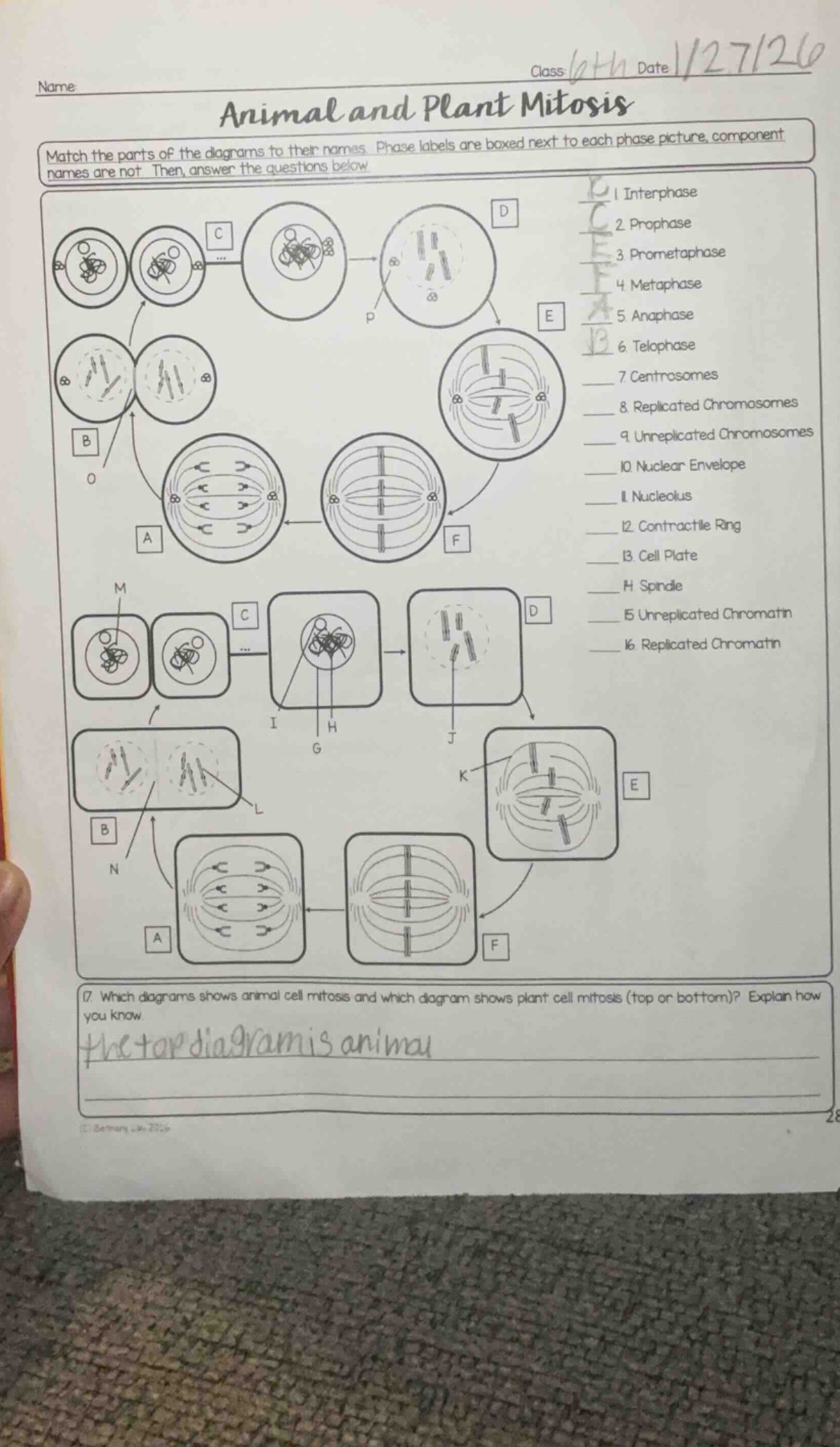
match the parts of the diagrams to their names. phase labels are boxed next to each phase picture, component names are not. then, answer the questions below
1 interphase
2 prophase
3 prometaphase
4 metaphase
5 anaphase
6 telophase
7 centrosomes
8 replicated chromosomes
9 unreplicated chromosomes
10 nuclear envelope
11 nucleolus
12 contractile ring
13 cell plate
14 spindle
15 unreplicated chromatin
16 replicated chromatin
- which diagrams shows animal cell mitosis and which diagram shows plant cell mitosis (top or bottom)? explain how you know.
the top diagram is animal
(c) bethany lau 2016
Matching (Top Animal Cell Mitosis):
- Interphase (C): Cell with intact nucleus, chromatin.
- Prophase (C): Chromatin condenses, centrosomes form.
- Prometaphase (D): Nuclear envelope breaks, spindle attaches.
- Metaphase (F): Chromosomes align at equator.
- Anaphase (A): Sister chromatids separate.
- Telophase (B): Nuclei reform, cleavage starts.
- Centrosomes (the circular structures labeled with "∞" in top diagrams)
- Replicated Chromosomes (structures in D, F)
- Unreplicated Chromosomes (structures in A, B)
- Nuclear Envelope (outer boundary in C)
- Nucleolus (small circle in C's nucleus)
- Contractile Ring (structure in B, forming cleavage furrow)
- Cell Plate (not present in animal cells)
- Spindle (fiber structures in E, F, A)
- Unreplicated Chromatin (not present in mitotic phases, interphase pre-replication)
- Replicated Chromatin (chromatin in C, pre-condensation)
Matching (Bottom Plant Cell Mitosis):
- Interphase (C): Square cell, intact nucleus, chromatin.
- Prophase (C): Chromatin condenses, no centrosomes.
- Prometaphase (D): Nuclear envelope breaks, spindle forms.
- Metaphase (F): Chromosomes align at equator.
- Anaphase (A): Sister chromatids separate.
- Telophase (B): Nuclei reform, cell plate forms.
- Centrosomes (not present in plant cells)
- Replicated Chromosomes (J in D, structures in F)
- Unreplicated Chromosomes (L in B, structures in A)
- Nuclear Envelope (outer boundary in C)
- Nucleolus (M in C's nucleus)
- Contractile Ring (not present in plant cells)
- Cell Plate (N in B, forming new cell wall)
- Spindle (K in E, fiber structures in F, A)
- Unreplicated Chromatin (pre-replication interphase, not shown)
- Replicated Chromatin (H in C, pre-condensation)
Question 17:
The top diagram shows animal cell mitosis, and the bottom shows plant cell mitosis. Animal cells have round shapes, centrosomes, and form a contractile ring/cleavage furrow to divide. Plant cells have rigid square shapes, lack centrosomes, and form a cell plate (instead of a cleavage furrow) to build a new cell wall during division.

Snap & solve any problem in the app
Get step-by-step solutions on Sovi AI
Photo-based solutions with guided steps
Explore more problems and detailed explanations
Matching Answers:
- Interphase: C (both top and bottom)
- Prophase: C (both top and bottom)
- Prometaphase: D (both top and bottom)
- Metaphase: F (both top and bottom)
- Anaphase: A (both top and bottom)
- Telophase: B (both top and bottom)
- Centrosomes: labeled "∞" (top diagram only)
- Replicated Chromosomes: D/F structures (top); J (bottom)
- Unreplicated Chromosomes: A/B structures (top); L (bottom)
- Nuclear Envelope: outer boundary of C (both)
- Nucleolus: small circle in C (top); M (bottom)
- Contractile Ring: structure in B (top only)
- Cell Plate: N (bottom only)
- Spindle: fiber structures in E/F/A (top); K (bottom)
- Unreplicated Chromatin: pre-replication interphase (not shown)
- Replicated Chromatin: chromatin in C (top); H (bottom)
Question 17 Answer:
Top diagram: Animal cell mitosis; Bottom diagram: Plant cell mitosis.
Animal cells are round, have centrosomes, and use a contractile ring/cleavage furrow for division. Plant cells have a rigid square shape, lack centrosomes, and form a cell plate to build a new cell wall during division.