QUESTION IMAGE
Question
name _____________ class worksheet - energy
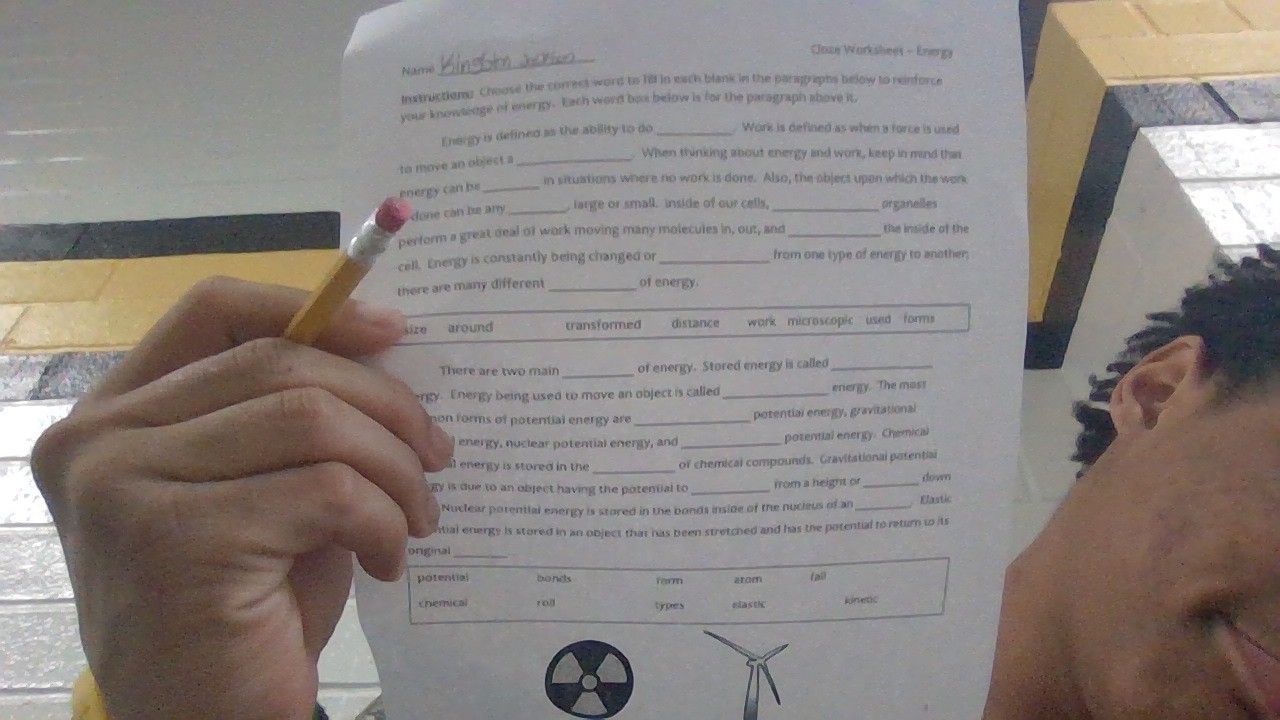
instructions: choose the correct word to fill in each blank in the paragraphs below to reinforce your knowledge of energy. each word box below is for the paragraph above it.
energy is defined as the ability to do ______. work is defined as when a force is used to move an object a ____. when thinking about energy and work, keep in mind that energy can be ____ in situations where no work is done. also, the object upon which the work done can be any ____, large or small. inside of our cells, ____ organelles perform a great deal of work moving many molecules in, out, and ____ the inside of the cell. energy is constantly being changed or ____ from one type of energy to another; there are many different ______ of energy.
size around transformed distance work microscopic used forms
there are two main ______ of energy. stored energy is called ____ energy. energy being used to move an object is called ____ energy. the main forms of potential energy are ____ potential energy, gravitational potential energy, nuclear potential energy, and ____ potential energy. chemical potential energy is stored in the ____ of chemical compounds. gravitational potential energy is due to an object having the potential to ____ from a height or ____ down. nuclear potential energy is stored in the bonds inside of the nucleus of an ____. elastic potential energy is stored in an object that has been stretched and has the potential to return to its original ______.
potential bonds form atom fall chemical roll types elastic kinetic
:
- work
- distance
- used
- microscopic
- around
- transformed
- forms
---
- types
- potential
- kinetic
- gravitational
- elastic
- bonds
- fall
- roll
- atom
- potential
Step1: Fill first paragraph blanks
- Energy = ability to do $\boldsymbol{work}$ (definition)
- Work moves object a $\boldsymbol{distance}$ (work formula: $W=Fd$)
- Energy can be $\boldsymbol{used}$ without work
- Objects can be $\boldsymbol{microscopic}$ (cell context)
- Organelles move molecules $\boldsymbol{around}$ the cell
- Energy is $\boldsymbol{transformed}$ between types
- Many $\boldsymbol{forms}$ of energy exist
Step2: Fill second paragraph blanks
- Two main $\boldsymbol{types}$ of energy
- Stored energy = $\boldsymbol{potential}$ energy (definition)
- Energy for motion = $\boldsymbol{kinetic}$ energy (definition)
- Potential energy type: $\boldsymbol{gravitational}$
- Potential energy type: $\boldsymbol{elastic}$
- Chemical energy in $\boldsymbol{bonds}$ of compounds
- Gravitational energy: object can $\boldsymbol{fall}$ from height
- Gravitational energy: object can $\boldsymbol{roll}$ down
- Nuclear energy in $\boldsymbol{atom}$ nucleus bonds
- Elastic energy: returns to original $\boldsymbol{potential}$ state

Snap & solve any problem in the app
Get step-by-step solutions on Sovi AI
Photo-based solutions with guided steps
Explore more problems and detailed explanations
Step1: Fill first paragraph blanks
- Energy = ability to do $\boldsymbol{work}$ (definition)
- Work moves object a $\boldsymbol{distance}$ (work formula: $W=Fd$)
- Energy can be $\boldsymbol{used}$ without work
- Objects can be $\boldsymbol{microscopic}$ (cell context)
- Organelles move molecules $\boldsymbol{around}$ the cell
- Energy is $\boldsymbol{transformed}$ between types
- Many $\boldsymbol{forms}$ of energy exist
Step2: Fill second paragraph blanks
- Two main $\boldsymbol{types}$ of energy
- Stored energy = $\boldsymbol{potential}$ energy (definition)
- Energy for motion = $\boldsymbol{kinetic}$ energy (definition)
- Potential energy type: $\boldsymbol{gravitational}$
- Potential energy type: $\boldsymbol{elastic}$
- Chemical energy in $\boldsymbol{bonds}$ of compounds
- Gravitational energy: object can $\boldsymbol{fall}$ from height
- Gravitational energy: object can $\boldsymbol{roll}$ down
- Nuclear energy in $\boldsymbol{atom}$ nucleus bonds
- Elastic energy: returns to original $\boldsymbol{potential}$ state