QUESTION IMAGE
Question
name
coltin
period
date:
\magnetism\ what do you notice? chart
research how these five objects or places are related to \magnetism\. be specific and explain.
see
what do you see?
label the pictures
think
what do you think is going on?
research: how does it relate to magnetism?
wonder
what does it make you wonder?
what questions do you have?
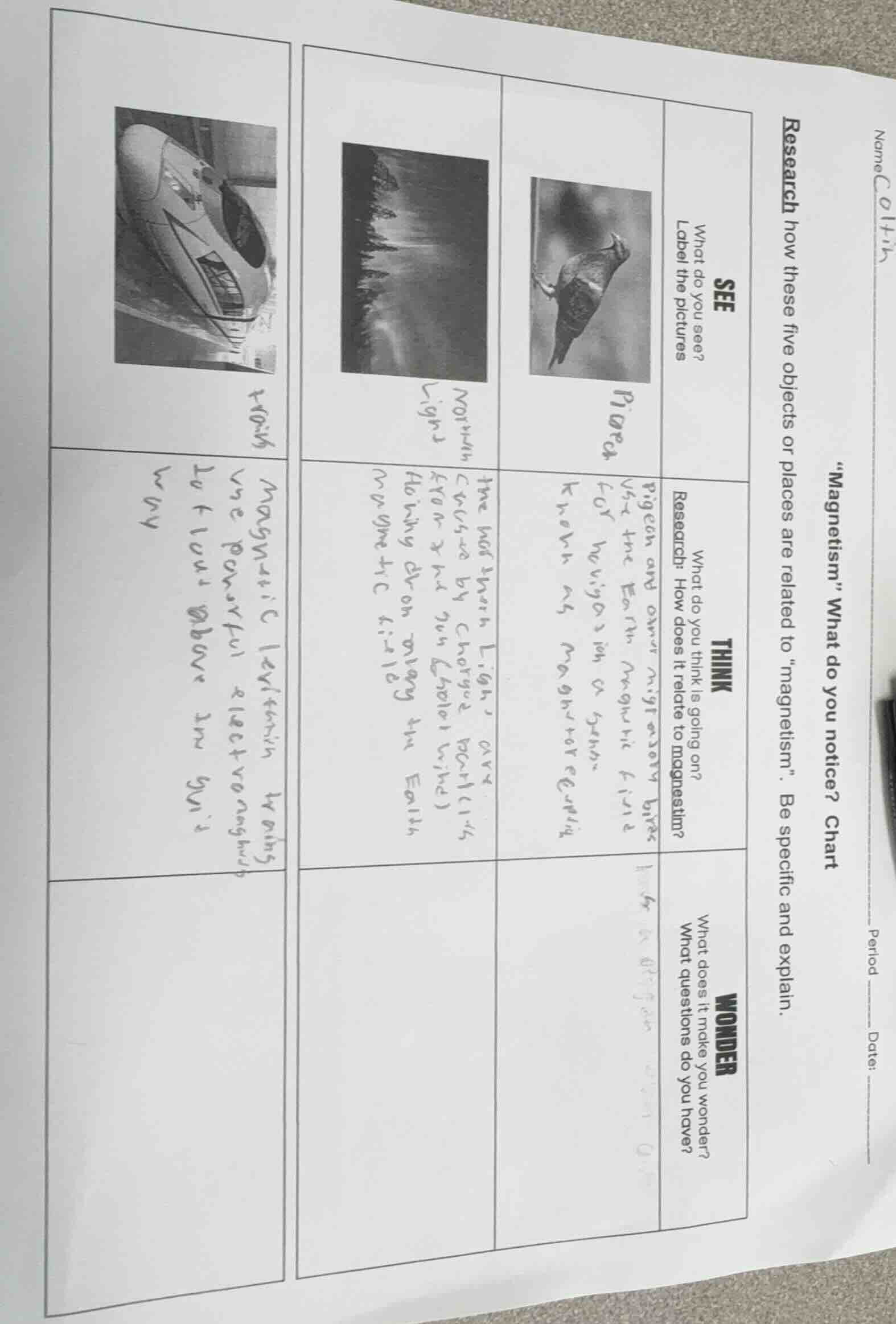
- Pigeon:
Pigeons (and other migratory birds) use the Earth's natural magnetic field to navigate during long-distance travel; this ability is called magnetoreception, letting them sense magnetic cues to find their way.
- Northern Lights (Aurora Borealis):
These are caused by charged particles (electrons and protons) from the Sun interacting with the Earth's magnetic field. The field directs these particles toward the polar regions, where they collide with atmospheric gases to create the glowing lights.
- Maglev Train:
This train uses magnetic levitation: powerful electromagnets lift the train above its guideway, eliminating friction. Magnetic forces also propel and guide the train, allowing it to travel at very high speeds.
---

Snap & solve any problem in the app
Get step-by-step solutions on Sovi AI
Photo-based solutions with guided steps
Explore more problems and detailed explanations
SEE (Labels):
- Pigeon
- Northern Lights (Aurora Borealis)
- Maglev (Magnetic Levitation) Train
THINK (Magnetism Connections):
- Pigeon: Relies on Earth's magnetic field for navigation (magnetoreception) during migration.
- Northern Lights: Created when solar charged particles are guided by Earth's magnetic field to collide with atmospheric gases at the poles.
- Maglev Train: Uses strong electromagnets to levitate above tracks (removing friction) and propel the train forward.
WONDER (Example Questions):
- How exactly do pigeons detect the Earth's magnetic field?
- Can we use the same magnetic principles from maglev trains to make other forms of transportation more efficient?
- How does the strength of the Earth's magnetic field affect the brightness of the Northern Lights?