QUESTION IMAGE
Question
name: _____________ date: ___________ period: ____
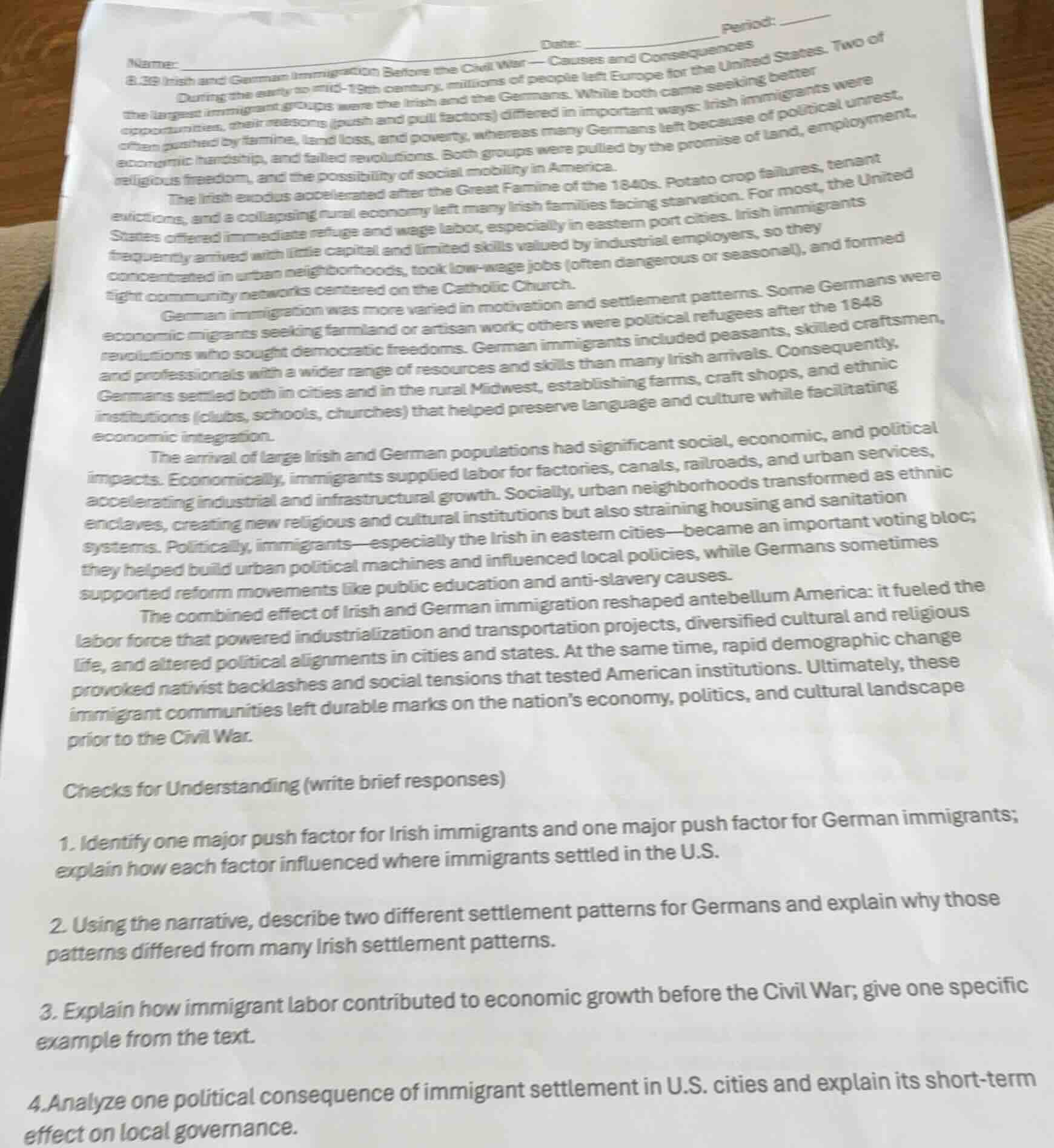
8.39 irish and german immigration before the civil war — causes and consequences
during the early to mid-19th century, millions of people left europe for the united states. two of the largest immigrant groups were the irish and germans. while both came seeking better opportunities, their reasons (push and pull factors) differed in important ways: irish immigrants were often pushed by famine, land loss, and poverty, whereas many germans left because of political unrest, economic hardship, and failed revolutions. both groups were pulled by the promise of land, employment, religious freedom, and the possibility of social mobility in america.
the irish exodus accelerated after the great famine of the 1840s. potato crop failures, tenant evictions, and a collapsing rural economy left many irish families facing starvation. for most, the united states offered immediate refuge and wage labor, especially in eastern port cities. irish immigrants frequently arrived with little capital and limited skills valued by industrial employers, so they concentrated in urban neighborhoods, took low-wage jobs (often dangerous or seasonal), and formed tight community networks centered on the catholic church.
german immigration was more varied in motivation and settlement patterns. some germans were economic migrants seeking farmland or artisan work; others were political refugees after the 1848 revolutions who sought democratic freedoms. german immigrants included peasants, skilled craftsmen, and professionals with a wider range of resources and skills than many irish arrivals. consequently, germans settled both in cities and in the rural midwest, establishing farms, craft shops, and ethnic institutions (clubs, schools, churches) that helped preserve language and culture while facilitating economic integration.
the arrival of large irish and german populations had significant social, economic, and political impacts. economically, immigrants supplied labor for factories, canals, railroads, and urban services, accelerating industrial and infrastructural growth. socially, urban neighborhoods transformed as ethnic enclaves, creating new religious and cultural institutions but also straining housing and sanitation systems. politically, immigrants—especially the irish in eastern cities—became an important voting bloc; they helped build urban political machines and influenced local policies, while germans sometimes supported reform movements like public education and anti-slavery causes.
the combined effect of irish and german immigration reshaped antebellum america: it fueled the labor force that powered industrialization and transportation projects, diversified cultural and religious life, and altered political alignments in cities and states. at the same time, rapid demographic change provoked nativist backlashes and social tensions that tested american institutions. ultimately, these immigrant communities left durable marks on the nations economy, politics, and cultural landscape prior to the civil war.
checks for understanding (write brief responses)
- identify one major push factor for irish immigrants and one major push factor for german immigrants; explain how each factor influenced where immigrants settled in the u.s.
- using the narrative, describe two different settlement patterns for germans and explain why those patterns differed from many irish settlement patterns.
- explain how immigrant labor contributed to economic growth before the civil war; give one specific example from the text.
- analyze one political consequence of immigrant settlement in u.s. cities and explain its short-term effect on local governance.
- For Irish immigrants, the Great Famine pushed them to the U.S. with little capital, so they settled in eastern port cities for immediate low-wage work. For German immigrants, failed 1848 revolutions pushed them; many had resources/skills, so some settled in rural Midwest for farming.
- Germans settled in eastern cities (for skilled/industrial work) and rural Midwest (for farming). Irish mostly settled in eastern port cities. This difference exists because Germans had more capital/skills to choose rural land, while Irish lacked resources and needed immediate urban wage labor.
- Immigrant labor supplied workers for industrial and infrastructure projects, accelerating growth. A specific example: they provided labor for factories, canals, railroads, and urban services.
- Irish immigrants became a key voting bloc in eastern cities, building urban political machines. In the short term, this let them influence local policies to address their community needs like housing or labor conditions.

Snap & solve any problem in the app
Get step-by-step solutions on Sovi AI
Photo-based solutions with guided steps
Explore more problems and detailed explanations
- Irish push factor: Great Famine; they settled in eastern port cities as they had little capital and needed immediate low-wage labor. German push factor: 1848 failed revolutions; some settled in the rural Midwest as they had the resources and skills to farm.
- German settlement patterns: Eastern cities (for skilled/industrial jobs) and rural Midwest (for farming). Irish settlement: Almost exclusively eastern port cities. Difference: Germans had more capital/skills to pursue rural farming, while Irish lacked resources and relied on immediate urban wage work.
- Immigrant labor fueled industrial and infrastructural growth by supplying a large workforce for key projects. Specific example: They provided labor for canals, railroads, factories, and urban services.
- Political consequence: Irish immigrants in eastern cities formed a powerful voting bloc and built urban political machines. Short-term effect: They influenced local policies to advocate for their community's needs, such as better housing access or fairer labor standards.