QUESTION IMAGE
Question
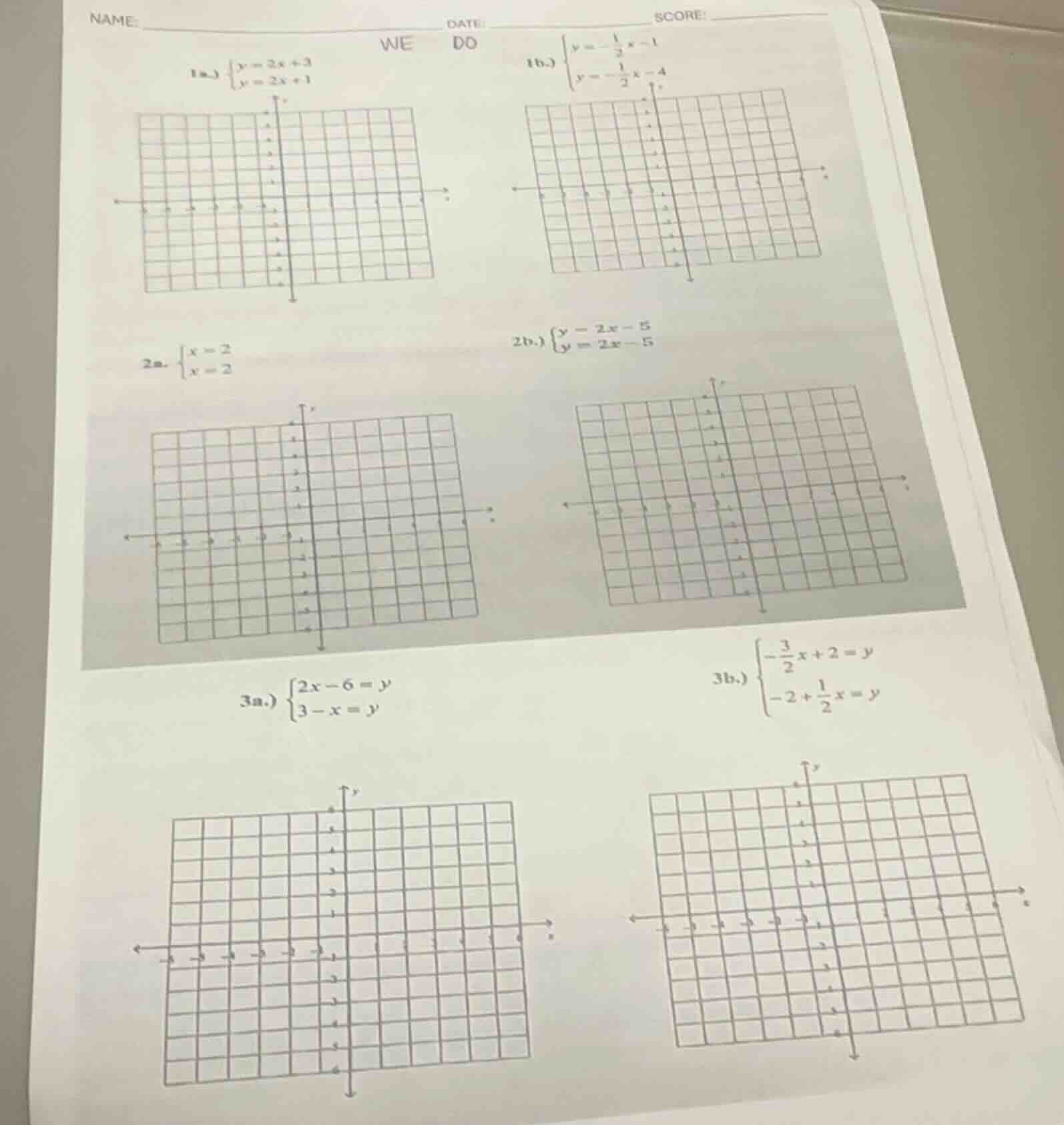
name: date: score: we do 1a.) \\(\
\\) 1b.) \\(\
\\) 2a.) \\(\
\\) 2b.) \\(\
\\) 3a.) \\(\
\\) 3b.) \\(\
\\)
Let's solve one of the systems, say 3a: \(
\)
Step1: Set the two equations equal
Since both equal \(y\), set \(2x - 6 = 3 - x\)
Step2: Solve for \(x\)
Add \(x\) to both sides: \(2x + x - 6 = 3\) → \(3x - 6 = 3\)
Add 6 to both sides: \(3x = 3 + 6\) → \(3x = 9\)
Divide by 3: \(x = \frac{9}{3} = 3\)
Step3: Find \(y\)
Substitute \(x = 3\) into \(3 - x = y\): \(y = 3 - 3 = 0\)
Step1: Analyze slopes
Both lines have slope \(m = 2\) (from \(y = mx + b\) form)
Step2: Check y-intercepts
Y-intercepts are \(3\) and \(1\), different. So parallel lines.
Step3: Conclusion
Parallel lines (same slope, different y-intercepts) have no solution.

Snap & solve any problem in the app
Get step-by-step solutions on Sovi AI
Photo-based solutions with guided steps
Explore more problems and detailed explanations
The solution is \(x = 3\), \(y = 0\) (for system 3a)
For another system, like 1a: \(
\)