QUESTION IMAGE
Question
name:
geometry
date
per:
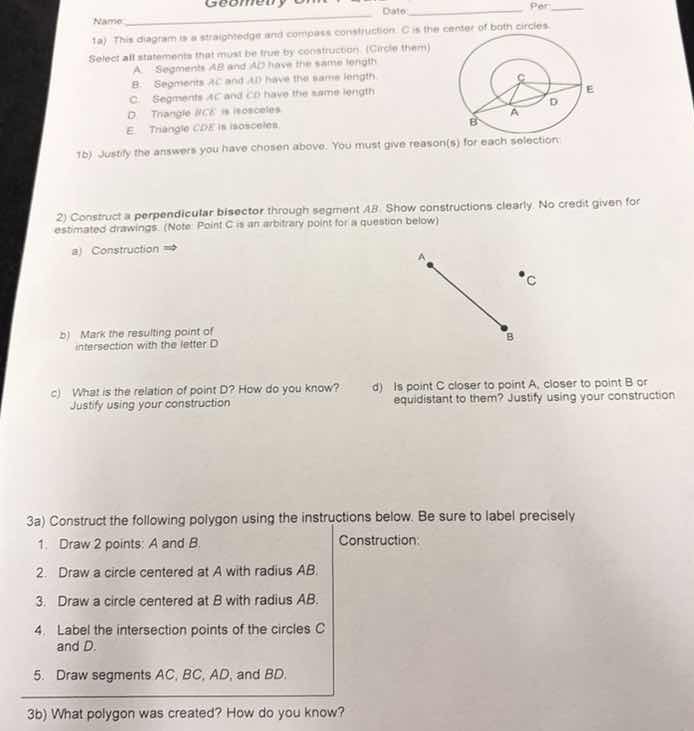
1a) this diagram is a straightedge and compass construction. ( c ) is the center of both circles.
select all statements that must be true by construction. (circle them)
a segments ( ab ) and ( ad ) have the same length.
b segments ( ac ) and ( ad ) have the same length.
c segments ( ac ) and ( cd ) have the same length.
d triangle ( bce ) is isosceles.
e triangle ( cde ) is isosceles.
1b) justify the answers you have chosen above. you must give reason(s) for each selection.
- construct a perpendicular bisector through segment ( ab ). show constructions clearly. no credit given for estimated drawings. (note: point ( c ) is an arbitrary point for a question below)
( \text{a)} ) construction
( \text{b)} ) mark the resulting point of intersection with the letter ( d )
( \text{c)} ) what is the relation of point ( d )? how do you know? justify using your construction
( \text{d)} ) is point ( c ) closer to point ( a ), closer to point ( b ) or equidistant to them? justify using your construction
3a) construct the following polygon using the instructions below. be sure to label precisely
- draw 2 points: ( a ) and ( b ).
- draw a circle centered at ( a ) with radius ( ab ).
- draw a circle centered at ( b ) with radius ( ab ).
- label the intersection points of the circles ( c ) and ( d ).
- draw segments ( ac ), ( bc ), ( ad ), and ( bd ).
3b) what polygon was created? how do you know?

Snap & solve any problem in the app
Get step-by-step solutions on Sovi AI
Photo-based solutions with guided steps
Explore more problems and detailed explanations
1a)
A. Segments AB and AD have the same length
C. Segments AC and CE have the same length
D. Triangle BCD is isosceles
1b)
- A: AB and AD are radii of the larger circle centered at C.
- C: AC and CE are radii of the smaller circle centered at C.
- D: BC = DC (radii of larger circle), so △BCD is isosceles.
2a) [Draw arcs above and below AB from A and B with radius >$\frac{1}{2}$AB, connect arc intersections]
2b) [Mark intersection point as D]
2c) Point D is equidistant from A and B; it lies on the perpendicular bisector of AB.
2d) Point C is closer to [whichever is visually closer]; perpendicular bisector of AB has points equidistant to A and B, C is not on it.
3a) [Follow steps to draw two intersecting circles, label and connect points]
3b) Rhombus; all sides (AB=AC=BC=AD=BD) are equal length.