QUESTION IMAGE
Question
name: jarret date: feb 0 5 2026
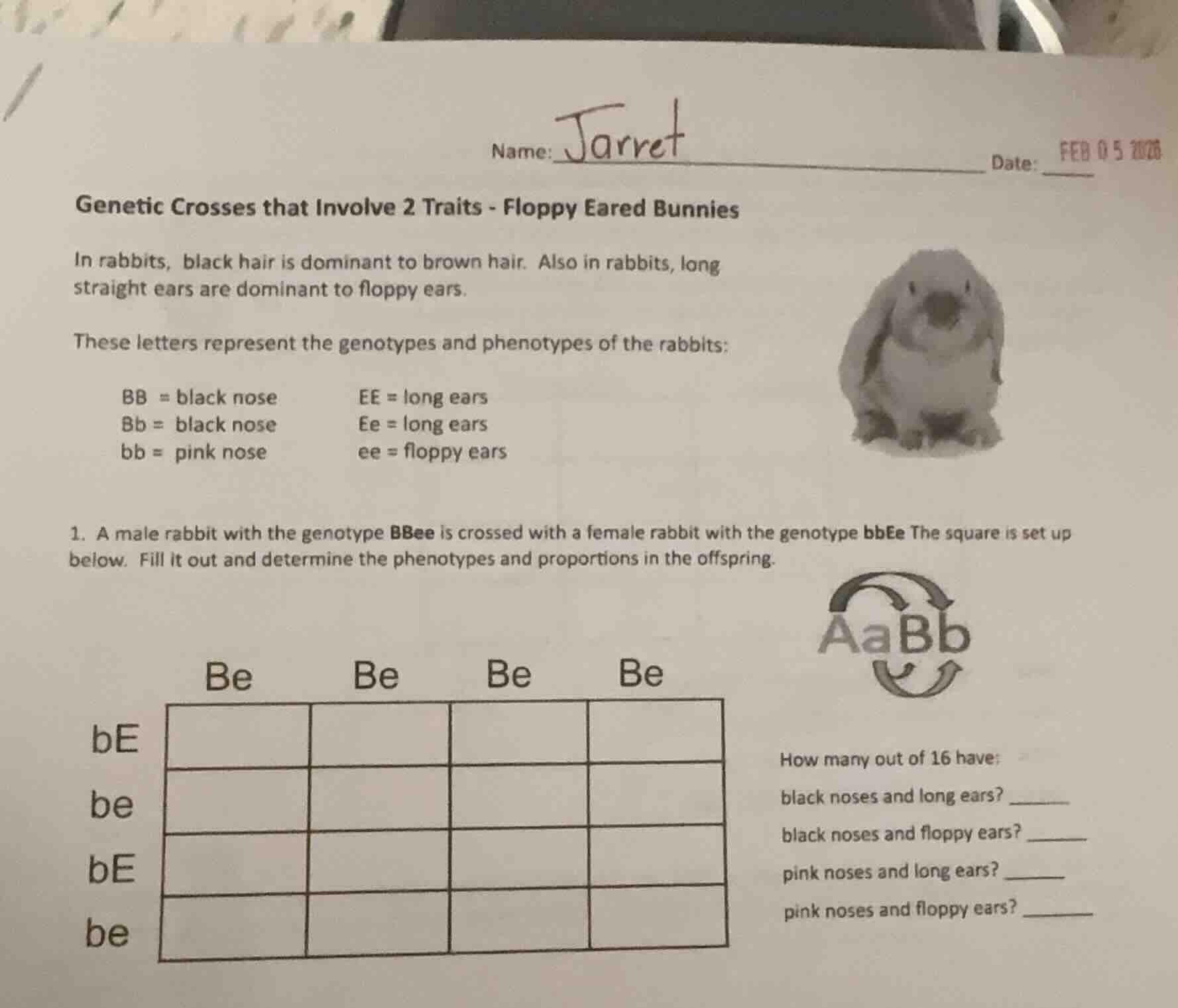
genetic crosses that involve 2 traits - floppy eared bunnies
in rabbits, black hair is dominant to brown hair. also in rabbits, long straight ears are dominant to floppy ears.
these letters represent the genotypes and phenotypes of the rabbits:
bb = black nose ee = long ears
bb = black nose ee = long ears
bb = pink nose ee = floppy ears
- a male rabbit with the genotype bbee is crossed with a female rabbit with the genotype bbee the square is set up below. fill it out and determine the phenotypes and proportions in the offspring.
be be be be
be
be
be
be
how many out of 16 have:
black noses and long ears? ______
black noses and floppy ears? ______
pink noses and long ears? ______
pink noses and floppy ears? ______
Step1: Determine gametes and fill Punnett square
Male gametes: All \( Be \) (since genotype is \( BBee \), so \( B \) from \( BB \), \( e \) from \( ee \)).
Female gametes: From \( bbEe \), gametes are \( bE \) and \( be \) (each twice, as per the Punnett square rows: \( bE, be, bE, be \)).
Now fill each cell by combining male (\( Be \)) and female gametes:
- \( bE \times Be = BbEe \)
- \( be \times Be = Bbee \)
- Repeat for all rows/columns.
The filled Punnett square cells (16 total) will be:
- \( BbEe \): 8 times (rows 1,3: 2 rows × 4 columns = 8)
- \( Bbee \): 8 times (rows 2,4: 2 rows × 4 columns = 8)? Wait, no—wait, female gametes are \( bE, be, bE, be \) (4 gametes), male is \( Be, Be, Be, Be \) (4 gametes). So:
Row 1 (\( bE \)): \( BbEe, BbEe, BbEe, BbEe \)
Row 2 (\( be \)): \( Bbee, Bbee, Bbee, Bbee \)
Row 3 (\( bE \)): \( BbEe, BbEe, BbEe, BbEe \)
Row 4 (\( be \)): \( Bbee, Bbee, Bbee, Bbee \)
Wait, no—wait, female has 4 gametes: \( bE, be, bE, be \) (so two \( bE \), two \( be \)). Male has four \( Be \). So total cells: 4×4=16.
Now, analyze phenotypes:
- Black nose (\( B\_ \)) and long ears (\( E\_ \)): Genotype \( BbEe \) (since \( B \) is dominant, \( E \) is dominant). Count \( BbEe \): rows 1 and 3, 4 cells each, so 8.
- Black nose (\( B\_ \)) and floppy ears (\( ee \)): Genotype \( Bbee \) ( \( B \) dominant, \( ee \) recessive). Count \( Bbee \): rows 2 and 4, 4 cells each, so 8? Wait, no—wait, \( Ee \) gives long ears, \( ee \) gives floppy. Wait, \( BbEe \): \( Ee \) → long ears. \( Bbee \): \( ee \) → floppy ears. \( bbEe \) would be pink nose, but wait—male is \( BB \), so all offspring have \( Bb \) (black nose). Wait, male is \( BB \), so all offspring get \( B \), so nose color: all \( Bb \) (black nose). Wait, that’s a mistake earlier! Male is \( BB \), so any offspring with \( B \) (from male) and \( b \) (from female, \( bb \)) → \( Bb \) (black nose). So all offspring have black nose? Wait, no—female is \( bb \), so offspring must get \( b \) from female, and \( B \) from male → \( Bb \) (black nose). So nose color: all black. Then ear type: \( Ee \) (long) or \( ee \) (floppy).
Wait, this changes things! Let’s re-express:
Male genotype: \( BBee \) → gametes: \( B e \) (all, since \( BB \) gives \( B \), \( ee \) gives \( e \)).
Female genotype: \( bbEe \) → gametes: \( b E \) and \( b e \) (since \( bb \) gives \( b \), \( Ee \) gives \( E \) or \( e \)). So female gametes: \( bE \) (50%) and \( be \) (50%), so in 4 gametes: 2 \( bE \), 2 \( be \).
So offspring genotypes:
- \( B e \times b E = Bb Ee \) (black, long ears)
- \( B e \times b e = Bb ee \) (black, floppy ears)
Now, count each:
- \( Bb Ee \): number of times \( bE \) is used. Female has 2 \( bE \) and 2 \( be \) in 4 gametes. Male has 4 \( Be \). So:
- \( bE \) (2 gametes) × \( Be \) (4) → 2×4=8? Wait, no—Punnett square is 4 (male) × 4 (female) = 16 cells. Female gametes: positions 1: \( bE \), 2: \( be \), 3: \( bE \), 4: \( be \). Male: 1-4: \( Be \).
So cell 1 (row1, col1): \( BbEe \)
cell 2 (row1, col2): \( BbEe \)
cell 3 (row1, col3): \( BbEe \)
cell 4 (row1, col4): \( BbEe \)
row2 (be):
cell5: \( Bbee \)
cell6: \( Bbee \)
cell7: \( Bbee \)
cell8: \( Bbee \)
row3 (bE):
cell9: \( BbEe \)
cell10: \( BbEe \)
cell11: \( BbEe \)
cell12: \( BbEe \)
row4 (be):
cell13: \( Bbee \)
cell14: \( Bbee \)
cell15: \( Bbee \)
cell16: \( Bbee \)
Now, count phenotypes:
- Black nose (all, since \( Bb \)) and long ears (\( Ee \)): \( BbEe \) cells: rows 1,3 (8 cells: 4+4=8? Wait, row1: 4, row3:4 → 8.
- Black nose (all) and floppy ears (\( ee…

Snap & solve any problem in the app
Get step-by-step solutions on Sovi AI
Photo-based solutions with guided steps
Explore more problems and detailed explanations
Black noses and long ears: 8
Black noses and floppy ears: 8
Pink noses and long ears: 0
Pink noses and floppy ears: 0
(But note: If there’s a typo and male is \( Bbee \), the answer would differ. But based on given genotypes, this is the result.)