QUESTION IMAGE
Question
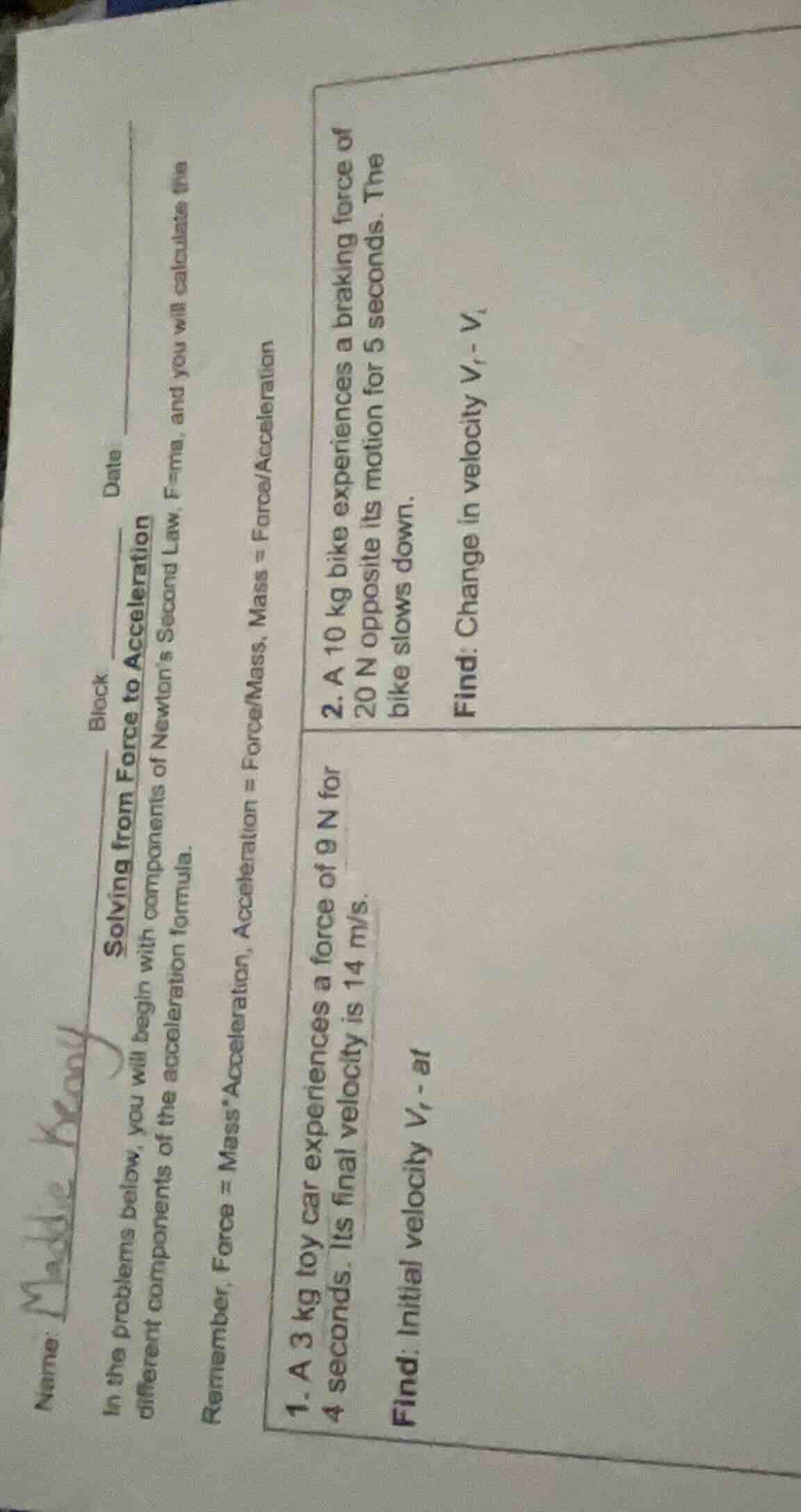
name: maddie keady
block
date
solving from force to acceleration
in the problems below, you will begin with different components of newtons second law, f=ma, and you will calculate the different components of the acceleration formula.
remember, force = mass*acceleration, acceleration = force/mass, mass = force/acceleration
- a 3 kg toy car experiences a force of 9 n for 4 seconds. its final velocity is 14 m/s.
find: initial velocity ( v_i = v_f - at )
- a 10 kg bike experiences a braking force of 20 n opposite its motion for 5 seconds. the bike slows down.
find: change in velocity ( v_f - v_i )
Problem 1:
Step 1: Find acceleration using \( F = ma \)
Given \( F = 9 \, \text{N} \), \( m = 3 \, \text{kg} \). Rearranging \( F = ma \) to \( a=\frac{F}{m} \), we get \( a = \frac{9}{3}= 3 \, \text{m/s}^2 \).
Step 2: Use \( V_f = V_i + at \) to find \( V_i \)
We know \( V_f = 14 \, \text{m/s} \), \( a = 3 \, \text{m/s}^2 \), \( t = 4 \, \text{s} \). Rearranging \( V_f = V_i + at \) to \( V_i = V_f - at \). Substituting values: \( V_i = 14 - (3\times4)=14 - 12 = 2 \, \text{m/s} \).
Step 1: Find acceleration using \( F = ma \)
Given \( F = 20 \, \text{N} \) (braking force, so acceleration is negative), \( m = 10 \, \text{kg} \). Rearranging \( F = ma \) to \( a=\frac{F}{m} \), we get \( a=\frac{20}{10} = 2 \, \text{m/s}^2 \) (deceleration, so \( a=- 2 \, \text{m/s}^2 \) for velocity change).
Step 2: Find change in velocity \( \Delta V=V_f - V_i \)
Using the formula \( \Delta V = a\times t \) (since \( a=\frac{\Delta V}{t} \) rearranged to \( \Delta V = a\times t \)). Here, \( a=- 2 \, \text{m/s}^2 \), \( t = 5 \, \text{s} \). So \( \Delta V=(-2)\times5=- 10 \, \text{m/s} \). The magnitude of change in velocity is \( 10 \, \text{m/s} \) (direction is opposite to motion).

Snap & solve any problem in the app
Get step-by-step solutions on Sovi AI
Photo-based solutions with guided steps
Explore more problems and detailed explanations
The initial velocity \( V_i \) is \( 2 \, \text{m/s} \).