QUESTION IMAGE
Question
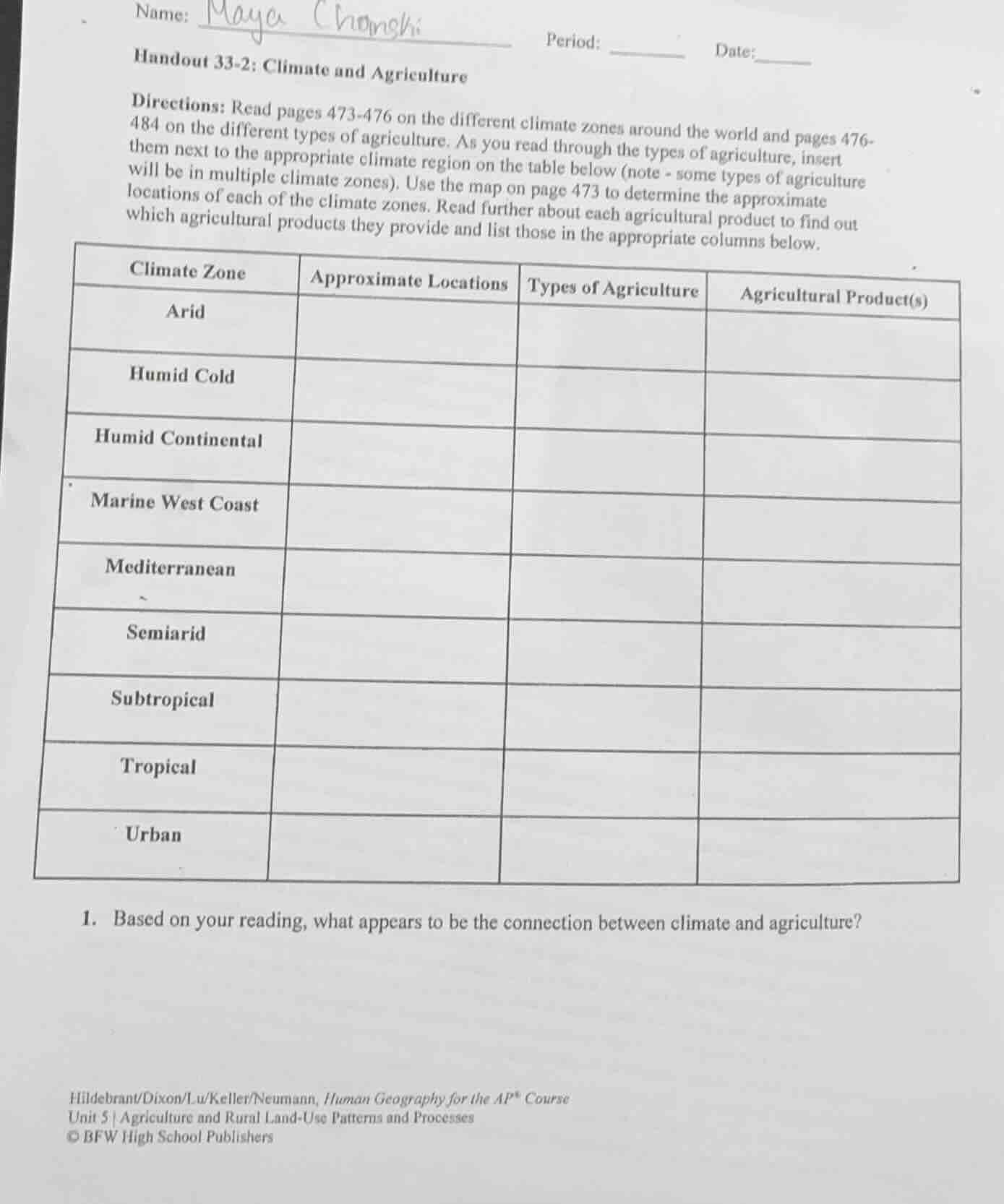
name: maya changhiperiod: ____ date:____handout 33-2: climate and agriculturedirections: read pages 473-476 on the different climate zones around the world and pages 476-484 on the different types of agriculture. as you read through the types of agriculture, insert them next to the appropriate climate region on the table below (note - some types of agriculture will be in multiple climate zones). use the map on page 473 to determine the approximate locations of each of the climate zones. read further about each agricultural product to find out which agricultural products they provide and list those in the appropriate columns below.climate zone | approximate locations | types of agriculture | agricultural product(s)--- | --- | --- | ---arid | | |humid cold | | |humid continental | | |marine west coast | | |mediterranean | | |semiarid | | |subtropical | | |tropical | | |urban | | |1. based on your reading, what appears to be the connection between climate and agriculture?hildebrant/dixon/lu/keller/neumann, human geography for the ap® courseunit 5 | agriculture and rural land-use patterns and processes© bfw high school publishers
The table is completed using standard geographic and agricultural knowledge matching each climate zone to its typical locations, dominant agricultural practices, and associated products. The final question addresses the core adaptive relationship between climate and agriculture.

Snap & solve any problem in the app
Get step-by-step solutions on Sovi AI
Photo-based solutions with guided steps
Explore more problems and detailed explanations
Completed Table:
| Climate Zone | Approximate Locations | Types of Agriculture | Agricultural Product(s) |
|---|---|---|---|
| Humid Cold | Northern Canada, Siberia, Iceland, Alaska interior | Subsistence hunting/gathering, reindeer herding, small-scale greenhouse farming | Reindeer meat/antlers, foraged berries, greenhouse vegetables |
| Humid Continental | Eastern US, Central Europe, Northern China, Southern Canada | Commercial grain farming, mixed crop-livestock, dairy farming | Corn, wheat, soybeans, dairy products, beef |
| Marine West Coast | Northwestern Europe, Pacific Northwest US, Southern Chile, New Zealand | Dairy farming, mixed crop-livestock, horticulture | Dairy products, apples, wheat, vegetables, sheep (wool) |
| Mediterranean | Southern Europe, California, Central Chile, South Africa's Western Cape, Southwest Australia | Mediterranean agriculture (horticulture, tree crops, livestock grazing) | Grapes, olives, citrus fruits, almonds, sheep (wool) |
| Semiarid | Great Plains US, Sahel region, Australian Outback, Central Asia | Commercial grain farming, pastoralism, dryland farming | Wheat, sorghum, cattle, sheep, goats |
| Subtropical | Southeastern US, Eastern Australia, Southern China, Northern India | Commercial crop farming, rice cultivation, citrus farming, livestock production | Rice, citrus fruits, cotton, sugarcane, poultry, beef |
| Tropical | Amazon Basin, Central Africa, Southeast Asia, Central America | Shifting cultivation, plantation agriculture, subsistence farming | Bananas, coffee, cocoa, rice, rubber, palm oil, tropical fruits |
| Urban | Around major global cities (e.g., Tokyo, Lagos, Chicago) | Urban agriculture, rooftop farming, community gardening, intensive horticulture | Fresh vegetables, herbs, fruits, eggs, honey |
Question 1:
Climate directly dictates the types of agriculture that can be practiced in a region, as temperature, precipitation, and seasonal patterns determine which crops can grow, which livestock can thrive, and the viability of farming/pastoral methods. Agriculture is adapted to match the constraints and resources of a given climate zone, with farmers selecting crops, livestock, and practices that align with local climatic conditions.