QUESTION IMAGE
Question
name:
middle east partitioning
end of the ottoman empire
period:
ss7h2 - a. explain how european partitioning in the middle east after the breakup of the ottoman empire led to regional conflict.
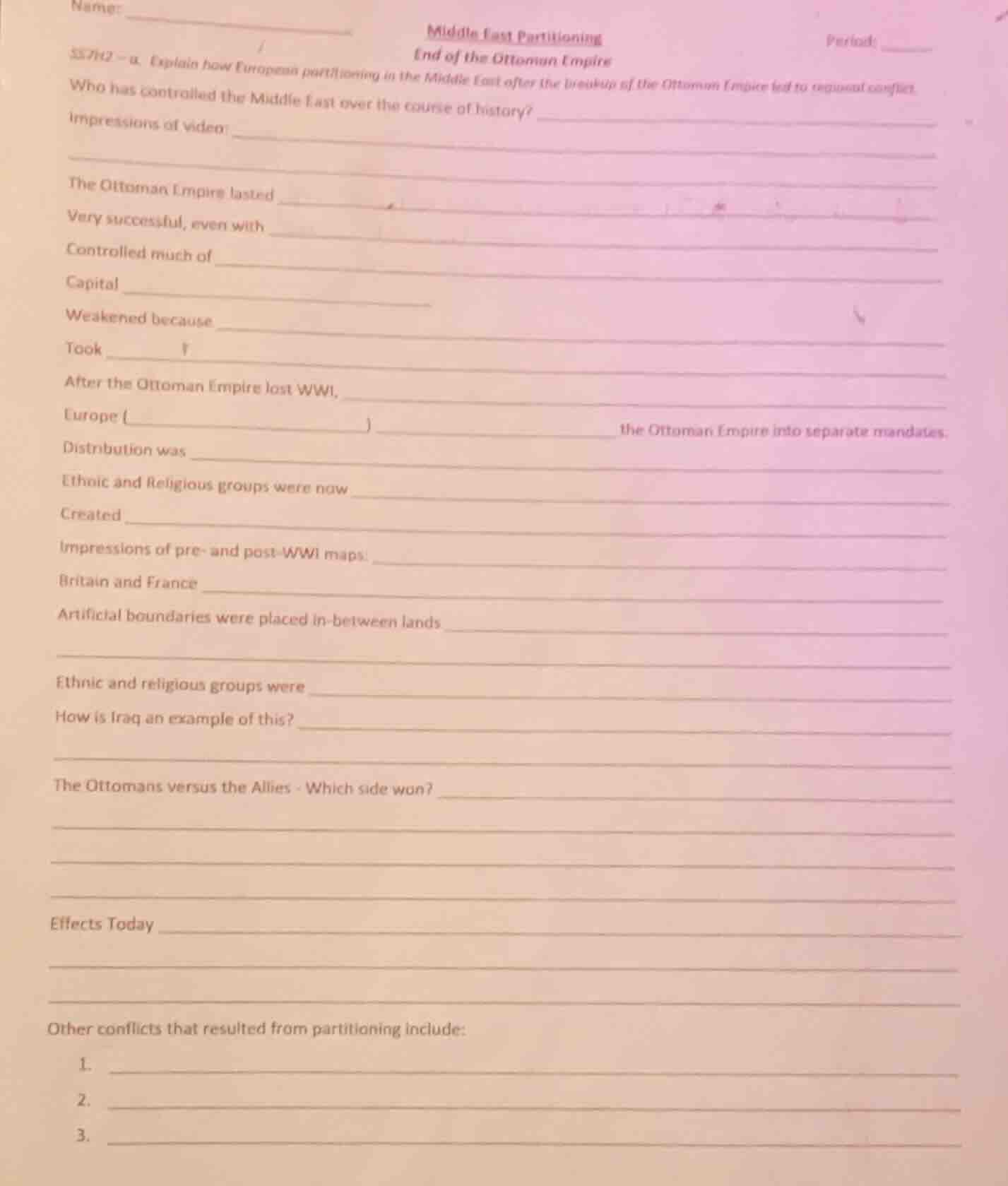
who has controlled the middle east over the course of history?
impressions of video:
the ottoman empire lasted
very successful, even with
controlled much of
capital
weakened because
took
after the ottoman empire lost wwi,
europe ( ) the ottoman empire into separate mandates.
distribution was
ethnic and religious groups were now
created
impressions of pre- and post-wwi maps:
britain and france
artificial boundaries were placed in-between lands
ethnic and religious groups were
how is iraq an example of this?
the ottomans versus the allies - which side won?
effects today
other conflicts that resulted from partitioning include:
1.
2.
3.
This is a worksheet about the Middle East partitioning after the Ottoman Empire's breakup. To answer the questions, we analyze historical context:
1. Who controlled the Middle East over history?
- Ancient: Various empires (Persian, Roman, Byzantine).
- Medieval: Islamic caliphates, then Ottoman Empire (1300s–1918).
- Post - WWI: European powers (Britain, France) via mandates, later independent states with local/foreign influences.
2. Ottoman Empire duration:
Lasted ~600 years (1299–1922, officially dissolved after WWI).
3. Success & control:
Very successful, even with ethnic/religious diversity. Controlled much of Southeast Europe, Western Asia, North Africa. Capital: Constantinople (Istanbul).
4. Weakening:
Weakened due to internal decline (corruption, economic issues) and external pressures (European imperialism, WWI).
5. After WWI loss:
Europe (Britain, France) partitioned the Ottoman Empire into mandates (e.g., British Mandate of Palestine, French Mandate of Syria/Lebanon). Distribution was arbitrary, ignoring ethnic/religious boundaries.
6. Ethnic/religious groups:
Split into new states, creating artificial boundaries (e.g., Iraq combined Sunni, Shia, Kurdish groups).
7. Iraq as an example:
Iraq was formed by merging Ottoman provinces, forcing diverse groups (Sunnis, Shias, Kurds) into one state, leading to sectarian conflicts.
8. Ottomans vs. Allies:
The Allies (Britain, France, Russia, etc.) won WWI; Ottomans were on the Central Powers’ side.
9. Effects today:
Ongoing conflicts (e.g., Israeli - Palestinian, sectarian wars in Iraq/Syria) stem from arbitrary partitioning.
10. Other conflicts from partitioning:
- Israeli - Palestinian conflict (mandate - era borders, Jewish - Arab tensions).
- Kurdish separatism (Kurdish groups split across Turkey, Iraq, Syria, Iran).
- Sectarian violence in Syria/Lebanon (artificial state boundaries).

Snap & solve any problem in the app
Get step-by-step solutions on Sovi AI
Photo-based solutions with guided steps
Explore more problems and detailed explanations
s (filled contextually):
- Who controlled...: Ancient empires, Ottoman, then Britain/France, now independent states with local/foreign influence.
- Ottoman lasted: ~600 years (1299–1922).
- Successful with: Ethnic/religious diversity; controlled: SE Europe, W Asia, N Africa.
- Capital: Constantinople (Istanbul).
- Weakened because: Internal decline, external pressure (WWI).
- After WWI: Europe (Britain, France) partitioned into mandates.
- Distribution: Arbitrary, ignored ethnic/religious lines.
- Ethnic groups: Split into new states, artificial boundaries.
- Iraq example: Merged diverse groups, causing sectarian conflict.
- Ottomans vs. Allies: Allies won.
- Effects today: Ongoing sectarian/territorial conflicts.
- Other conflicts: 1. Israeli - Palestinian, 2. Kurdish separatism, 3. Syrian civil war (sectarian/territorial roots).