QUESTION IMAGE
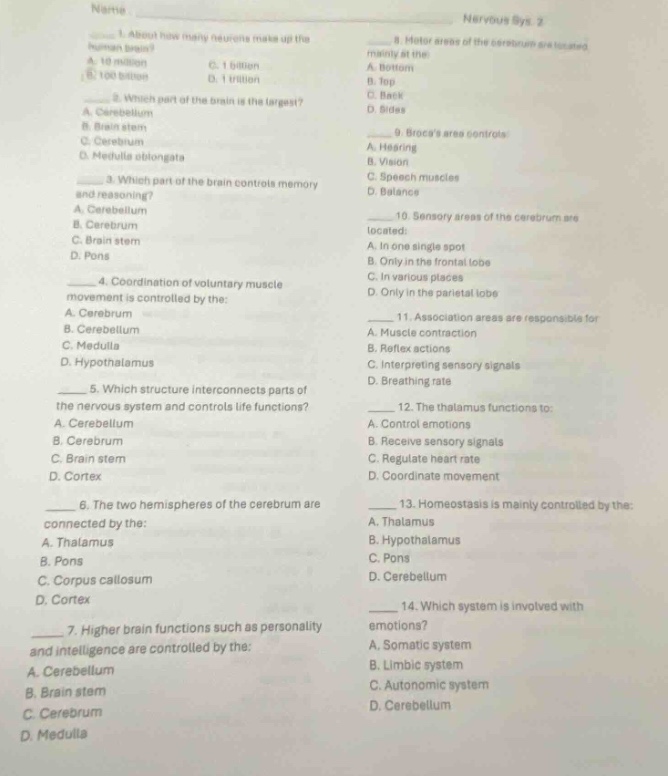
Question
name nervous sys. 2
- about how many neurons make up the human brain?
a. 10 million c. 1 billion
b. 100 billion d. 1 trillion
- which part of the brain is the largest?
a. cerebrum
b. brain stem
c. cerebellum
d. medulla oblongata
- which part of the brain controls memory and reasoning?
a. cerebellum
b. cerebrum
c. brain stem
d. pons
- coordination of voluntary muscle movement is controlled by the:
a. cerebrum
b. cerebellum
c. medulla
d. hypothalamus
- which structure interconnects parts of the nervous system and controls life functions?
a. cerebellum
b. cerebrum
c. brain stem
d. cortex
- the two hemispheres of the cerebrum are connected by the:
a. thalamus
b. pons
c. corpus callosum
d. cortex
- higher brain functions such as personality and intelligence are controlled by the:
a. cerebellum
b. brain stem
c. cerebrum
d. medulla
- motor areas of the cerebrum are located mainly at the:
a. bottom
b. top
c. back
d. sides
- brocas area controls:
a. hearing
b. vision
c. speech muscles
d. balance
- sensory areas of the cerebrum are located:
a. in one single spot
b. only in the frontal lobe
c. in various places
d. only in the parietal lobe
- association areas are responsible for:
a. muscle contraction
b. reflex actions
c. interpreting sensory signals
d. breathing rate
- the thalamus functions to:
a. control emotions
b. receive sensory signals
c. regulate heart rate
d. coordinate movement
- homeostasis is mainly controlled by the:
a. thalamus
b. hypothalamus
c. pons
d. cerebellum
- which system is involved with emotions?
a. somatic system
b. limbic system
c. autonomic system
d. cerebellum
coordinates voluntary muscle movement and balance.
- The brain stem regulates involuntary life functions like breathing and heart rate.
- The corpus callosum is the thick nerve tract connecting the two cerebral hemispheres.
- Higher cognitive functions (personality, intelligence) are centered in the cerebrum.
- The cerebrum's motor areas are primarily located in the top/outer regions (precentral gyrus).
- Broca's area, in the frontal lobe, controls the muscles involved in speech production.
- Sensory areas of the cerebrum are distributed (e.g., visual in occipital, auditory in temporal).
- Association areas process and interpret incoming sensory information.
- The thalamus acts as a relay station, receiving and routing sensory signals to the cerebrum.
- The hypothalamus maintains homeostasis (temperature, hunger, hormone regulation).
- The limbic system (including amygdala, hippocampus) governs emotions and emotional memory.

Snap & solve any problem in the app
Get step-by-step solutions on Sovi AI
Photo-based solutions with guided steps
Explore more problems and detailed explanations
coordinates voluntary muscle movement and balance.
- The brain stem regulates involuntary life functions like breathing and heart rate.
- The corpus callosum is the thick nerve tract connecting the two cerebral hemispheres.
- Higher cognitive functions (personality, intelligence) are centered in the cerebrum.
- The cerebrum's motor areas are primarily located in the top/outer regions (precentral gyrus).
- Broca's area, in the frontal lobe, controls the muscles involved in speech production.
- Sensory areas of the cerebrum are distributed (e.g., visual in occipital, auditory in temporal).
- Association areas process and interpret incoming sensory information.
- The thalamus acts as a relay station, receiving and routing sensory signals to the cerebrum.
- The hypothalamus maintains homeostasis (temperature, hunger, hormone regulation).
- The limbic system (including amygdala, hippocampus) governs emotions and emotional memory.