QUESTION IMAGE
Question
name
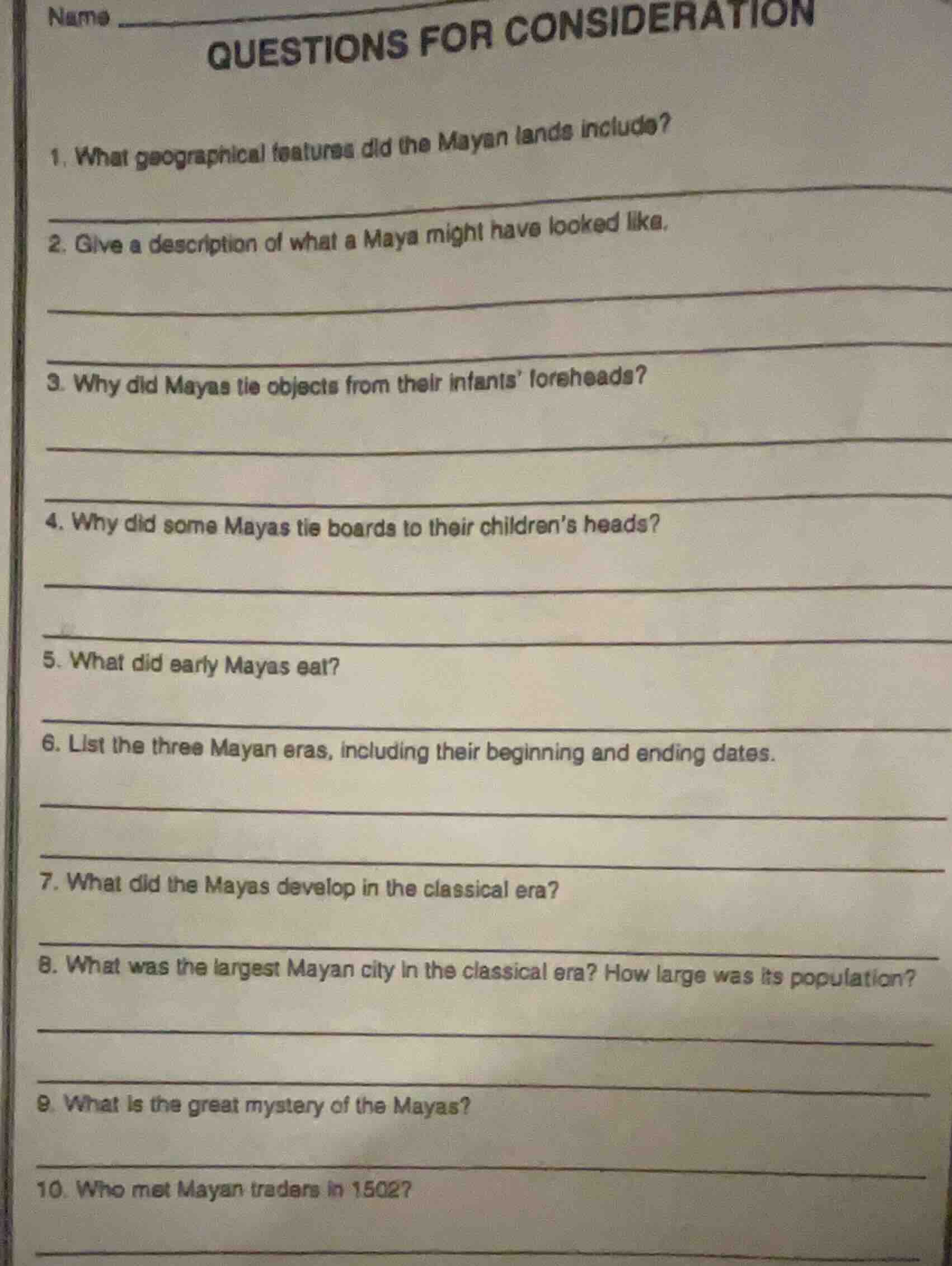
questions for consideration
- what geographical features did the mayan lands include?
- give a description of what a maya might have looked like.
- why did mayas tie objects from their infants’ foreheads?
- why did some mayas tie boards to their children’s heads?
- what did early mayas eat?
- list the three mayan eras, including their beginning and ending dates.
- what did the mayas develop in the classical era?
- what was the largest mayan city in the classical era? how large was its population?
- what is the great mystery of the mayas?
- who met mayan traders in 1502?
Brief Explanations
- Covers key physical features of Mayan territories.
- Describes typical physical traits and adornments of Maya people.
- Explains the cultural motivation for this infant practice.
- Details the cultural goal of this head modification.
- Lists staple and common foods of early Maya groups.
- Outlines the standard three eras of Mayan history with accepted date ranges.
- Summarizes major advancements of the Classical Mayan period.
- Identifies the largest Classical Mayan city and its estimated population.
- Notes the unsolved core question about Mayan civilization.
- Names the European figure who encountered Mayan traders in 1502.

Snap & solve any problem in the app
Get step-by-step solutions on Sovi AI
Photo-based solutions with guided steps
Explore more problems and detailed explanations
- Mayan lands included tropical rainforests, lowland plains, highland plateaus, limestone karst regions, and coastal areas along the Caribbean Sea and Pacific Ocean, with numerous rivers and cenotes (natural sinkholes).
- Maya people typically had short, sturdy builds, dark straight hair, dark eyes, and broad cheekbones. They often wore body paint, tattoos, and elaborate headdresses; elites wore jade jewelry, cotton garments, and decorated loincloths or tunics.
- They tied objects to infants' foreheads to create a sloped or flattened forehead shape, which was a desirable, culturally valued physical trait signifying beauty and status.
- Tying boards to children's heads was a form of intentional cranial deformation to achieve a flattened, elongated skull shape, a marker of nobility and cultural identity among some Maya groups.
- Early Mayas ate staple crops like maize (corn), beans, and squash (the "Three Sisters"), plus fruits such as papaya and avocado, game like deer and turkey, fish, and insects like grasshoppers.
- - Preclassic Era: c. 2000 BCE – 250 CE
- Classic Era: c. 250 CE – 900 CE
- Postclassic Era: c. 900 CE – 1521 CE
- In the Classical era, the Mayas developed complex city-states with monumental architecture (pyramids, palaces), a fully written hieroglyphic script, advanced mathematics including the concept of zero, precise astronomical calendars, and sophisticated art and pottery.
- The largest Mayan city in the classical era was Tikal (in present-day Guatemala), with an estimated peak population of 60,000 to 100,000 people.
- The great mystery of the Mayas is the sudden, widespread collapse of most Classic-era Mayan city-states between the 8th and 9th centuries CE, with no single definitive cause proposed (scholars cite factors like drought, overpopulation, warfare, and environmental degradation).
- Christopher Columbus and his crew met Mayan traders in 1502 during his fourth voyage to the Americas.