QUESTION IMAGE
Question
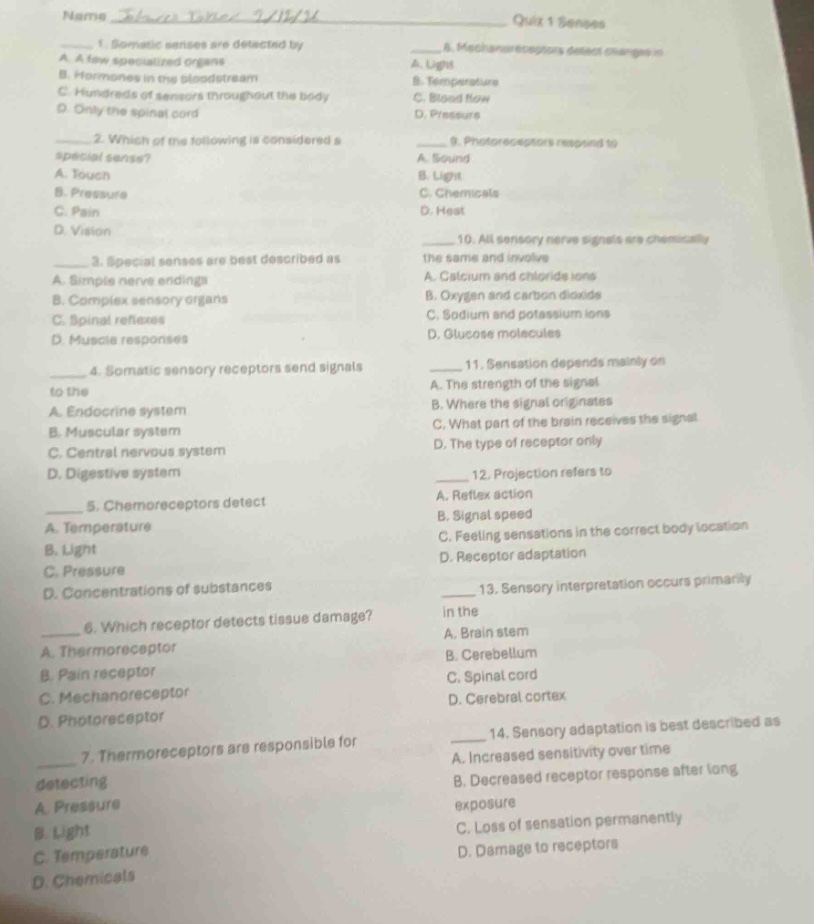
name ______ quiz 1 senses
- somatic senses are detected by
a. a few specialized organs
b. hormones in the bloodstream
c. hundreds of sensors throughout the body
d. only the spinal cord
- which of the following is considered a special sense?
a. touch
b. pressure
c. pain
d. vision
- special senses are best described as
a. simple nerve endings
b. complex sensory organs
c. spinal reflexes
d. muscle responses
- somatic sensory receptors send signals to the
a. endocrine system
b. muscular system
c. central nervous system
d. digestive system
- chemoreceptors detect
a. temperature
b. light
c. pressure
d. concentrations of substances
- which receptor detects tissue damage?
a. thermoreceptor
b. pain receptor
c. mechanoreceptor
d. photoreceptor
- thermoreceptors are responsible for detecting
a. pressure
b. light
c. temperature
d. chemicals
- mechanoreceptors detect changes in
a. light
b. temperature
c. blood flow
d. pressure
- photoreceptors respond to
a. sound
b. light
c. chemicals
d. heat
- all sensory nerve signals are chemically the same and involve
a. calcium and chloride ions
b. oxygen and carbon dioxide
c. sodium and potassium ions
d. glucose molecules
- sensation depends mainly on
a. the strength of the signal
b. where the signal originates
c. what part of the brain receives the signal
d. the type of receptor only
- projection refers to
a. reflex action
b. signal speed
c. feeling sensations in the correct body location
d. receptor adaptation
- sensory interpretation occurs primarily in the
a. brain stem
b. cerebellum
c. spinal cord
d. cerebral cortex
- sensory adaptation is best described as
a. increased sensitivity over time
b. decreased receptor response after long exposure
c. loss of sensation permanently
d. damage to receptors
the central nervous system (brain and spinal cord) for processing.
- Chemoreceptors detect chemical concentrations (e.g., taste, blood oxygen levels).
- Pain receptors (nociceptors) specifically detect tissue damage or potential damage.
- Thermoreceptors are specialized to detect changes in temperature.
- Mechanoreceptors respond to physical forces, including pressure, as well as stretch and vibration.
- Photoreceptors (in the eyes) are stimulated by light energy to produce visual signals.
- Nerve signals rely on the movement of sodium and potassium ions across neuron membranes to generate action potentials.
- The brain interprets sensation based on which region receives the signal (e.g., visual cortex processes eye signals as sight).
- Projection is the brain's ability to localize sensations to their correct body site.
- The cerebral cortex is the primary site for interpreting and processing sensory information into conscious perception.
- Sensory adaptation is the reduction of receptor response to a constant, unchanging stimulus over time.

Snap & solve any problem in the app
Get step-by-step solutions on Sovi AI
Photo-based solutions with guided steps
Explore more problems and detailed explanations
the central nervous system (brain and spinal cord) for processing.
- Chemoreceptors detect chemical concentrations (e.g., taste, blood oxygen levels).
- Pain receptors (nociceptors) specifically detect tissue damage or potential damage.
- Thermoreceptors are specialized to detect changes in temperature.
- Mechanoreceptors respond to physical forces, including pressure, as well as stretch and vibration.
- Photoreceptors (in the eyes) are stimulated by light energy to produce visual signals.
- Nerve signals rely on the movement of sodium and potassium ions across neuron membranes to generate action potentials.
- The brain interprets sensation based on which region receives the signal (e.g., visual cortex processes eye signals as sight).
- Projection is the brain's ability to localize sensations to their correct body site.
- The cerebral cortex is the primary site for interpreting and processing sensory information into conscious perception.
- Sensory adaptation is the reduction of receptor response to a constant, unchanging stimulus over time.