QUESTION IMAGE
Question
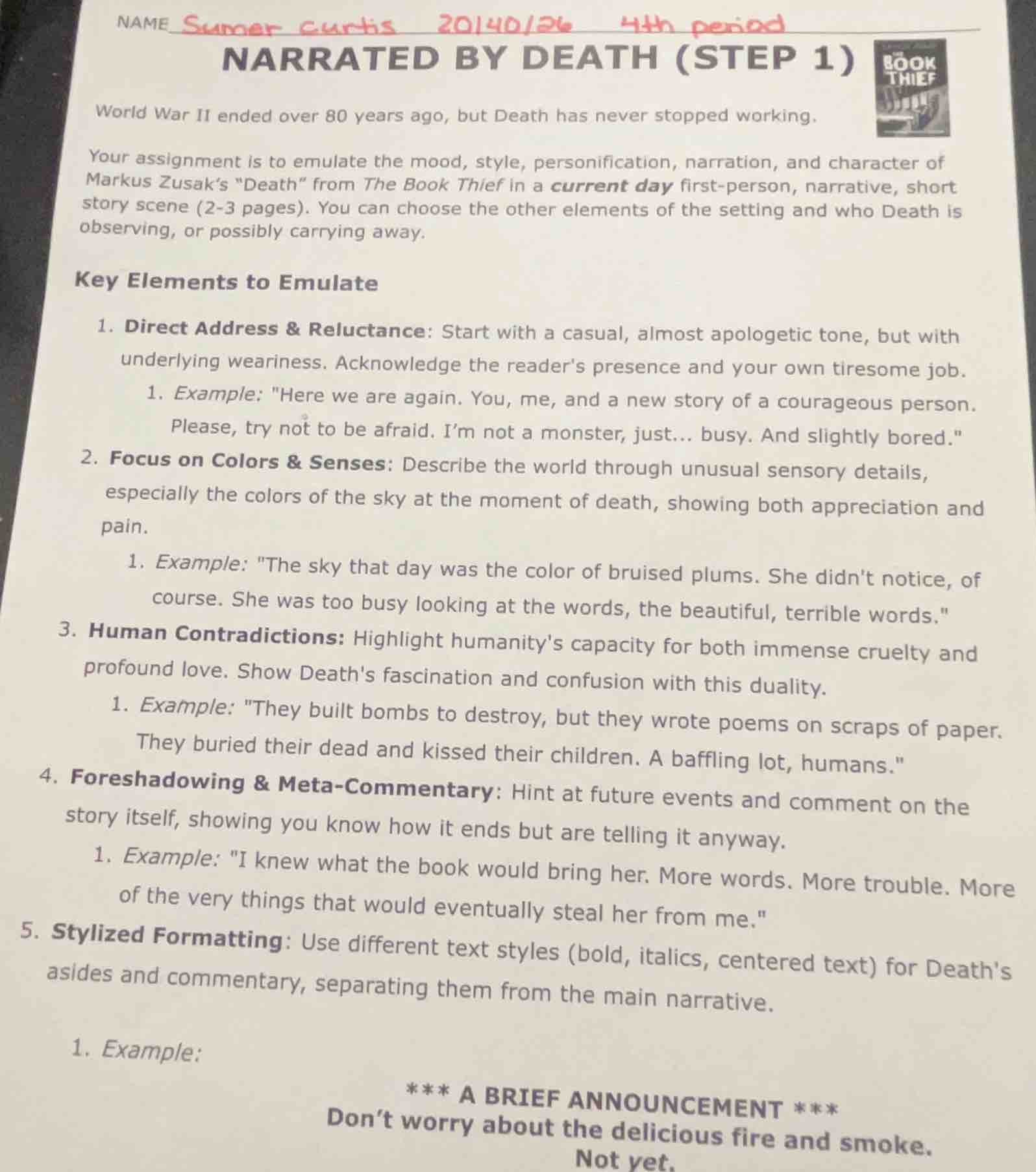
name sumer curtis 20140/26 4th period narrated by death (step 1) world war ii ended over 80 years ago, but death has never stopped working. your assignment is to emulate the mood, style, personification, narration, and character of markus zusak’s \death\ from the book thief in a current day first - person, narrative, short story scene (2 - 3 pages). you can choose the other elements of the setting and who death is observing, or possibly carrying away. key elements to emulate 1. direct address & reluctance: start with a casual, almost apologetic tone, but with underlying weariness. acknowledge the reader’s presence and your own tiresome job. 1. example: \here we are again. you, me, and a new story of a courageous person. please, try not to be afraid. i’m not a monster, just... busy. and slightly bored.\ 2. focus on colors & senses: describe the world through unusual sensory details, especially the colors of the sky at the moment of death, showing both appreciation and pain. 1. example: \the sky that day was the color of bruised plums. she didnt notice, of course. she was too busy looking at the words, the beautiful, terrible words.\ 3. human contradictions: highlight humanitys capacity for both immense cruelty and profound love. show deaths fascination and confusion with this duality. 1. example: \they built bombs to destroy, but they wrote poems on scraps of paper. they buried their dead and kissed their children. a baffling lot, humans.\ 4. foreshadowing & meta - commentary: hint at future events and comment on the story itself, showing you know how it ends but are telling it anyway. 1. example: \i knew what the book would bring her. more words. more trouble. more of the very things that would eventually steal her from me.\ 5. stylized formatting: use different text styles (bold, italics, centered text) for deaths asides and commentary, separating them from the main narrative. 1. example: a brief announcement don’t worry about the delicious fire and smoke. not yet.
This is a creative writing assignment that requires emulating the narrative voice of Death from The Book Thief in a modern-day scene. The key elements to include are: a casual, weary direct address to the reader; sensory/color-focused descriptions (especially sky color at death); exploration of humanity's contradictory nature; foreshadowing with meta-commentary on the story; and stylized formatting for asides. Below is a sample short scene that adheres to all these requirements.

Snap & solve any problem in the app
Get step-by-step solutions on Sovi AI
Photo-based solutions with guided steps
Explore more problems and detailed explanations
Here we are again. You, me, and another one. Don’t look so grim—I’m not here to startle you. I’m just… working. Always working.
The sky this evening is the color of faded indigo jeans, stretched thin and frayed at the edges. I find it fitting, given the circumstances. She’s on a fire escape, legs dangling over the rusted rail, a dog-eared poetry collection splayed across her knees. Below, the street hums: a taxi blares its horn, a couple shouts a goodbye that’s equal parts sharp and tender, a kid chases a stray cat with a slice of pizza. Humans. They make so much noise over everything.
She doesn’t see me leaning against the brick wall of her apartment building. Her eyes are fixed on the page, and her thumb brushes a line of ink like it’s a secret. I know what she’s reading. “I carry your heart with me(I carry it in”—the rest is smudged, rain or tears, I can’t tell.
A OBSERVATION, FOR WHAT IT’S WORTH
They write about love like it’s a thing they can hold. Like it won’t slip through their fingers like smoke.
Downstairs, her phone buzzes in her purse. I know who it is. The one who left three days ago, who screamed that he couldn’t “keep up with all her feelings.” The one who still texts her at 9 PM, when he’s drunk and lonely. She ignores it. Turns the page. Smiles, just a little.
I’ve been watching her for weeks. I watched her bring soup to her elderly neighbor, the one who calls her “sweetheart” and forgets her name by the next day. I watched her scream at a stranger who kicked a pigeon in the park, her voice cracking like a glass bottle. I watched her cry in the shower for an hour after her sister called to say she wasn’t coming home for Christmas. Humans. They’re so cruel, so kind, so loud. I’ll never understand them.
The sky darkens. The indigo bleeds into black, and the first star pricks through. She closes her book, tucks it into her sweatshirt pocket, and stands up. Her foot slips on a loose rusted rung.
I WARNED YOU ABOUT THE SMOKE
Not the fire kind. The kind that comes from falling.
She doesn’t scream. Just gasps, a soft little sound, like she’s surprised. Her hands flail, but there’s nothing to grab. I move closer, slow, like I’m approaching a skittish animal. I don’t want to scare her.
When she hits the pavement, the poetry book flies out of her pocket. The wind turns the pages, and I see the line she was reading, now complete: “I carry your heart with me(I carry it in my heart)”.
I kneel down. Close her eyes. Pick up the book. Tuck it back into her pocket.
Below, the couple is still arguing. The kid finally catches the cat, and gives it the pizza. The taxi driver honks again, annoyed. The world keeps turning. I keep working.
I’ll see you again soon. Don’t worry.
PROMISE
I always do.