QUESTION IMAGE
Question
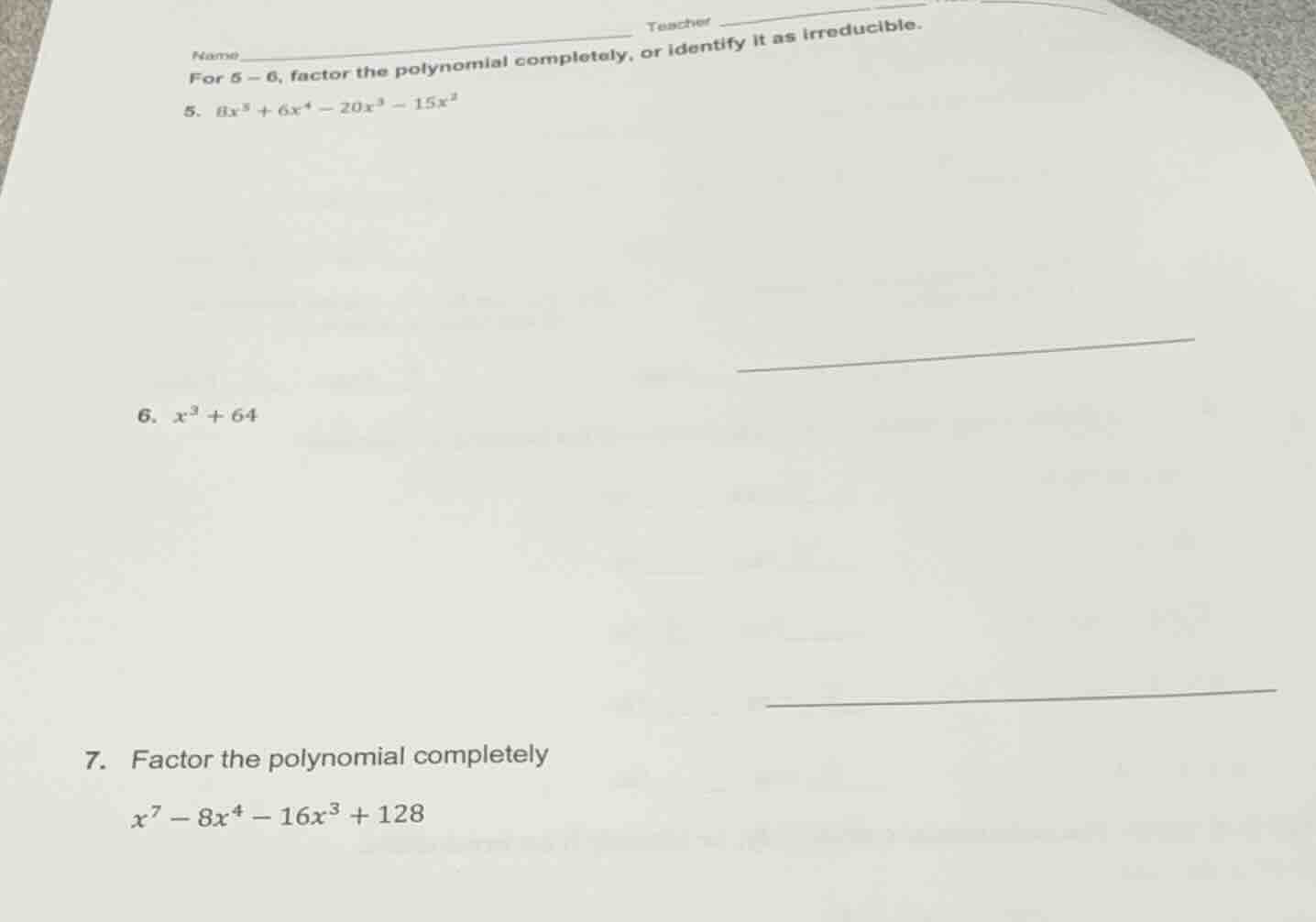
name teacher for 5 - 6, factor the polynomial completely, or identify it as irreducible. 5. $8x^5 + 6x^4 - 20x^3 - 15x^2$ 6. $x^3 + 64$ 7. factor the polynomial completely $x^7 - 8x^4 - 16x^3 + 128$
Problem 5: \(8x^5 + 6x^4 - 20x^3 - 15x^2\)
Step 1: Factor out the GCF
First, find the greatest common factor (GCF) of all terms. The GCF of \(8x^5\), \(6x^4\), \(-20x^3\), and \(-15x^2\) is \(x^2\).
\[
8x^5 + 6x^4 - 20x^3 - 15x^2 = x^2(8x^3 + 6x^2 - 20x - 15)
\]
Step 2: Group the terms in the parentheses
Group the first two terms and the last two terms in the parentheses:
\[
x^2[(8x^3 + 6x^2) + (-20x - 15)]
\]
Step 3: Factor out the GCF from each group
Factor out \(2x^2\) from the first group and \(-5\) from the second group:
\[
x^2[2x^2(4x + 3) - 5(4x + 3)]
\]
Step 4: Factor out the common binomial factor
Now, factor out the common binomial factor \((4x + 3)\):
\[
x^2(4x + 3)(2x^2 - 5)
\]
Step 1: Recognize the sum of cubes
The expression \(x^3 + 64\) is a sum of cubes, since \(64 = 4^3\). The formula for factoring the sum of cubes is \(a^3 + b^3 = (a + b)(a^2 - ab + b^2)\). Here, \(a = x\) and \(b = 4\).
Step 2: Apply the sum of cubes formula
Using the formula \(a^3 + b^3 = (a + b)(a^2 - ab + b^2)\) with \(a = x\) and \(b = 4\):
\[
x^3 + 4^3 = (x + 4)(x^2 - x \cdot 4 + 4^2) = (x + 4)(x^2 - 4x + 16)
\]
Step 1: Group the terms
Group the first two terms and the last two terms:
\[
(x^7 - 8x^4) + (-16x^3 + 128)
\]
Step 2: Factor out the GCF from each group
Factor out \(x^4\) from the first group and \(-16\) from the second group:
\[
x^4(x^3 - 8) - 16(x^3 - 8)
\]
Step 3: Factor out the common binomial factor
Now, factor out the common binomial factor \((x^3 - 8)\):
\[
(x^3 - 8)(x^4 - 16)
\]
Step 4: Factor the difference of cubes and difference of squares
- Factor \(x^3 - 8\) (difference of cubes: \(a^3 - b^3 = (a - b)(a^2 + ab + b^2)\) where \(a = x\) and \(b = 2\)):
\[
x^3 - 2^3 = (x - 2)(x^2 + 2x + 4)
\]
- Factor \(x^4 - 16\) (difference of squares: \(a^2 - b^2 = (a - b)(a + b)\) where \(a = x^2\) and \(b = 4\)):
\[
x^4 - 4^2 = (x^2 - 4)(x^2 + 4)
\]
- Further factor \(x^2 - 4\) (difference of squares: \(a^2 - b^2 = (a - b)(a + b)\) where \(a = x\) and \(b = 2\)):
\[
x^2 - 2^2 = (x - 2)(x + 2)
\]
Step 5: Combine all the factors
Putting it all together:
\[
(x - 2)(x^2 + 2x + 4)(x - 2)(x + 2)(x^2 + 4)
\]
Simplify by combining the two \((x - 2)\) factors:
\[
(x - 2)^2(x + 2)(x^2 + 2x + 4)(x^2 + 4)
\]

Snap & solve any problem in the app
Get step-by-step solutions on Sovi AI
Photo-based solutions with guided steps
Explore more problems and detailed explanations
\(x^2(4x + 3)(2x^2 - 5)\)