QUESTION IMAGE
Question
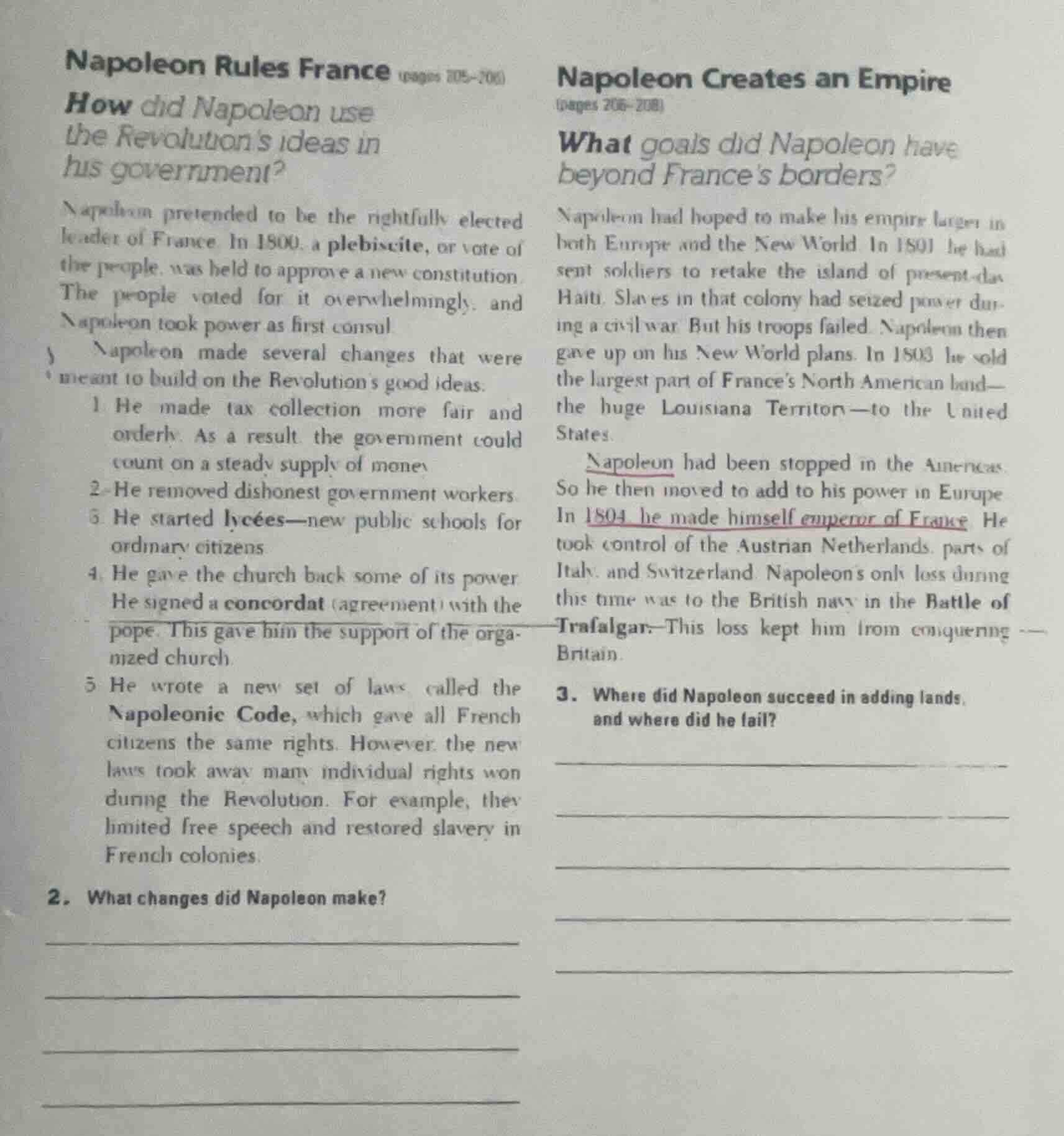
napoleon rules france (pages 205 - 206)
how did napoleon use
the revolution’s ideas in
his government?
napoleon pretended to be the rightfully elected
leader of france. in 1800, a plebiscite, or vote of
the people, was held to approve a new constitution.
the people voted for it overwhelmingly, and
napoleon took power as first consul.
napoleon made several changes that were
meant to build on the revolution’s good ideas.
1 he made tax collection more fair and
orderly. as a result, the government could
count on a steady supply of money.
2 - he removed dishonest government workers.
- he started lycées—new public schools for
ordinary citizens.
- he gave the church back some of its power.
he signed a concordat (agreement) with the
pope. this gave him the support of the orga-
ized church.
5 he wrote a new set of laws called the
napoleonic code, which gave all french
citizens the same rights. however, the new
laws took away many individual rights won
during the revolution. for example, they
limited free speech and restored slavery in
french colonies.
- what changes did napoleon make?
napoleon creates an empire
(pages 206 - 208)
what goals did napoleon have
beyond france’s borders?
napoleon had hoped to make his empire larger in
both europe and the new world. in 1801 he had
sent soldiers to retake the island of present - day
haiti. slaves in that colony had seized power dur-
ing a civil war. but his troops failed. napoleon then
gave up on his new world plans. in 1803 he sold
the largest part of france’s north american land—
the huge louisiana territory—to the united
states.
napoleon had been stopped in the americas.
so he then moved to add to his power in europe.
in 1804 he made himself emperor of france. he
took control of the austrian netherlands, parts of
italy, and switzerland. napoleon’s only loss during
this time was to the british navy in the battle of
trafalgar. this loss kept him from conquering
britain.
- where did napoleon succeed in adding lands,
and where did he fail?
Question 2: What changes did Napoleon make?
To answer this, we extract the changes listed in the text under "Napoleon made several changes...": 1. Fairer tax collection. 2. Removed dishonest government workers. 3. Started lycées (public schools). 4. Restored some church power (via concordat). 5. Created the Napoleonic Code (equal rights but limited some Revolution - won rights). Also, he took power via plebiscite - approved constitution as first consul.
For success, we look at the text: "He took control of the Austrian Netherlands, parts of Italy, and Switzerland". For failure: "sent soldiers to retake...Haiti...troops failed", "sold the Louisiana Territory" (gave up New World plans), "loss...Battle of Trafalgar...kept him from conquering Britain".

Snap & solve any problem in the app
Get step-by-step solutions on Sovi AI
Photo-based solutions with guided steps
Explore more problems and detailed explanations
- He had a plebiscite in 1800 to approve a new constitution and took power as first consul.
- Made tax collection more fair and orderly.
- Removed dishonest government workers.
- Started lycées (new public schools for ordinary citizens).
- Gave the church back some power by signing a concordat with the pope.
- Wrote the Napoleonic Code, which gave all French citizens the same rights but also took away many individual rights won during the Revolution (e.g., limited free speech, restored slavery in French colonies).