QUESTION IMAGE
Question
the narrative of the life of frederick douglass
(question completion)
chapter 1
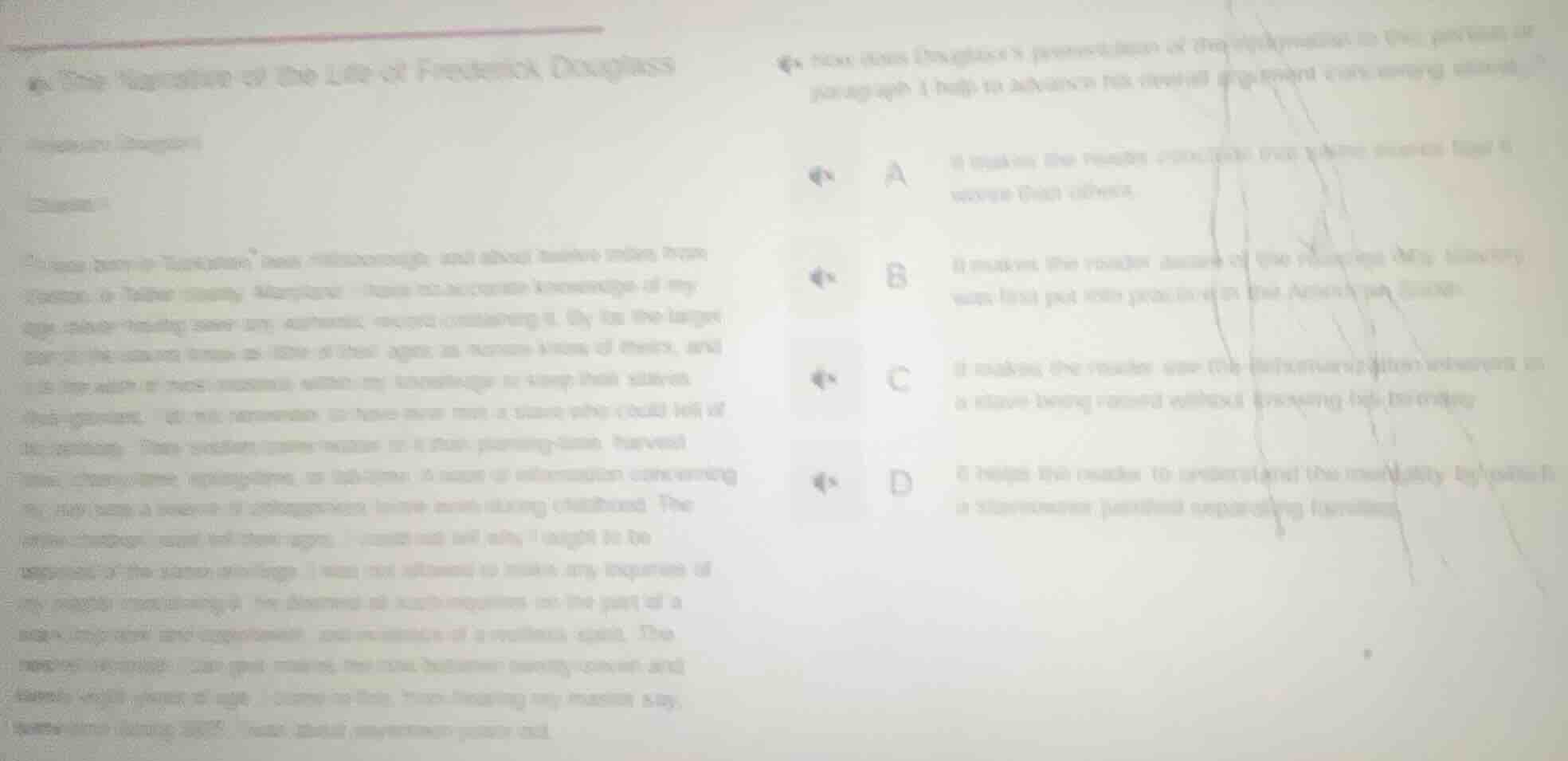
i was born in tuckahoe, near hillsborough, and about twelve miles from easton, in talbot county, maryland. i have no accurate knowledge of my age, never having seen any authentic record containing it. by far the larger part of the slaves know as little of their ages as horses know of theirs, and it is the wish of most masters within my knowledge to keep their slaves thus ignorant. i do not remember to have ever met a slave who could tell of his birthday. they seldom come nearer to it than planting-time, harvesttime, cherry-time, springtime, or falltime. a want of information concerning my own was a source of unhappiness to me even during childhood. the white children could tell their ages. i could not tell why i ought to be deprived of the same privilege. i was not allowed to make any inquiries of my master concerning it. he deemed all such inquiries on the part of a slave improper and impertinent, and evidence of a restless spirit. the nearest estimate i can give makes me now between twenty-seven and twenty-eight years of age. i come to this, from hearing my master say, some time during 1835, i was about seventeen years old.
how does douglass’s presentation of the information in this passage or paragraph 1 help to advance his overall argument in the memoir?
a it makes the reader conclude that white masters liked to misuse their slaves.
b it makes the reader aware of the physical and mental harm that was first put into practice in the american south.
c it makes the reader see the inhumanity of a slave being owned without knowing his birthday.
d it helps the reader to understand the inhumanity by calling it a slaveowner’s punishment for disobedience.
Paragraph 1 of Narrative of the Life of Frederick Douglass focuses on how enslavers intentionally withheld basic information (like his birth date and parentage) from Douglass and other enslaved people. This deliberate ignorance was a tool to strip enslaved people of a sense of personal identity, history, and connection to family, which reinforced their subjugation. Option C directly addresses this: the presentation of these deprivations shows how enslavers used forced ignorance to keep enslaved people in a state of perpetual psychological and social subjugation, advancing Douglass's argument about the dehumanizing mechanisms of slavery.
Option A is incorrect because the paragraph does not focus on comparing enslaved people to animals. Option B is wrong as the text does not center on the origins of slavery in America. Option D is inaccurate because the paragraph emphasizes the denial of identity, not the instability of enslaved family structures as the core point.

Snap & solve any problem in the app
Get step-by-step solutions on Sovi AI
Photo-based solutions with guided steps
Explore more problems and detailed explanations
C. It makes the reader see the deliberate effort enslavemen to a slave being robbed without a losing his identity