QUESTION IMAGE
Question
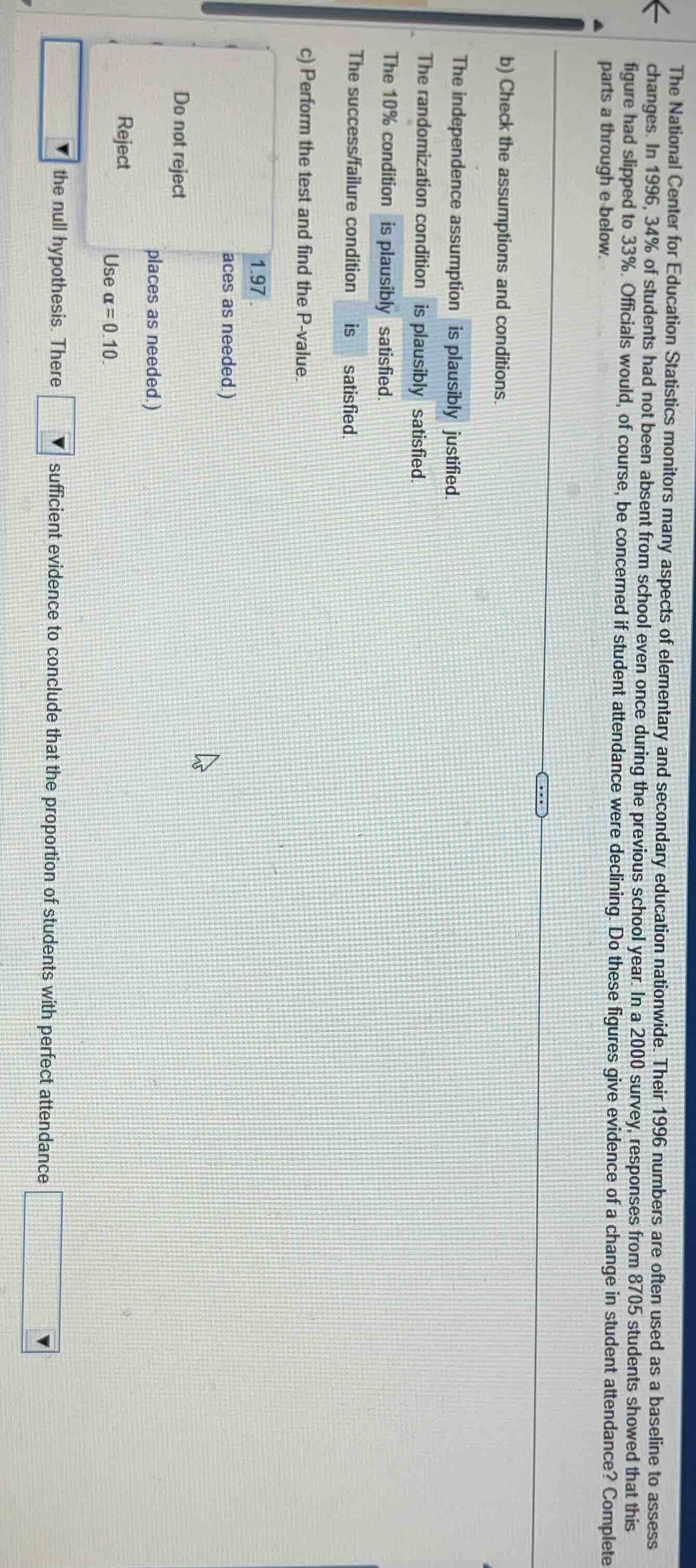
the national center for education statistics monitors many aspects of elementary and secondary education nationwide. their 1996 numbers are often used as a baseline to assess changes. in 1996, 34% of students had not been absent from school even once during the previous school year. in a 2000 survey, responses from 8705 students showed that this figure had slipped to 33%. officials would, of course, be concerned if student attendance were declining. do these figures give evidence of a change in student attendance? complete parts a through e below.
b) check the assumptions and conditions.
the independence assumption is plausibly justified.
the randomization condition is plausibly satisfied.
the 10% condition is plausibly satisfied.
the success/failure condition is satisfied.
c) perform the test and find the p - value.
1.97 (aces as needed)
places as needed)
use α = 0.10.
do not reject
reject
the null hypothesis. there
sufficient evidence to conclude that the proportion of students with perfect attendance
Step1: State hypotheses
Let $p$ = proportion of students with perfect attendance.
$H_0: p = 0.34$
$H_a: p
eq 0.34$
Step2: Calculate sample proportion
Sample proportion $\hat{p} = 0.33$, $n=8705$
$\hat{p} = 0.33$
Step3: Compute test statistic
Use z-test for proportion:
$$z = \frac{\hat{p} - p_0}{\sqrt{\frac{p_0(1-p_0)}{n}}}$$
$$z = \frac{0.33 - 0.34}{\sqrt{\frac{0.34(1-0.34)}{8705}}} = \frac{-0.01}{\sqrt{\frac{0.2244}{8705}}} \approx -1.97$$
Step4: Find P-value
Two-tailed test, so P-value = $2 \times P(Z < -1.97)$
From z-table, $P(Z < -1.97) = 0.0244$, so P-value = $2 \times 0.0244 = 0.0488$
Step5: Compare to α
$\alpha = 0.10$, P-value = 0.0488 < 0.10

Snap & solve any problem in the app
Get step-by-step solutions on Sovi AI
Photo-based solutions with guided steps
Explore more problems and detailed explanations
Reject the null hypothesis. There is sufficient evidence to conclude that the proportion of students with perfect attendance has changed.
P-value: 0.0488