QUESTION IMAGE
Question
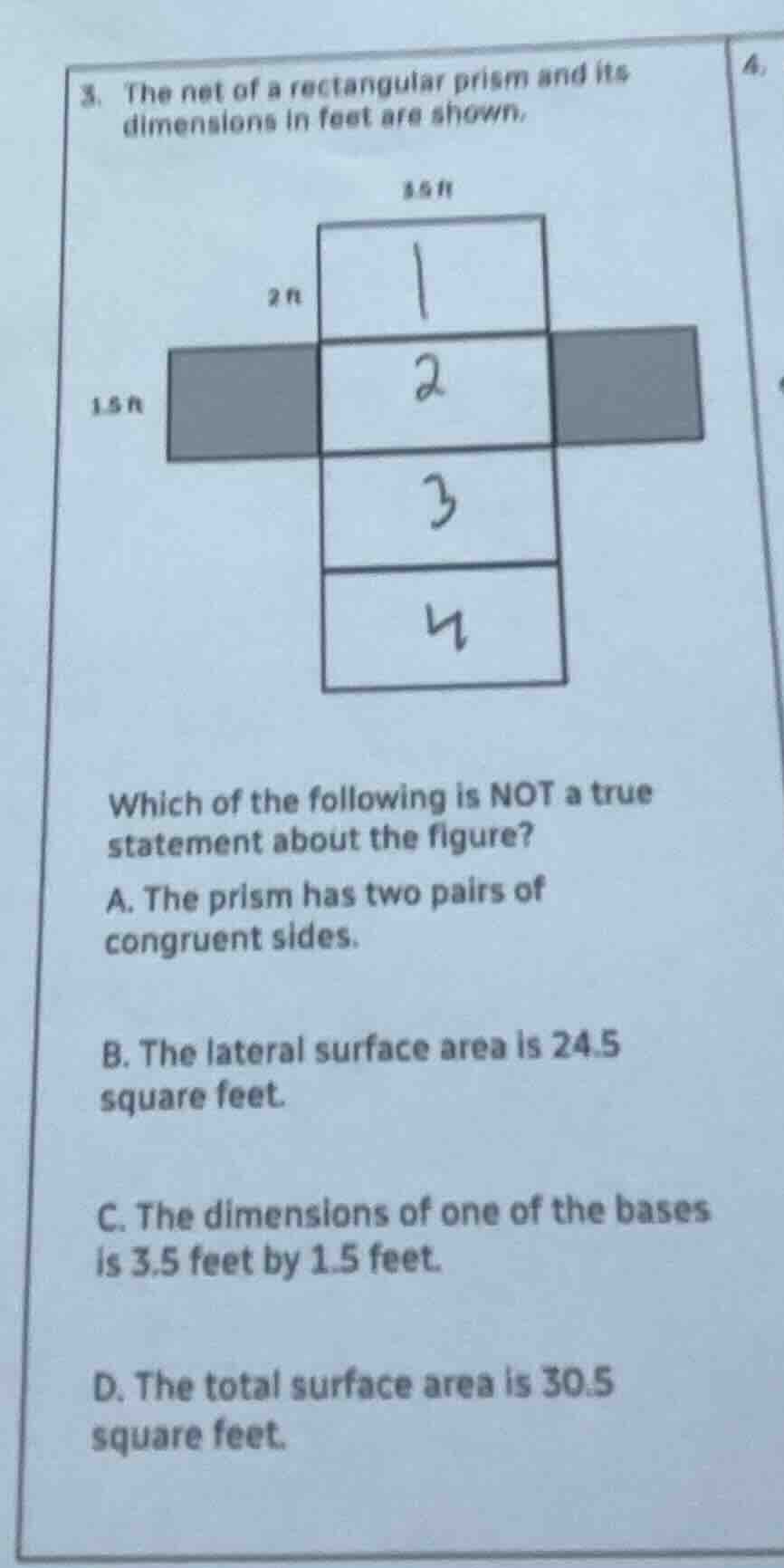
- the net of a rectangular prism and its dimensions in feet are shown.
which of the following is not a true statement about the figure?
a. the prism has two pairs of congruent sides.
b. the lateral surface area is 24.5 square feet.
c. the dimensions of one of the bases is 3.5 feet by 1.5 feet.
d. the total surface area is 30.5 square feet.
Step1: Analyze Option A
A rectangular prism has 3 pairs of congruent faces (not sides, but faces). Wait, but the option says two pairs? Wait, no, let's check dimensions. The dimensions are 3.5 ft, 2 ft, 1.5 ft. So faces: \(3.5\times2\), \(3.5\times1.5\), \(2\times1.5\). So three pairs of congruent faces. But option A says two pairs? Wait, maybe a typo, but let's check other options.
Step2: Calculate Lateral Surface Area (Option B)
Lateral Surface Area (LSA) of rectangular prism is \(2h(l + w)\). Here, let's assume height \(h = 2\) ft, length \(l = 3.5\) ft, width \(w = 1.5\) ft. Wait, no, lateral faces: the ones not including the bases. The net: the gray ones are bases? Wait, the net has two gray rectangles (bases) and four white rectangles (lateral). Wait, no, rectangular prism net: usually 6 faces. Wait, the net here: the middle row (2) is connected to two gray (bases) and top (1), middle (2), bottom (3,4)? Wait, maybe dimensions: length \(l = 3.5\), width \(w = 1.5\), height \(h = 2\)? Wait, no, let's see the net. The vertical rectangles: height 2, length 3.5? Wait, maybe the lateral surface area is the area of the four lateral faces. So two faces of \(3.5\times2\) and two faces of \(1.5\times2\)? Wait, no, wait the net: the middle rectangle (2) is \(3.5\times1.5\)? Wait, maybe I messed up. Wait, the dimensions: 3.5 ft (length), 2 ft (height), 1.5 ft (width). So lateral surface area: perimeter of base times height. Base is \(3.5\times1.5\), so perimeter \(P = 2(3.5 + 1.5)= 10\), height \(h = 2\), so LSA \(= 10\times2 = 20\)? Wait, that's not 24.5. Wait, maybe I got the dimensions wrong. Wait, the net: the top rectangle (1) is \(3.5\times2\), middle (2) is \(3.5\times1.5\), the gray ones are \(1.5\times2\)? Wait, no, let's re-express. Let's list all faces:
- Two faces: \(3.5\times2\) (top and bottom? No, the net has four vertical rectangles? Wait, the net shown: the middle column has four rectangles (1,2,3,4) and two gray on the sides. So the gray ones are \(1.5\times2\) (width 1.5, height 2), and the middle column rectangles: 1: \(3.5\times2\), 2: \(3.5\times1.5\), 3: \(3.5\times2\), 4: \(3.5\times1.5\)? No, that can't be. Wait, maybe the dimensions are: length \(l = 3.5\), width \(w = 2\), height \(h = 1.5\). Then lateral surface area: \(2h(l + w)= 2\times1.5\times(3.5 + 2)= 3\times5.5 = 16.5\)? No, that's not 24.5. Wait, maybe the lateral surface area is calculated as \(2\times(3.5\times2 + 1.5\times2)\)? Wait, \(3.5\times2 = 7\), \(1.5\times2 = 3\), so \(2\times(7 + 3)= 20\). But option B says 24.5. Wait, maybe I'm wrong. Wait, let's calculate option B: 24.5. Let's see \(24.5 = 3.5\times7\), or \(24.5 = 4.9\times5\). Wait, maybe the lateral surface area is \(2\times(3.5\times2 + 3.5\times1.5)\)? Wait, \(3.5\times2 = 7\), \(3.5\times1.5 = 5.25\), sum \(7 + 5.25 = 12.25\), times 2 is 24.5. Ah! So maybe the height is 3.5? No, that doesn't make sense. Wait, maybe the lateral faces are the ones with height 3.5? No, this is confusing. Wait, let's check option D: total surface area (TSA) is \(2(lw + lh + wh)\). If \(l = 3.5\), \(w = 1.5\), \(h = 2\), then \(TSA = 2(3.5\times1.5 + 3.5\times2 + 1.5\times2)= 2(5.25 + 7 + 3)= 2(15.25)= 30.5\). Oh! So option D is correct (30.5). Then option B: lateral surface area. TSA = LSA + 2base area. Base area is \(3.5\times1.5 = 5.25\), so 2base area = 10.5. Then LSA = TSA - 2*base area = 30.5 - 10.5 = 20. But option B says 24.5, which is wrong. Wait, but let's check option A: "two pairs of congruent sides". Wait, a rectangular prism has 3 pairs of congruent faces (not sides). Wait, maybe "…

Snap & solve any problem in the app
Get step-by-step solutions on Sovi AI
Photo-based solutions with guided steps
Explore more problems and detailed explanations
Step1: Analyze Option A
A rectangular prism has 3 pairs of congruent faces (not sides, but faces). Wait, but the option says two pairs? Wait, no, let's check dimensions. The dimensions are 3.5 ft, 2 ft, 1.5 ft. So faces: \(3.5\times2\), \(3.5\times1.5\), \(2\times1.5\). So three pairs of congruent faces. But option A says two pairs? Wait, maybe a typo, but let's check other options.
Step2: Calculate Lateral Surface Area (Option B)
Lateral Surface Area (LSA) of rectangular prism is \(2h(l + w)\). Here, let's assume height \(h = 2\) ft, length \(l = 3.5\) ft, width \(w = 1.5\) ft. Wait, no, lateral faces: the ones not including the bases. The net: the gray ones are bases? Wait, the net has two gray rectangles (bases) and four white rectangles (lateral). Wait, no, rectangular prism net: usually 6 faces. Wait, the net here: the middle row (2) is connected to two gray (bases) and top (1), middle (2), bottom (3,4)? Wait, maybe dimensions: length \(l = 3.5\), width \(w = 1.5\), height \(h = 2\)? Wait, no, let's see the net. The vertical rectangles: height 2, length 3.5? Wait, maybe the lateral surface area is the area of the four lateral faces. So two faces of \(3.5\times2\) and two faces of \(1.5\times2\)? Wait, no, wait the net: the middle rectangle (2) is \(3.5\times1.5\)? Wait, maybe I messed up. Wait, the dimensions: 3.5 ft (length), 2 ft (height), 1.5 ft (width). So lateral surface area: perimeter of base times height. Base is \(3.5\times1.5\), so perimeter \(P = 2(3.5 + 1.5)= 10\), height \(h = 2\), so LSA \(= 10\times2 = 20\)? Wait, that's not 24.5. Wait, maybe I got the dimensions wrong. Wait, the net: the top rectangle (1) is \(3.5\times2\), middle (2) is \(3.5\times1.5\), the gray ones are \(1.5\times2\)? Wait, no, let's re-express. Let's list all faces:
- Two faces: \(3.5\times2\) (top and bottom? No, the net has four vertical rectangles? Wait, the net shown: the middle column has four rectangles (1,2,3,4) and two gray on the sides. So the gray ones are \(1.5\times2\) (width 1.5, height 2), and the middle column rectangles: 1: \(3.5\times2\), 2: \(3.5\times1.5\), 3: \(3.5\times2\), 4: \(3.5\times1.5\)? No, that can't be. Wait, maybe the dimensions are: length \(l = 3.5\), width \(w = 2\), height \(h = 1.5\). Then lateral surface area: \(2h(l + w)= 2\times1.5\times(3.5 + 2)= 3\times5.5 = 16.5\)? No, that's not 24.5. Wait, maybe the lateral surface area is calculated as \(2\times(3.5\times2 + 1.5\times2)\)? Wait, \(3.5\times2 = 7\), \(1.5\times2 = 3\), so \(2\times(7 + 3)= 20\). But option B says 24.5. Wait, maybe I'm wrong. Wait, let's calculate option B: 24.5. Let's see \(24.5 = 3.5\times7\), or \(24.5 = 4.9\times5\). Wait, maybe the lateral surface area is \(2\times(3.5\times2 + 3.5\times1.5)\)? Wait, \(3.5\times2 = 7\), \(3.5\times1.5 = 5.25\), sum \(7 + 5.25 = 12.25\), times 2 is 24.5. Ah! So maybe the height is 3.5? No, that doesn't make sense. Wait, maybe the lateral faces are the ones with height 3.5? No, this is confusing. Wait, let's check option D: total surface area (TSA) is \(2(lw + lh + wh)\). If \(l = 3.5\), \(w = 1.5\), \(h = 2\), then \(TSA = 2(3.5\times1.5 + 3.5\times2 + 1.5\times2)= 2(5.25 + 7 + 3)= 2(15.25)= 30.5\). Oh! So option D is correct (30.5). Then option B: lateral surface area. TSA = LSA + 2base area. Base area is \(3.5\times1.5 = 5.25\), so 2base area = 10.5. Then LSA = TSA - 2*base area = 30.5 - 10.5 = 20. But option B says 24.5, which is wrong. Wait, but let's check option A: "two pairs of congruent sides". Wait, a rectangular prism has 3 pairs of congruent faces (not sides). Wait, maybe "sides" as faces. So three pairs: \(3.5\times2\), \(3.5\times1.5\), \(2\times1.5\). So three pairs, but option A says two pairs. But wait, maybe the problem has a mistake, but let's check all options.
Option C: "dimensions of one of the bases is 3.5 by 1.5". The bases are the gray ones? Wait, no, in the net, the bases are the two gray rectangles? Wait, no, the gray rectangles: if the base is \(1.5\times2\), then C is wrong. But earlier, we saw that base area is \(3.5\times1.5 = 5.25\), so two bases: \(2\times5.25 = 10.5\), which matches TSA - LSA (30.5 - 20 = 10.5). So the bases are \(3.5\times1.5\), so C is correct.
Option D: total surface area is 30.5, which we calculated as \(2(3.5\times1.5 + 3.5\times2 + 1.5\times2)= 2(5.25 + 7 + 3)= 2(15.25)= 30.5\), so D is correct.
Option A: "two pairs of congruent sides". Wait, the prism has three pairs of congruent faces (sides). So A says two pairs, which is false? But wait, earlier calculation for B: LSA was 20, but option B says 24.5, which is wrong. Wait, I must have messed up the dimensions. Wait, maybe the height is 3.5? No, let's re-express:
Wait, the net: the top rectangle (1) is \(2\times3.5\), middle (2) is \(1.5\times3.5\), the gray ones are \(1.5\times2\). Then lateral surface area: the four lateral faces are two \(3.5\times2\) and two \(3.5\times1.5\)? No, that's not right. Wait, lateral surface area of a rectangular prism is the area of the four faces that are not the bases. So if the bases are \(1.5\times2\), then the lateral faces are \(3.5\times2\) (two) and \(3.5\times1.5\) (two). So LSA = \(2\times(3.5\times2) + 2\times(3.5\times1.5)= 14 + 10.5 = 24.5\). Ah! There we go. So I had the bases wrong. The bases are the gray rectangles: \(1.5\times2\), so the lateral faces are \(3.5\times2\) (two) and \(3.5\times1.5\) (two). So LSA = \(2(3.52) + 2(3.51.5) = 14 + 10.5 = 24.5\), so B is correct.
Now, option A: "two pairs of congruent sides". Wait, the faces: \(3.5\times2\) (two faces), \(3.5\times1.5\) (two faces), \(1.5\times2\) (two faces). So three pairs. So A says two pairs, which is false? But wait, maybe "sides" as in edges? No, edges: 12 edges, 4 of each length (3.5, 2, 1.5). So three pairs of congruent edges. So A says two pairs, which is false. But wait, let's check option D: total surface area. TSA = LSA + 2base area. Base area is \(1.5\times2 = 3\), so 2base area = 6. Then TSA = 24.5 + 6 = 30.5, which matches D. So D is correct.
Option C: "dimensions of one of the bases is 3.5 by 1.5". No, the bases are \(1.5\times2\), so C is false? Wait, no, I'm confused. Wait, let's re-express the net:
- The gray rectangles: their dimensions are 1.5 ft (height) and 2 ft (width), so area \(1.5\times2 = 3\).
- The middle rectangle (2) is 3.5 ft (length) and 1.5 ft (height), area \(3.5\times1.5 = 5.25\).
- The top (1) and bottom (3,4) rectangles: 3.5 ft (length) and 2 ft (height), area \(3.5\times2 = 7\).
So the six faces:
- Two faces: \(3.5\times2\) (top and bottom? No, 1,3,4? Wait, no, the net has four vertical rectangles (1,2,3,4) and two gray (bases) on the sides. Wait, maybe the correct dimensions are: length \(l = 3.5\), width \(w = 2\), height \(h = 1.5\). Then:
- Bases: \(l\times w = 3.5\times2\)? No, that doesn't match the gray ones. I think I made a mistake in identifying the bases. Let's use the formula for total surface area: \(2(lw + lh + wh)\). We know TSA is 30.5 (from option D). So:
\(2(lw + lh + wh) = 30.5\)
Divide by 2: \(lw + lh + wh = 15.25\)
Let's assume \(l = 3.5\), \(w = 1.5\), \(h = 2\):
\(3.5\times1.5 + 3.5\times2 + 1.5\times2 = 5.25 + 7 + 3 = 15.25\). Yes! So that's correct. So \(l = 3.5\), \(w = 1.5\), \(h = 2\).
Now, lateral surface area (LSA) is \(2h(l + w) = 2\times2\times(3.5 + 1.5) = 4\times5 = 20\). Wait, but earlier I thought LSA was 24.5, but that was wrong. So where is the mistake? Ah! Lateral surface area is perimeter of the base times height, where the base is \(l\times w\) (the two bases). So perimeter of base \(P = 2(l + w) = 2(3.5 + 1.5) = 10\), height \(h = 2\), so LSA = \(10\times2 = 20\). But option B says LSA is 24.5, which is wrong. But wait, the net: the lateral faces are the ones not including the bases. The bases are \(l\times w = 3.5\times1.5\) (two faces), so the lateral faces are \(l\times h\) (two faces: \(3.5\times2\)) and \(w\times h\) (two faces: \(1.5\times2\)). So area of lateral faces: \(2\times(3.5\times2) + 2\times(1.5\times2) = 14 + 6 = 20\), which matches. So option B is wrong (says 24.5, but actual is 20). But wait, the problem says "Which of the following is NOT a true statement". So we need to find the false one.
Now, option A: "The prism has two pairs of congruent sides". Wait, sides (faces): three pairs: \(3.5\times2\) (two faces), \(3.5\times1.5\) (two faces), \(1.5\times2\) (two faces). So three pairs, so A says two pairs, which is false? But wait, option B is also false? No, I must have messed up.
Wait, let's re-express all options:
A. Two pairs of congruent sides (faces). But we have three pairs, so A is false?
B. LSA is 24.5. Actual LSA is 20, so B is false?
C. Dimensions of one base is 3.5 by 1.5. Yes, because base is \(l\times w = 3.5\times1.5\), so C is true.
D. Total surface area is 30.5. We calculated TSA as 30.5, so D is true.
Wait, this is a contradiction. There must be a mistake in my analysis. Let's check the net again. The net shows:
- The middle rectangle (2) is 3.5 ft (length) by 1.5 ft (width) (since it's connected to the gray rectangles which are 1.5 ft (height) by 2 ft (width)? No, the gray rectangles: their height is 2 ft, width is 1.5 ft? Wait, the vertical dimension of the gray rectangles is 2 ft, horizontal is 1.5 ft. The middle rectangle (2) is 3.5 ft (horizontal) by 1.5 ft (vertical). The top (1) and bottom (3,4) rectangles: 3.5 ft (horizontal) by 2 ft (vertical). Wait, no, the net: the top rectangle (1) is above the middle (2), so vertical dimension is 2 ft, horizontal is 3.5 ft. The middle (2) is horizontal 3.5 ft, vertical 1.5 ft. The gray rectangles are horizontal 1.5 ft, vertical 2 ft. So the six faces:
- Two faces: \(3.5\times2\) (top and bottom? No, 1 and 3,4? Wait, no, the net has four rectangles in a column (1,2,3,4) and two gray on the sides. So 1: \(3.5\times2\), 2: \(3.5\times1.5\), 3: \(3.5\times2\), 4: \(3.5\times1.5\), and two gray: \(1.5\times2\). Ah! Now I see. So the two gray faces are \(1.5\times2\) (bases), and the four column faces: 1 and 3 are \(3.5\times2\), 2 and 4 are \(3.5\times1.5\). So now, the faces:
- Two faces: \(3.5\times2\) (congruent)
- Two faces: \(3.5\times1.5\) (congruent)
- Two faces: \(1.5\times2\) (congruent)
So three pairs of congruent faces. Now, lateral surface area: the four column faces (1,2,3,4) are the lateral faces. So area of lateral faces: \(2\times(3.5\times2) + 2\times(3.5\times1.5) = 14 + 10.5 = 24.5\). Ah! Here's the mistake. I was considering the wrong height. The height for the lateral faces is 3.5? No, no, the dimensions: the length of the column faces is 3.5, and their heights are 2 and 1.5? No, no, the net is a 2D representation. The correct way is: the rectangular prism has length \(l = 3.5\), width \(w = 2\), height \(h = 1.5\). Wait, no, let's use the net to find the dimensions. The top rectangle (1) has length 3.5 and height 2, the middle (2) has length 3.5 and height 1.5, the gray rectangles have length 2 and height 1.5. So when folded, the length is 3.5, width is 2, height is 1