QUESTION IMAGE
Question
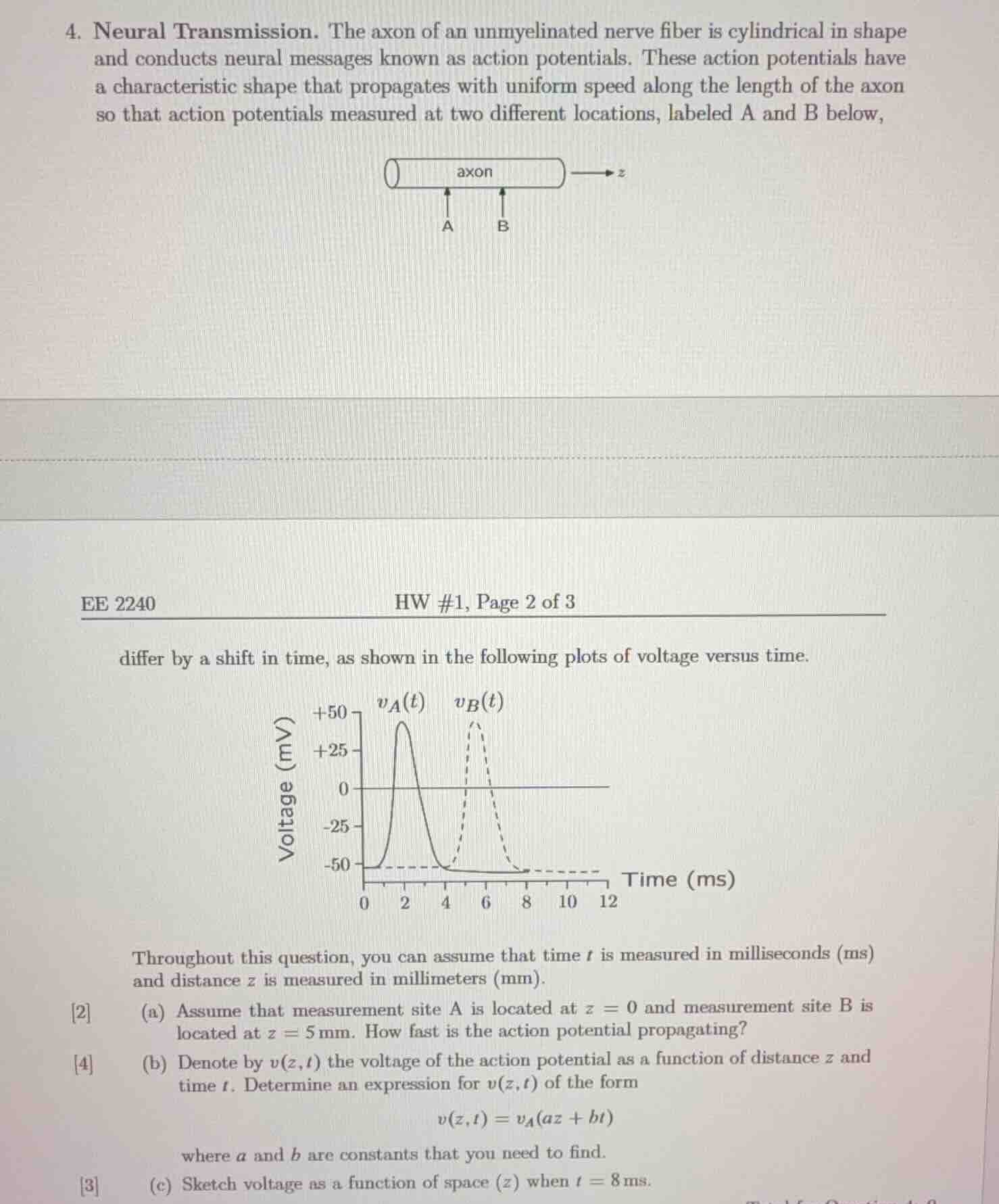
- neural transmission. the axon of an unmyelinated nerve fiber is cylindrical in shape and conducts neural messages known as action potentials. these action potentials have a characteristic shape that propagates with uniform speed along the length of the axon so that action potentials measured at two different locations, labeled a and b below,
ee 2240 hw #1, page 2 of 3
differ by a shift in time, as shown in the following plots of voltage versus time.
throughout this question, you can assume that time ( t ) is measured in milliseconds (ms) and distance ( z ) is measured in millimeters (mm).
2 (a) assume that measurement site a is located at ( z = 0 ) and measurement site b is located at ( z = 5 )mm. how fast is the action potential propagating?
4 (b) denote by ( v(z,t) ) the voltage of the action potential as a function of distance ( z ) and time ( t ). determine an expression for ( v(z,t) ) of the form v(z,t) = v_a(az + bt) where ( a ) and ( b ) are constants that you need to find.
3 (c) sketch voltage as a function of space (( z )) when ( t = 8 )ms.
Step1: Find time shift from plot
From the voltage-time plot, the peak of $v_A(t)$ is at $t=2$ ms, and the peak of $v_B(t)$ is at $t=6$ ms. The time shift $\Delta t = 6 - 2 = 4$ ms.
Step2: Calculate propagation speed
The distance between A and B is $\Delta z = 5$ mm. Speed $v = \frac{\Delta z}{\Delta t}$.
$v = \frac{5\ \text{mm}}{4\ \text{ms}} = 1.25\ \text{mm/ms}$
Step3: Find constant $a$ for $v(z,t)$
For the function $v(z,t)=v_A(az+bt)$, when the peak occurs, the argument of $v_A$ must equal 2 ms (the peak time of $v_A$). At $z=0, t=2$, $az+bt=2$; at $z=5, t=6$, $az+bt=2$. Substitute $z=5, t=6$: $5a + 6b = 2$. From the speed, the wave propagates in +z direction, so the argument has the form $-\frac{z}{v} + t$. Rewrite as $az+bt = -\frac{1}{1.25}z + t = -0.8z + t$. Thus $a = -0.8\ \text{mm}^{-1}$.
Step4: Find constant $b$ for $v(z,t)$
From the argument form, $b = 1\ \text{ms}^{-1}$. Verify with $5(-0.8) + 6(1) = -4 + 6 = 2$, which matches the peak condition.

Snap & solve any problem in the app
Get step-by-step solutions on Sovi AI
Photo-based solutions with guided steps
Explore more problems and detailed explanations
(a) $1.25\ \text{mm/ms}$
(b) $v(z,t) = v_A(-0.8z + t)$ where $a=-0.8\ \text{mm}^{-1}$ and $b=1\ \text{ms}^{-1}$
(c) When $t=8$ ms, $v(z,8)=v_A(-0.8z + 8)$. This is a spatial flip and shift of $v_A(t)$: the peak of $v(z,8)$ occurs when $-0.8z + 8 = 2$, so $z = \frac{8-2}{0.8}=7.5$ mm. The voltage will be a mirrored (left-right flipped) version of $v_A(t)$, with its peak at $z=7.5$ mm, decaying to -50 mV as $z$ moves away from 7.5 mm in either direction, matching the shape of the original $v_A(t)$ plot but along the z-axis.