QUESTION IMAGE
Question
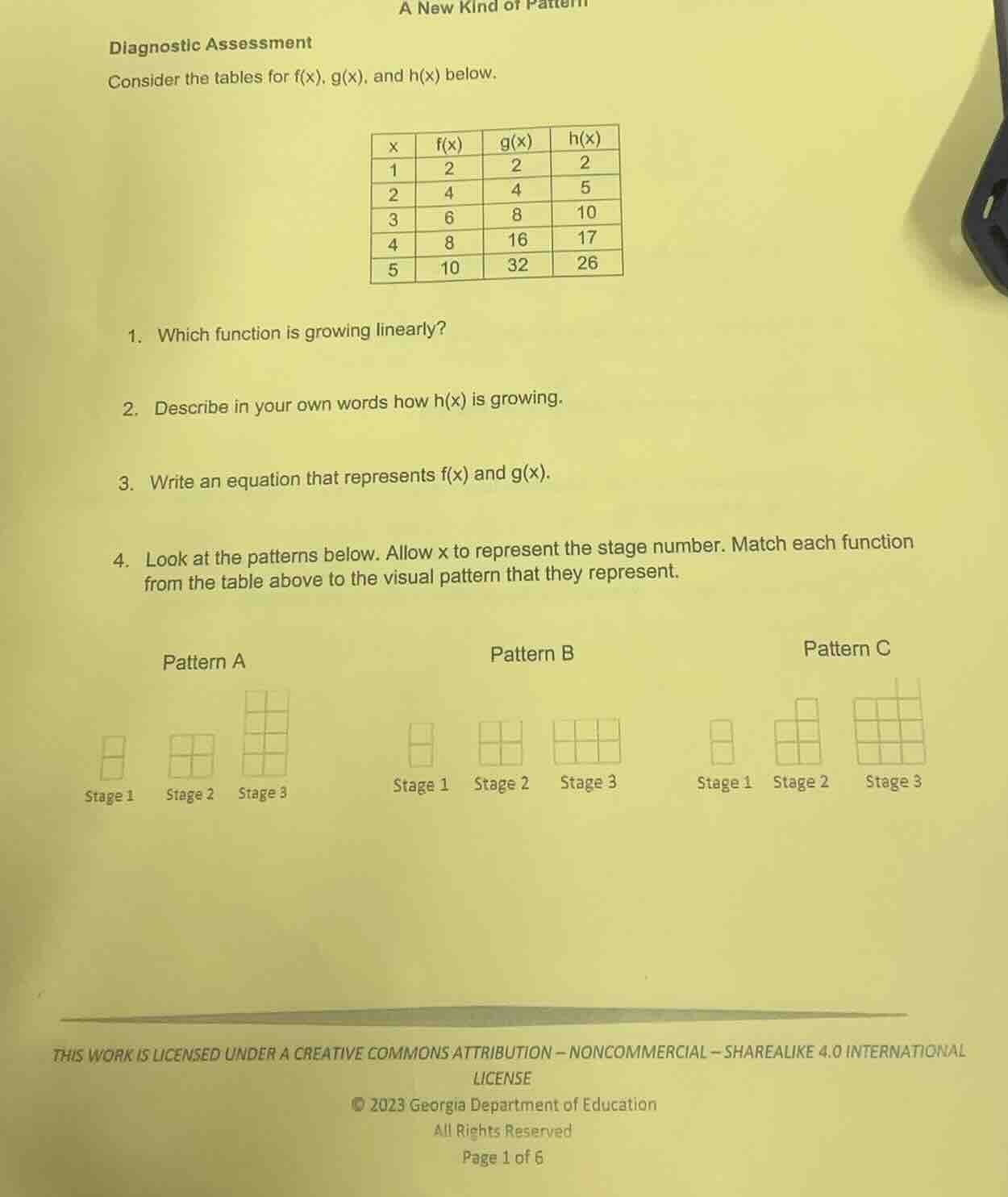
a new kind of patterndiagnostic assessmentconsider the tables for f(x), g(x), and h(x) below.| x | f(x) | g(x) | h(x) ||---|------|------|------|| 1 | 2 | 2 | 2 || 2 | 4 | 4 | 5 || 3 | 6 | 8 | 10 || 4 | 8 | 16 | 17 || 5 | 10 | 32 | 26 |1. which function is growing linearly?2. describe in your own words how h(x) is growing.3. write an equation that represents f(x) and g(x).4. look at the patterns below. allow x to represent the stage number. match each function from the table above to the visual pattern that they represent.pattern astage 1 stage 2 stage 3pattern bstage 1 stage 2 stage 3pattern cstage 1 stage 2 stage 3this work is licensed under a creative commons attribution - noncommercial - sharealike 4.0 international license© 2023 georgia department of educationall rights reservedpage 1 of 6
Step1: Identify linear growth (constant Δ)
Check $\Delta f(x)=f(x+1)-f(x)$:
$\Delta f(1)=4-2=2$, $\Delta f(2)=6-4=2$, $\Delta f(3)=8-6=2$, $\Delta f(4)=10-8=2$
Check $\Delta g(x)=g(x+1)-g(x)$:
$\Delta g(1)=4-2=2$, $\Delta g(2)=8-4=4$, $\Delta g(3)=16-8=8$, $\Delta g(4)=32-16=16$
Check $\Delta h(x)=h(x+1)-h(x)$:
$\Delta h(1)=5-2=3$, $\Delta h(2)=10-5=5$, $\Delta h(3)=17-10=7$, $\Delta h(4)=26-17=9$
Step2: Analyze h(x) growth pattern
Calculate differences of differences for h(x):
$5-3=2$, $7-5=2$, $9-7=2$
Step3: Derive f(x) linear equation
Linear form: $f(x)=mx+b$. $m=2$, $f(1)=2=2(1)+b \Rightarrow b=0$
Step4: Derive g(x) exponential equation
Exponential form: $g(x)=a(r)^x$. $g(1)=2=a(r)^1$, $g(2)=4=a(r)^2$. Divide: $r=2$, $a=1$
Step5: Match functions to visual patterns
Count shapes per stage:
Pattern A: Stage1=2, Stage2=4, Stage3=6 (matches linear f(x))
Pattern B: Stage1=2, Stage2=4, Stage3=8 (matches exponential g(x))
Pattern C: Stage1=2, Stage2=5, Stage3=10 (matches quadratic h(x))

Snap & solve any problem in the app
Get step-by-step solutions on Sovi AI
Photo-based solutions with guided steps
Explore more problems and detailed explanations
- $f(x)$ is growing linearly.
- $h(x)$ grows by increasing odd numbers (the difference between consecutive values increases by a constant 2 each time, which is quadratic growth).
- Equation for $f(x)$: $f(x)=2x$
Equation for $g(x)$: $g(x)=2^x$
- - $f(x)$ matches Pattern A
- $g(x)$ matches Pattern B
- $h(x)$ matches Pattern C