QUESTION IMAGE
Question
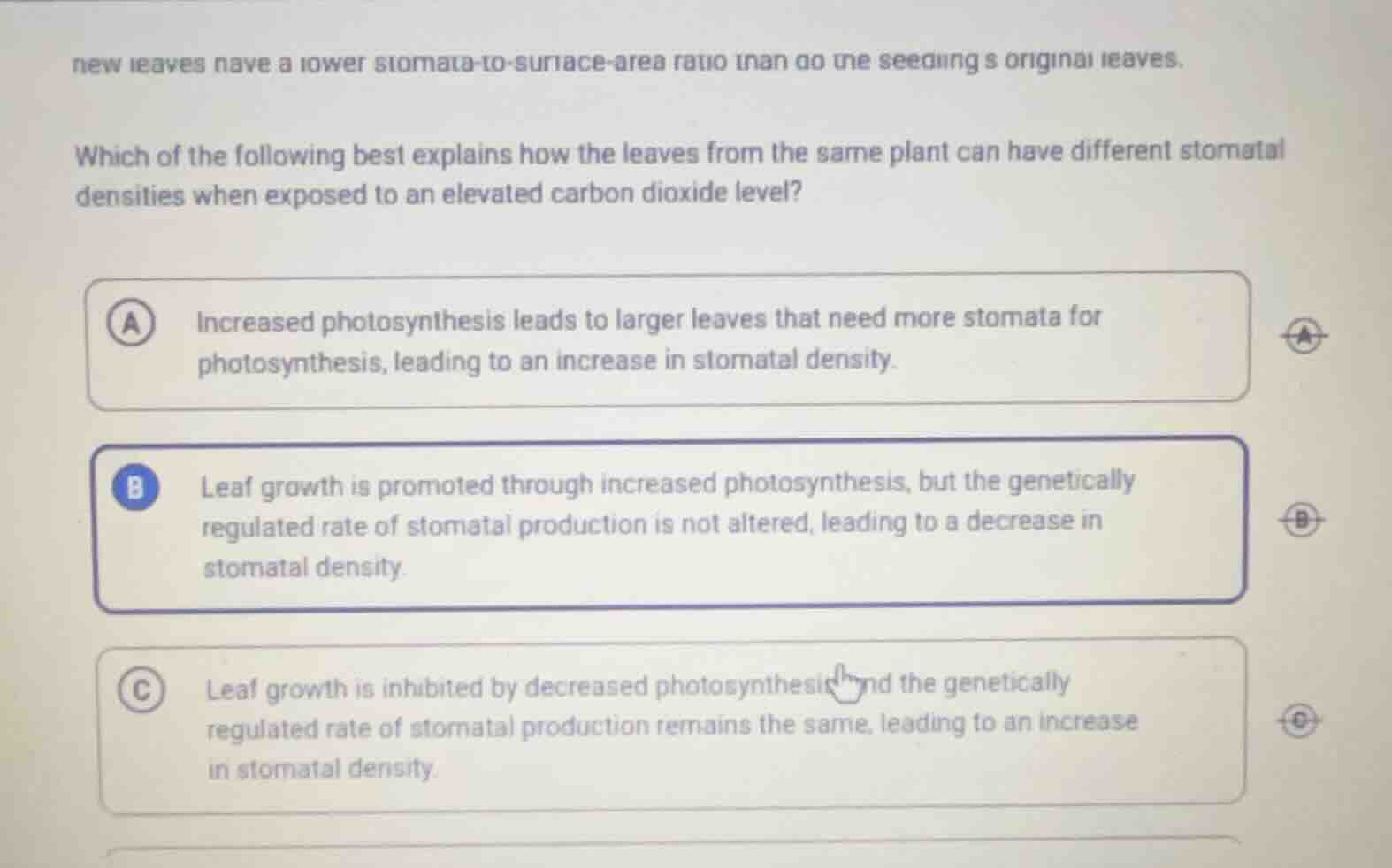
new leaves have a lower stomata - to - surface - area ratio than do the seedling’s original leaves.
which of the following best explains how the leaves from the same plant can have different stomatal densities when exposed to an elevated carbon dioxide level?
a increased photosynthesis leads to larger leaves that need more stomata for photosynthesis, leading to an increase in stomatal density.
b leaf growth is promoted through increased photosynthesis, but the genetically regulated rate of stomatal production is not altered, leading to a decrease in stomatal density.
c leaf growth is inhibited by decreased photosynthesis and the genetically regulated rate of stomatal production remains the same, leading to an increase in stomatal density.
- Option A: Elevated CO₂ increases photosynthesis, but if leaves get larger and need more stomata, stomatal density (stomata per area) wouldn't increase if the rate of stomatal production isn't adjusted for the larger area. So A is incorrect.
- Option B: Elevated CO₂ boosts photosynthesis, promoting leaf growth (larger leaf area). If the genetic rate of stomatal production (total stomata made) stays the same, then as the leaf area increases, the number of stomata per unit area (density) decreases. This matches the idea of different stomatal densities due to growth and unaltered stomatal production rate.
- Option C: Elevated CO₂ should increase, not decrease, photosynthesis, so the premise of inhibited leaf growth is wrong. Thus, C is incorrect.

Snap & solve any problem in the app
Get step-by-step solutions on Sovi AI
Photo-based solutions with guided steps
Explore more problems and detailed explanations
B. Leaf growth is promoted through increased photosynthesis, but the genetically regulated rate of stomatal production is not altered, leading to a decrease in stomatal density.