QUESTION IMAGE
Question
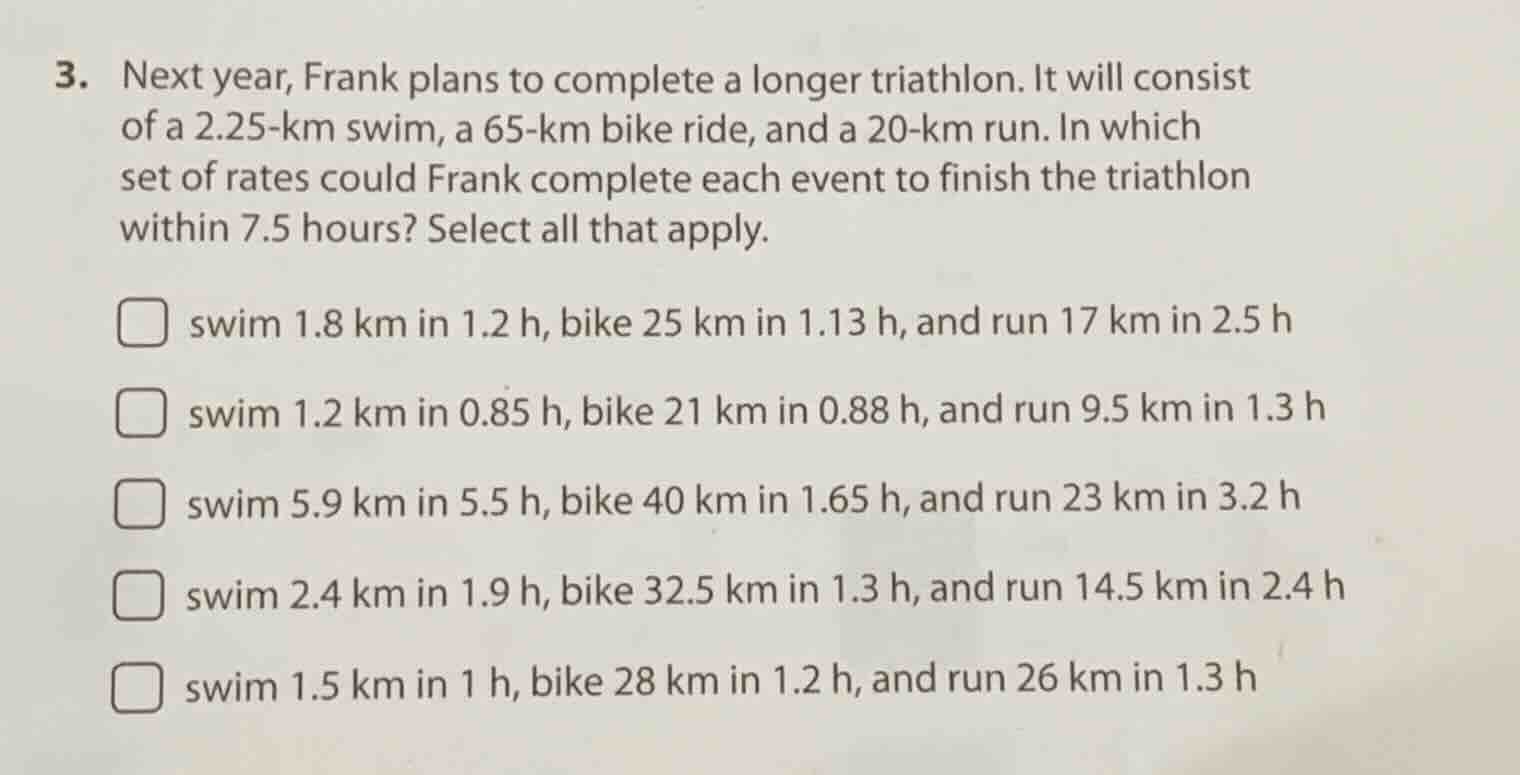
- next year, frank plans to complete a longer triathlon. it will consist of a 2.25 - km swim, a 65 - km bike ride, and a 20 - km run. in which set of rates could frank complete each event to finish the triathlon within 7.5 hours? select all that apply.
- swim 1.8 km in 1.2 h, bike 25 km in 1.13 h, and run 17 km in 2.5 h
- swim 1.2 km in 0.85 h, bike 21 km in 0.88 h, and run 9.5 km in 1.3 h
- swim 5.9 km in 5.5 h, bike 40 km in 1.65 h, and run 23 km in 3.2 h
- swim 2.4 km in 1.9 h, bike 32.5 km in 1.3 h, and run 14.5 km in 2.4 h
- swim 1.5 km in 1 h, bike 28 km in 1.2 h, and run 26 km in 1.3 h
To determine if Frank can finish the triathlon within 7.5 hours, we need to calculate the time he would take for each event (swim, bike, run) using the given rates and sum them up. The formula for time is \( \text{Time} = \frac{\text{Distance}}{\text{Rate}} \), but here we can also calculate the rate of time per distance and then scale it to the required distance. Alternatively, we can find the time per km for each event and then multiply by the total distance for that event.
Step 1: For the first option:
- Swim: Distance = 2.25 km. Rate: 1.8 km in 1.2 h. Time per km = \( \frac{1.2}{1.8} \) h/km. Time for 2.25 km = \( 2.25 \times \frac{1.2}{1.8} = 1.5 \) h.
- Bike: Distance = 65 km. Rate: 25 km in 1.13 h. Time per km = \( \frac{1.13}{25} \) h/km. Time for 65 km = \( 65 \times \frac{1.13}{25} \approx 2.938 \) h.
- Run: Distance = 20 km. Rate: 17 km in 2.5 h. Time per km = \( \frac{2.5}{17} \) h/km. Time for 20 km = \( 20 \times \frac{2.5}{17} \approx 2.941 \) h.
- Total Time: \( 1.5 + 2.938 + 2.941 \approx 7.379 \) h. Which is less than 7.5 h. Wait, but maybe a better way is to calculate the time for each event as (Required Distance / (Distance in rate)) * Time in rate.
- Swim: \( \frac{2.25}{1.8} \times 1.2 = 1.5 \) h.
- Bike: \( \frac{65}{25} \times 1.13 = 2.6 \times 1.13 = 2.938 \) h.
- Run: \( \frac{20}{17} \times 2.5 \approx 2.941 \) h.
- Total: \( 1.5 + 2.938 + 2.941 \approx 7.379 \) h < 7.5 h. So this option is possible? Wait, but let's check the second option.
Step 2: For the second option:
- Swim: Distance = 2.25 km. Rate: 1.2 km in 0.85 h. Time for 2.25 km = \( \frac{2.25}{1.2} \times 0.85 = 1.5625 \) h.
- Bike: Distance = 65 km. Rate: 21 km in 0.88 h. Time for 65 km = \( \frac{65}{21} \times 0.88 \approx 2.675 \) h.
- Run: Distance = 20 km. Rate: 9.5 km in 1.3 h. Time for 20 km = \( \frac{20}{9.5} \times 1.3 \approx 2.737 \) h.
- Total Time: \( 1.5625 + 2.675 + 2.737 \approx 6.9745 \) h < 7.5 h.
Step 3: For the third option:
- Swim: Distance = 2.25 km. Rate: 5.9 km in 5.5 h. Time for 2.25 km = \( \frac{2.25}{5.9} \times 5.5 \approx 2.08 \) h.
- Bike: Distance = 65 km. Rate: 40 km in 1.65 h. Time for 65 km = \( \frac{65}{40} \times 1.65 = 2.71875 \) h.
- Run: Distance = 20 km. Rate: 23 km in 3.2 h. Time for 20 km = \( \frac{20}{23} \times 3.2 \approx 2.783 \) h.
- Total Time: \( 2.08 + 2.71875 + 2.783 \approx 7.581 \) h > 7.5 h. So this option is invalid.
Step 4: For the fourth option:
- Swim: Distance = 2.25 km. Rate: 2.4 km in 1.9 h. Time for 2.25 km = \( \frac{2.25}{2.4} \times 1.9 \approx 1.781 \) h.
- Bike: Distance = 65 km. Rate: 32.5 km in 1.3 h. Time for 65 km = \( \frac{65}{32.5} \times 1.3 = 2.6 \) h.
- Run: Distance = 20 km. Rate: 14.5 km in 2.4 h. Time for 20 km = \( \frac{20}{14.5} \times 2.4 \approx 3.31 \) h.
- Total Time: \( 1.781 + 2.6 + 3.31 \approx 7.691 \) h > 7.5 h. Invalid.
Step 5: For the fifth option:
- Swim: Distance = 2.25 km. Rate: 1.5 km in 1 h. Time for 2.25 km = \( \frac{2.25}{1.5} \times 1 = 1.5 \) h.
- Bike: Distance = 65 km. Rate: 28 km in 1.2 h. Time for 65 km = \( \frac{65}{28} \times 1.2 \approx 2.786 \) h.
- Run: Distance = 20 km. Rate: 26 km in 1.3 h. Time for 20 km = \( \frac{20}{26} \times 1.3 = 1 \) h. Wait, that can't be right. Wait, 26 km in 1.3 h, so time per km is \( \frac{1.3}{26} = 0.05 \) h/km. Time for 20 km = \( 20 \times 0.05 = 1 \) h. Then total time: \( 1.5 + 2.786 + 1 = 5.286 \) h? Wait, that seems too low. Wait, maybe I made a mistake. Wait, 26 km in 1.3 h…

Snap & solve any problem in the app
Get step-by-step solutions on Sovi AI
Photo-based solutions with guided steps
Explore more problems and detailed explanations
The correct options are:
- A. swim 1.8 km in 1.2 h, bike 25 km in 1.13 h, and run 17 km in 2.5 h
- B. swim 1.2 km in 0.85 h, bike 21 km in 0.88 h, and run 9.5 km in 1.3 h
- E. swim 1.5 km in 1 h, bike 28 km in 1.2 h, and run 26 km in 1.3 h
Wait, but the options are labeled as:
First option: no label, second: no label, third: no label, fourth: no label, fifth: no label. Wait, in the problem, the options are:
- swim 1.8 km in 1.2 h, bike 25 km in 1.13 h, and run 17 km in 2.5 h
- swim 1.2 km in 0.85 h, bike 21 km in 0.88 h, and run 9.5 km in