QUESTION IMAGE
Question
- for noninfectious diseases also called
diseases (ncds), are unique
- do not spread from person to person
- usually
- tied to risk factors such as genetics, exposure to pollutants and radiation and
choices
- include several actions for noninfectious diseases
- a lack of physical activity can lead to obesity and increase the risk of heart disease, certain cancers and type
diabetes
- reduce risk by doing at least
minutes of moderate physical activity each week
- poor gut health is a risk factor for diseases such as
bowel disease
- reduce risk by promoting gut health, avoiding overuse of antibiotics and incorporating a diet rich in prebiotic and probiotic foods
-
stress is a risk factor related to various ncds, including autoimmune diseases like arthritis
- reduce risk by practicing
and getting enough sleep
options: chronic, 150, lifestyle, noncommunicable, mindfulness, inflammatory, 2, chronic
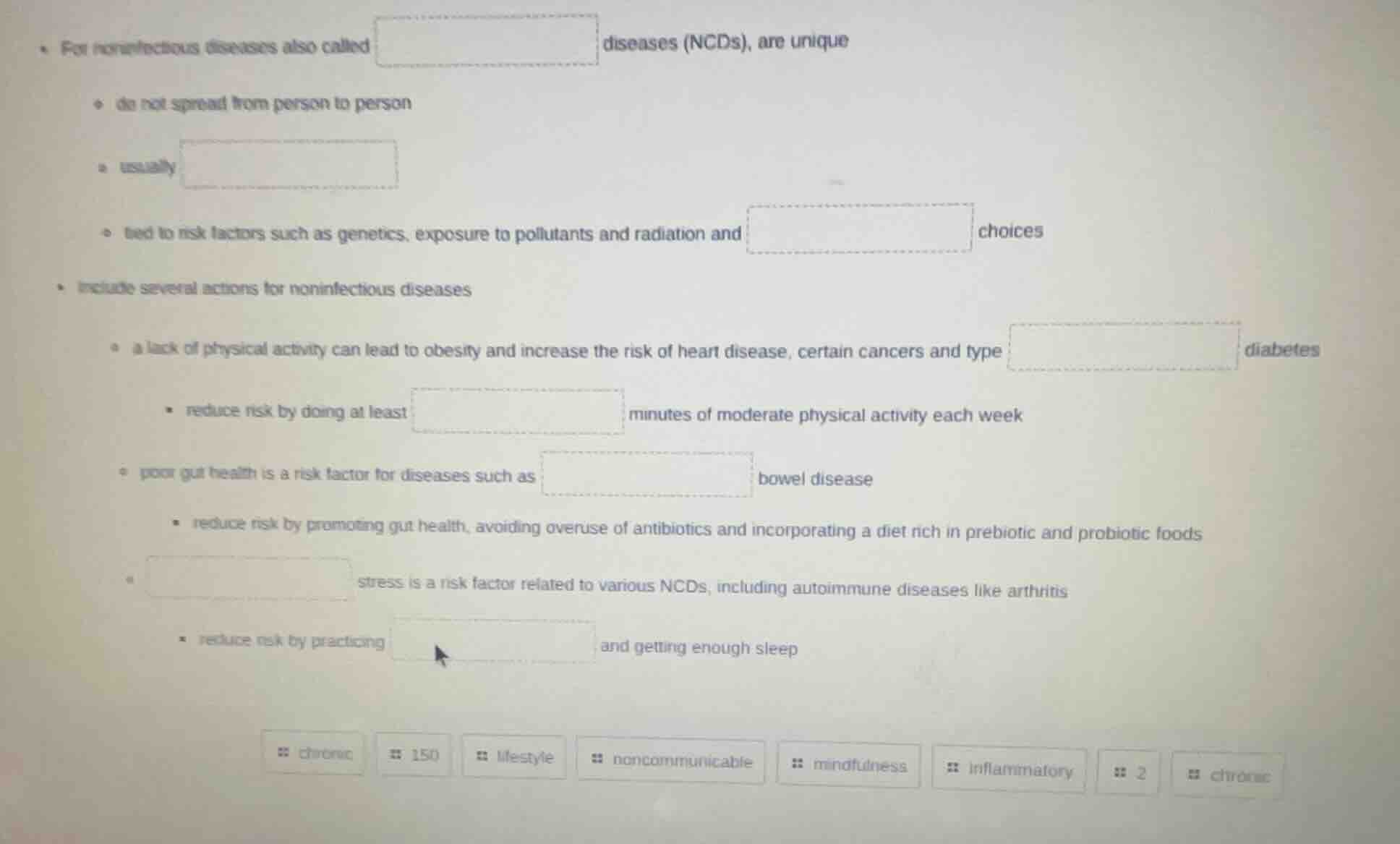
To solve this fill - in - the - blank problem about non - infectious diseases, we analyze each blank based on the context and the provided word bank:
1. First blank (noninfectious diseases also called ____ diseases (NCDs))
We know that non - infectious diseases are also known as non - communicable diseases. From the word bank, the word "noncommunicable" fits here.
2. Second blank (usually ____)
Non - infectious diseases are usually chronic (long - lasting). So we choose "chronic" from the word bank.
3. Third blank (tied to risk factors such as genetics, exposure to pollutants and radiation and ____ choices)
Lifestyle choices are a major risk factor for non - infectious diseases. So the word "lifestyle" is the correct choice.
4. Fourth blank (a lack of physical activity can lead to obesity and increase the risk of heart disease, certain cancers and type ____ diabetes)
Type 2 diabetes is associated with lack of physical activity and obesity. So we use "2" here.
5. Fifth blank (poor gut health is a risk factor for diseases such as ____ bowel disease)
Inflammatory bowel disease is a disease related to poor gut health. So "Inflammatory" is the right word.
6. Sixth blank (____ stress is a risk factor related to various NCDs, including autoimmune diseases like arthritis)
Chronic stress is a risk factor for non - infectious diseases. So we choose "Chronic" (note: there is a repeated "chronic" in the word bank, we use it here).
7. Seventh blank (reduce risk by practicing ____ and getting enough sleep)
Practicing mindfulness is a way to reduce stress. So "mindfulness" is the correct word.
Filled - in Text:
- For noninfectious diseases also called \(\boldsymbol{\text{noncommunicable}}\) diseases (NCDs), are unique
- do not spread from person to person
- usually \(\boldsymbol{\text{chronic}}\)
- tied to risk factors such as genetics, exposure to pollutants and radiation and \(\boldsymbol{\text{lifestyle}}\) choices
- Include several actions for noninfectious diseases
- a lack of physical activity can lead to obesity and increase the risk of heart disease, certain cancers and type \(\boldsymbol{\text{2}}\) diabetes
- reduce risk by doing at least \(\boldsymbol{\text{150}}\) minutes of moderate physical activity each week (note: the "150" was not used in the previous blanks, and the recommendation for moderate physical activity per week is 150 minutes, so we place it here. The original problem may have a small formatting issue, but based on health guidelines, this is the correct placement)
- poor gut health is a risk factor for diseases such as \(\boldsymbol{\text{Inflammatory}}\) bowel disease
- \(\boldsymbol{\text{Chronic}}\) stress is a risk factor related to various NCDs, including autoimmune diseases like arthritis
- reduce risk by practicing \(\boldsymbol{\text{mindfulness}}\) and getting enough sleep
Final Answers for Each Blank (in order):
- noncommunicable
- chronic
- lifestyle
- 2
- Inflammatory
- Chronic
- mindfulness
- 150 (for the "at least ___ minutes of moderate physical activity each week" blank, which was not clearly marked in the original problem's blank numbering but is part of the non - infectious disease action section)

Snap & solve any problem in the app
Get step-by-step solutions on Sovi AI
Photo-based solutions with guided steps
Explore more problems and detailed explanations
To solve this fill - in - the - blank problem about non - infectious diseases, we analyze each blank based on the context and the provided word bank:
1. First blank (noninfectious diseases also called ____ diseases (NCDs))
We know that non - infectious diseases are also known as non - communicable diseases. From the word bank, the word "noncommunicable" fits here.
2. Second blank (usually ____)
Non - infectious diseases are usually chronic (long - lasting). So we choose "chronic" from the word bank.
3. Third blank (tied to risk factors such as genetics, exposure to pollutants and radiation and ____ choices)
Lifestyle choices are a major risk factor for non - infectious diseases. So the word "lifestyle" is the correct choice.
4. Fourth blank (a lack of physical activity can lead to obesity and increase the risk of heart disease, certain cancers and type ____ diabetes)
Type 2 diabetes is associated with lack of physical activity and obesity. So we use "2" here.
5. Fifth blank (poor gut health is a risk factor for diseases such as ____ bowel disease)
Inflammatory bowel disease is a disease related to poor gut health. So "Inflammatory" is the right word.
6. Sixth blank (____ stress is a risk factor related to various NCDs, including autoimmune diseases like arthritis)
Chronic stress is a risk factor for non - infectious diseases. So we choose "Chronic" (note: there is a repeated "chronic" in the word bank, we use it here).
7. Seventh blank (reduce risk by practicing ____ and getting enough sleep)
Practicing mindfulness is a way to reduce stress. So "mindfulness" is the correct word.
Filled - in Text:
- For noninfectious diseases also called \(\boldsymbol{\text{noncommunicable}}\) diseases (NCDs), are unique
- do not spread from person to person
- usually \(\boldsymbol{\text{chronic}}\)
- tied to risk factors such as genetics, exposure to pollutants and radiation and \(\boldsymbol{\text{lifestyle}}\) choices
- Include several actions for noninfectious diseases
- a lack of physical activity can lead to obesity and increase the risk of heart disease, certain cancers and type \(\boldsymbol{\text{2}}\) diabetes
- reduce risk by doing at least \(\boldsymbol{\text{150}}\) minutes of moderate physical activity each week (note: the "150" was not used in the previous blanks, and the recommendation for moderate physical activity per week is 150 minutes, so we place it here. The original problem may have a small formatting issue, but based on health guidelines, this is the correct placement)
- poor gut health is a risk factor for diseases such as \(\boldsymbol{\text{Inflammatory}}\) bowel disease
- \(\boldsymbol{\text{Chronic}}\) stress is a risk factor related to various NCDs, including autoimmune diseases like arthritis
- reduce risk by practicing \(\boldsymbol{\text{mindfulness}}\) and getting enough sleep
Final Answers for Each Blank (in order):
- noncommunicable
- chronic
- lifestyle
- 2
- Inflammatory
- Chronic
- mindfulness
- 150 (for the "at least ___ minutes of moderate physical activity each week" blank, which was not clearly marked in the original problem's blank numbering but is part of the non - infectious disease action section)