QUESTION IMAGE
Question
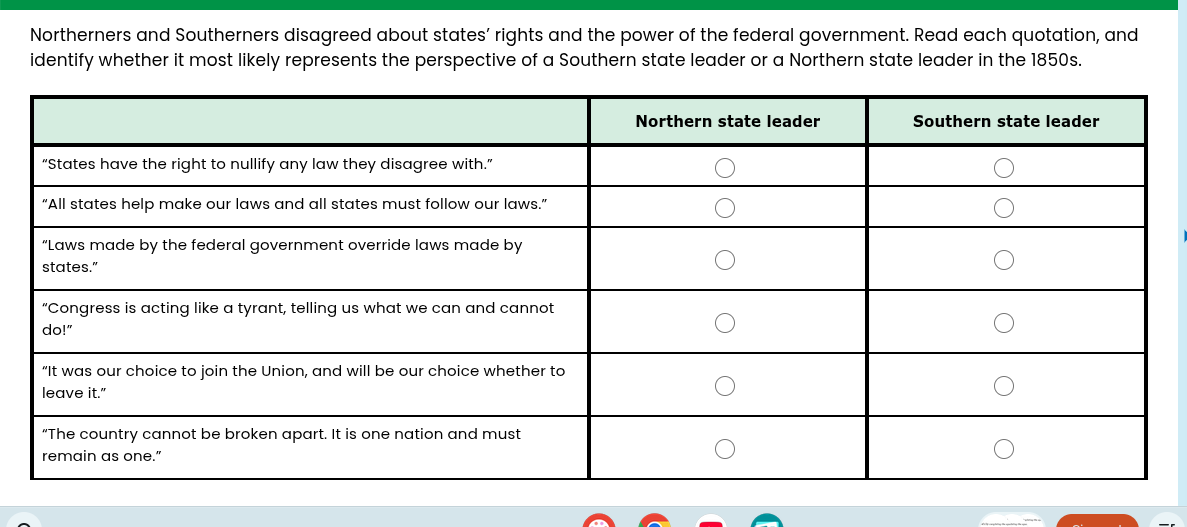
northerners and southerners disagreed about states’ rights and the power of the federal government. read each quotation, and identify whether it most likely represents the perspective of a southern state leader or a northern state leader in the 1850s.
\states have the right to nullify any law they disagree with.\
\all states help make our laws and all states must follow our laws.\
\laws made by the federal government override laws made by states.\
\congress is acting like a tyrant, telling us what we can and cannot do!\
\it was our choice to join the union, and will be our choice whether to leave it.\
\the country cannot be broken apart. it is one nation and must remain as one.\
To solve this, we analyze each quote based on the historical perspectives of Northern (federal power, union) and Southern (states' rights, potential secession) leaders in the 1850s:
1. “States have the right to nullify any law they disagree with.”
- Southern leaders emphasized states’ rights, including nullification (the idea states could reject federal laws). Northern leaders supported federal authority.
- Southern state leader (circle the Southern column for this row).
2. “All states help make our laws and all states must follow our laws.”
- Northern leaders believed in federal law supremacy and that all states (as part of the Union) must follow federal laws made collectively. Southern leaders resisted this.
- Northern state leader (circle the Northern column for this row).
3. “Laws made by the federal government override laws made by states.”
- This reflects the Northern view of federal law supremacy (e.g., the Supremacy Clause of the Constitution). Southern leaders rejected this in favor of states’ rights.
- Northern state leader (circle the Northern column for this row).
4. “Congress is acting like a tyrant, telling us what we can and cannot do!”
- Southern leaders often viewed federal actions (like Congress passing laws on slavery or trade) as tyrannical overreach of states’ rights. Northern leaders saw federal action as legitimate.
- Southern state leader (circle the Southern column for this row).
5. “It was our choice to join the Union, and will be our choice whether to leave it.”
- Southern leaders argued states voluntarily joined the Union and could voluntarily secede (a key precursor to the Civil War). Northern leaders believed the Union was perpetual.
- Southern state leader (circle the Southern column for this row).
6. “The country cannot be broken apart. It is one nation and must remain as one.”
- Northern leaders (and many Unionists) emphasized the Union was indissoluble and the country was a single nation. Southern leaders advocated for states’ right to secede.
- Northern state leader (circle the Northern column for this row).
Final Answers (for each row, circle the appropriate column):
- Southern state leader
- Northern state leader
- Northern state leader
- Southern state leader
- Southern state leader
- Northern state leader
(Visually, for each row, mark the circle in the column corresponding to the above conclusions.)

Snap & solve any problem in the app
Get step-by-step solutions on Sovi AI
Photo-based solutions with guided steps
Explore more problems and detailed explanations
To solve this, we analyze each quote based on the historical perspectives of Northern (federal power, union) and Southern (states' rights, potential secession) leaders in the 1850s:
1. “States have the right to nullify any law they disagree with.”
- Southern leaders emphasized states’ rights, including nullification (the idea states could reject federal laws). Northern leaders supported federal authority.
- Southern state leader (circle the Southern column for this row).
2. “All states help make our laws and all states must follow our laws.”
- Northern leaders believed in federal law supremacy and that all states (as part of the Union) must follow federal laws made collectively. Southern leaders resisted this.
- Northern state leader (circle the Northern column for this row).
3. “Laws made by the federal government override laws made by states.”
- This reflects the Northern view of federal law supremacy (e.g., the Supremacy Clause of the Constitution). Southern leaders rejected this in favor of states’ rights.
- Northern state leader (circle the Northern column for this row).
4. “Congress is acting like a tyrant, telling us what we can and cannot do!”
- Southern leaders often viewed federal actions (like Congress passing laws on slavery or trade) as tyrannical overreach of states’ rights. Northern leaders saw federal action as legitimate.
- Southern state leader (circle the Southern column for this row).
5. “It was our choice to join the Union, and will be our choice whether to leave it.”
- Southern leaders argued states voluntarily joined the Union and could voluntarily secede (a key precursor to the Civil War). Northern leaders believed the Union was perpetual.
- Southern state leader (circle the Southern column for this row).
6. “The country cannot be broken apart. It is one nation and must remain as one.”
- Northern leaders (and many Unionists) emphasized the Union was indissoluble and the country was a single nation. Southern leaders advocated for states’ right to secede.
- Northern state leader (circle the Northern column for this row).
Final Answers (for each row, circle the appropriate column):
- Southern state leader
- Northern state leader
- Northern state leader
- Southern state leader
- Southern state leader
- Northern state leader
(Visually, for each row, mark the circle in the column corresponding to the above conclusions.)