QUESTION IMAGE
Question
note: the quizzes make use of the standard normal table and t - table which have been provided within the content sections and posted in the tables module. it does not use the more exact values which may be obtained from an internet calculator. please use the tables to obtain z - values and t - values as you take your quizzes and tests in this course.
this quiz is due on sunday before midnight.
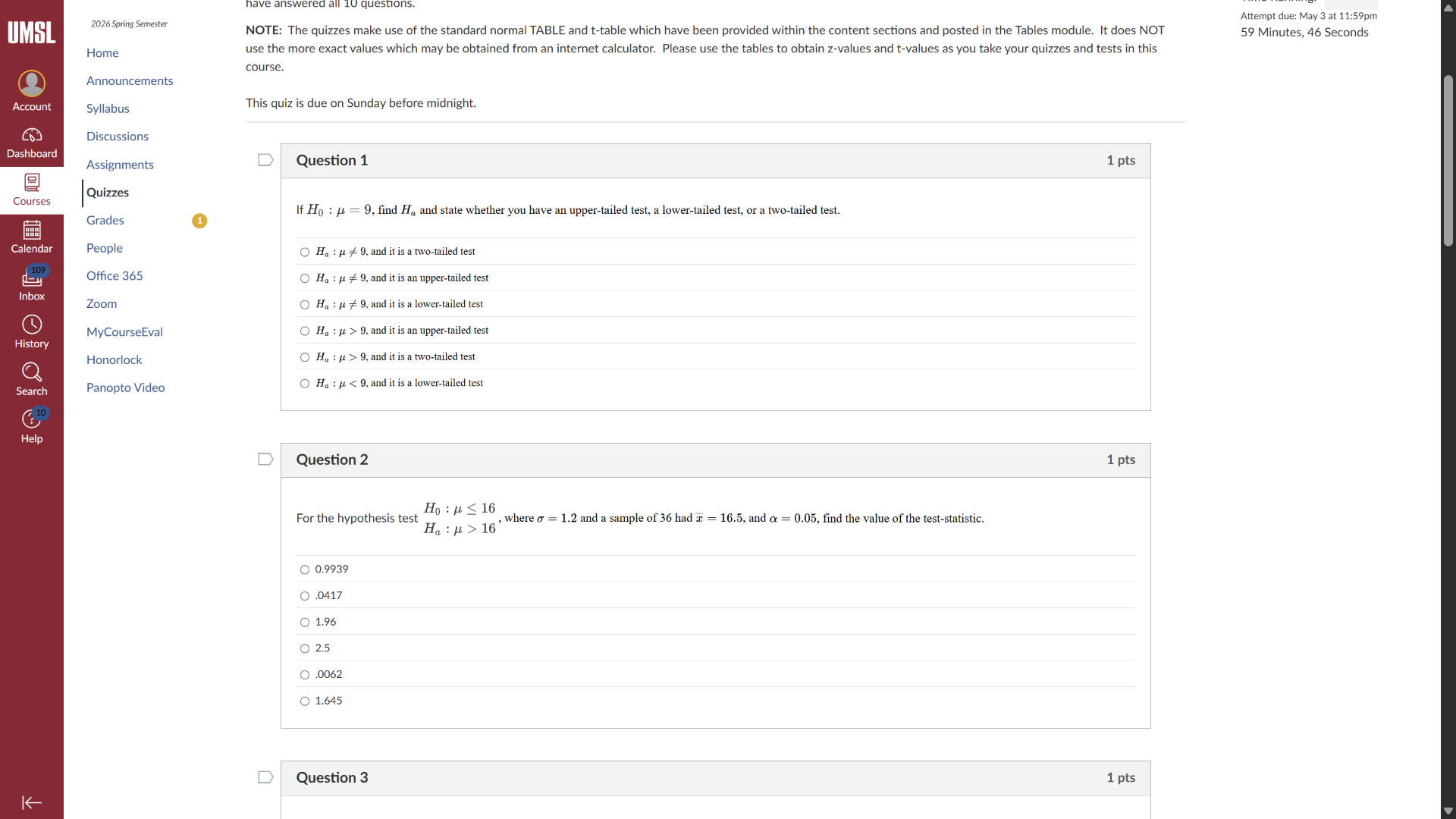
question 1
1 pts
if ( h_0:mu = 9 ), find ( h_a ) and state whether you have an upper - tailed test, a lower - tailed test, or a two - tailed test.
( h_a:mu
eq9 ), and it is a two - tailed test
( h_a:mu
eq9 ), and it is an upper - tailed test
( h_a:mu
eq9 ), and it is a lower - tailed test
( h_a:mu > 9 ), and it is an upper - tailed test
( h_a:mu > 9 ), and it is a two - tailed test
( h_a:mu < 9 ), and it is a lower - tailed test
question 2
1 pts
for the hypothesis test ( \begin{cases}h_0:muleq16\\h_a:mu > 16end{cases} ), where ( sigma = 1.2 ) and a sample of 36 had ( \bar{x}=16.5 ), and ( alpha = 0.05 ), find the value of the test - statistic.
0.9939
.0417
1.96
2.5
.0062
1.645
question 3
1 pts
Question 1
In hypothesis testing, the alternative hypothesis \( H_a \) is what we test against the null hypothesis \( H_0 \). When \( H_0: \mu = 9 \), the common alternative for a two - tailed test is \( H_a: \mu
eq9 \), as it tests if the mean is different (either greater or less) from 9. Upper - tailed is for \( \mu>9 \), lower - tailed for \( \mu < 9 \). So \( H_a:\mu
eq9 \) is two - tailed.
Step 1: Recall the z - test statistic formula for a single - sample mean
The formula for the z - test statistic when the population standard deviation \( \sigma \) is known is \( z=\frac{\bar{x}-\mu}{\frac{\sigma}{\sqrt{n}}} \), where \( \bar{x} \) is the sample mean, \( \mu \) is the population mean under the null hypothesis, \( \sigma \) is the population standard deviation, and \( n \) is the sample size.
Step 2: Identify the values
We have \( \bar{x} = 16.5 \), \( \mu = 16 \) (from \( H_0:\mu\leq16 \), we use \( \mu = 16 \) for the test), \( \sigma=1.2 \), and \( n = 36 \).
Step 3: Substitute the values into the formula
First, calculate the denominator \( \frac{\sigma}{\sqrt{n}}=\frac{1.2}{\sqrt{36}}=\frac{1.2}{6}=0.2 \).
Then, calculate the numerator \( \bar{x}-\mu=16.5 - 16 = 0.5 \).
Now, calculate the z - statistic \( z=\frac{0.5}{0.2}=2.5 \).

Snap & solve any problem in the app
Get step-by-step solutions on Sovi AI
Photo-based solutions with guided steps
Explore more problems and detailed explanations
A. \( H_{a}:\mu
eq9 \), and it is a two - tailed test