QUESTION IMAGE
Question
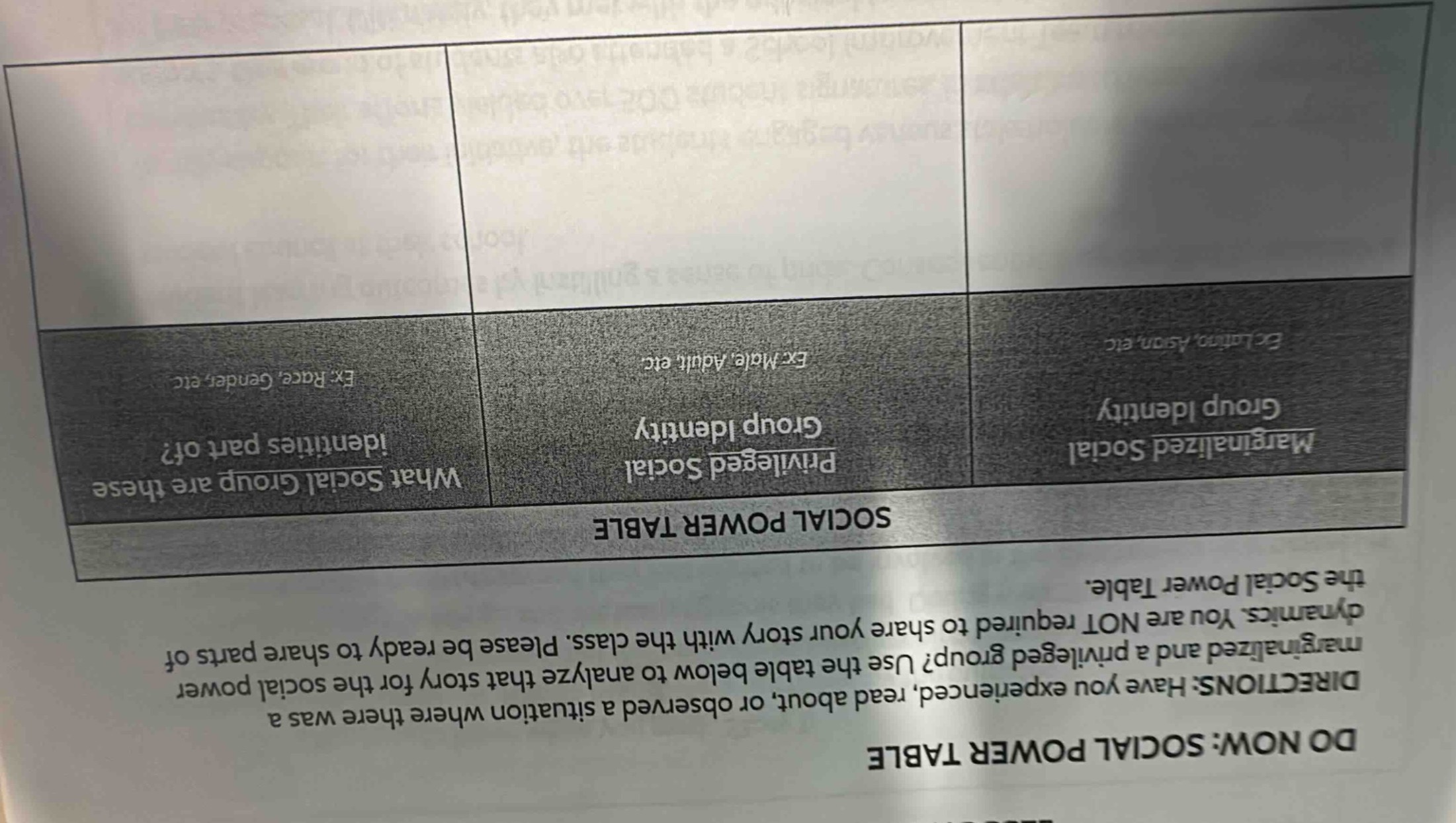
do now: social power tabledirections: have you experienced, read about, or observed a situation where there was a marginalized and a privileged group? use the table below to analyze that story for the social power dynamics. you are not required to share your story with the class. please be ready to share parts of the social power table.social power table|marginalized social group identity|privileged social group identity|what social group are these identities part of?|| ---- | ---- | ---- ||ex: latino, asian, etc|ex: male, adult, etc|ex: race, gender, etc|
- First, identify a real or observed scenario with clear power dynamics. For example: A non-English speaking Latino (marginalized) job applicant is passed over for a less qualified native English-speaking white male (privileged) for a customer service role, with the hiring manager citing "cultural fit" without evidence.
- Map the identities to the table:
- Marginalized Social Group Identity: Latino (non-native English speaker)
- Privileged Social Group Identity: White, native English-speaking male
- Underlying social groups: Race/ethnicity, language proficiency, gender
- Analyze the power dynamic: The privileged group (white male) benefits from systemic biases that prioritize dominant cultural and demographic norms, while the marginalized group faces barriers tied to their non-dominant identity.

Snap & solve any problem in the app
Get step-by-step solutions on Sovi AI
Photo-based solutions with guided steps
Explore more problems and detailed explanations
Example Social Power Table Completion & Analysis:
| Marginalized Social Group Identity | Privileged Social Group Identity | What Social Group are these identities part of? |
|---|
Scenario Analysis: In a customer service hiring scenario, the non-native English-speaking Latino applicant was rejected in favor of a less qualified white, native English-speaking male. The hiring manager's vague "cultural fit" justification reflects how privileged social groups (white, native English-speaking males) often benefit from unexamined systemic biases that center dominant identities, while marginalized groups face barriers to equal opportunity based on their non-dominant social identities.