QUESTION IMAGE
Question
now, test yourself!
- express the strength of a solution both as a ratio and as a percentage if 500 ml of the solution contain 25 ml of solute.
- express the strength of a solution both as a ratio and as a percentage if 200 ml of the solution contain 40 g of solute.
- express the strength of a solution both as a ratio and as a percentage if 2 l of the solution contain 400 mg of solute.
- betadine solution is a 10% povidone-iodine solution. express this strength both as a fraction and as a ratio.
- thorazine is available in a strength of 25 mg/ml. express this strength as a percent.
- which of the following could be solution strengths?
1:10,000 0.5% 25 ml $\frac{1}{3}$ 2 mg/ml 100 g
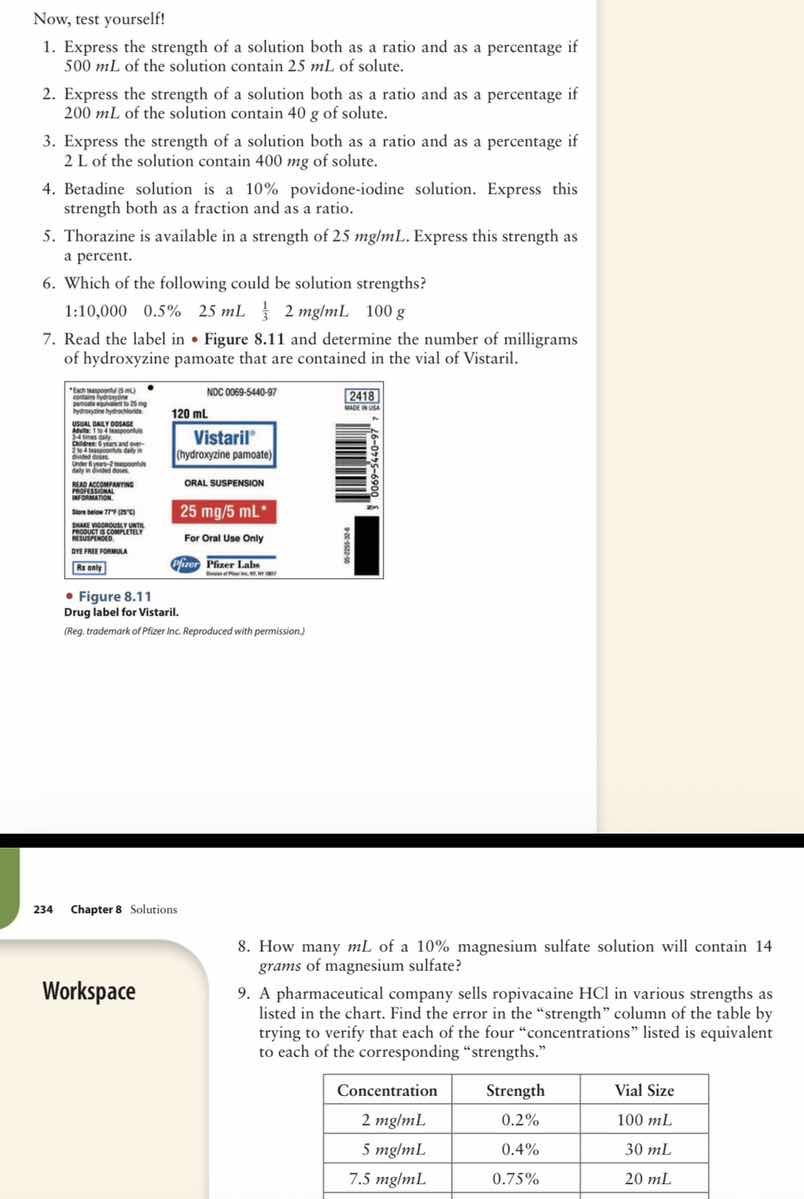
- read the label in • figure 8.11 and determine the number of milligrams of hydroxyzine pamoate that are contained in the vial of vistaril.
- figure 8.11
drug label for vistaril.
(reg. trademark of pfizer inc. reproduced with permission.)
- how many ml of a 10% magnesium sulfate solution will contain 14 grams of magnesium sulfate?
- a pharmaceutical company sells ropivacaine hcl in various strengths as listed in the chart. find the error in the \strength\ column of the table by trying to verify that each of the four \concentrations\ listed is equivalent to each of the corresponding \strengths.\
| concentration | strength | vial size |
|---|---|---|
| 5 mg/ml | 0.4% | 30 ml |
| 7.5 mg/ml | 0.75% | 20 ml |
Step1: Define ratio (solute:total)
Ratio = $\frac{\text{Solute volume}}{\text{Total solution volume}} = \frac{25}{500} = \frac{1}{20}$, so 1:20
Step2: Calculate percentage strength
Percentage = $\frac{25}{500} \times 100\% = 5\%$
---
Step1: Define ratio (solute:total)
Ratio = $\frac{\text{Solute mass}}{\text{Total solution volume}} = \frac{40}{200} = \frac{1}{5}$, so 1:5
Step2: Calculate percentage strength
Percentage = $\frac{40}{200} \times 100\% = 20\%$
---
Step1: Convert units to match
2 L = 2000 mL
Step2: Define ratio (solute:total)
Ratio = $\frac{400}{2000} = \frac{1}{5}$, so 1:5
Step3: Calculate percentage strength
Percentage = $\frac{400}{2000} \times 100\% = 20\%$
---
Step1: Convert percentage to fraction
10% = $\frac{10}{100} = \frac{1}{10}$
Step2: Convert fraction to ratio
$\frac{1}{10}$ corresponds to 1:10
---
Step1: Convert mg/mL to percentage
100 mL solution contains $25 \times 100 = 2500$ mg = 2.5 g
Percentage = $\frac{2.5}{100} \times 100\% = 2.5\%$
---
Step1: Identify valid strength units
Solution strength describes concentration (ratio, %, mass/volume, etc.). 25 mL and 100 g are absolute amounts, not strengths.
Valid options: 1:10,000, 0.5%, $\frac{1}{3}$, 2 mg/mL
---
Step1: Use label concentration
Label states 25 mg/5 mL = 5 mg/mL
Step2: Calculate total mass in 120 mL
Total mass = $5 \, \text{mg/mL} \times 120 \, \text{mL} = 600$ mg
---
Step1: Rearrange percentage formula
Volume = $\frac{\text{Mass of solute}}{\text{Percentage strength}} \times 100$
Step2: Substitute values
Volume = $\frac{14}{10} \times 100 = 140$ mL
---
Step1: Verify each concentration-percent pair
- $2 \, \text{mg/mL} = \frac{200 \, \text{mg}}{100 \, \text{mL}} = 0.2\%$ (correct)
- $5 \, \text{mg/mL} = \frac{500 \, \text{mg}}{100 \, \text{mL}} = 0.5\%$ (not 0.4%, error)
- $7.5 \, \text{mg/mL} = \frac{750 \, \text{mg}}{100 \, \text{mL}} = 0.75\%$ (correct)

Snap & solve any problem in the app
Get step-by-step solutions on Sovi AI
Photo-based solutions with guided steps
Explore more problems and detailed explanations
- Ratio: 1:20, Percentage: 5%
- Ratio: 1:5, Percentage: 20%
- Ratio: 1:5, Percentage: 20%
- Fraction: $\frac{1}{10}$, Ratio: 1:10
- 2.5%
- 1:10,000, 0.5%, $\frac{1}{3}$, 2 mg/mL
- 600 mg
- 140 mL
- The error is in the second row: 5 mg/mL corresponds to 0.5%, not 0.4%