QUESTION IMAGE
Question
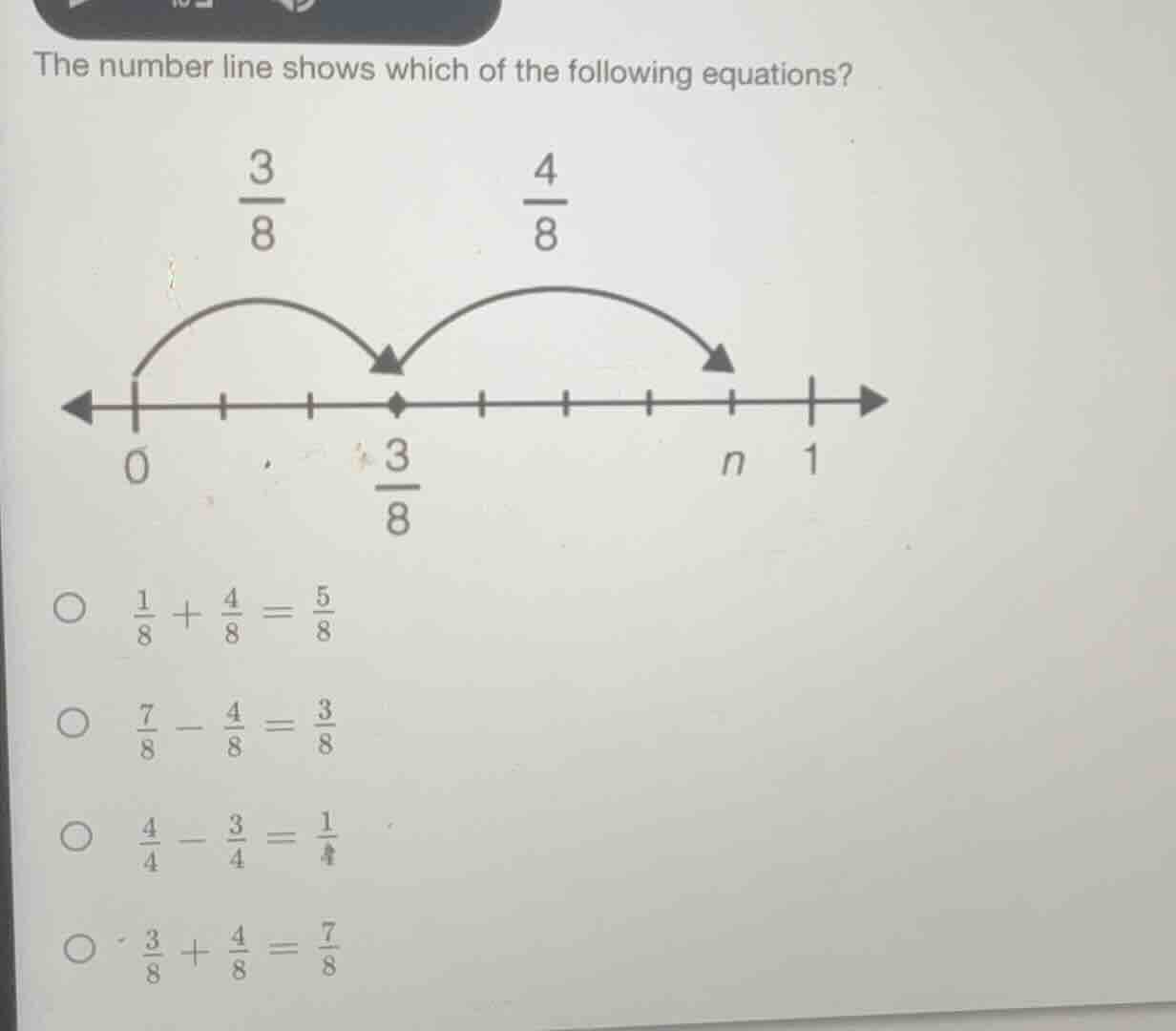
the number line shows which of the following equations?
\\(\frac{1}{8} + \frac{4}{8} = \frac{5}{8}\\)
\\(\frac{7}{8} - \frac{4}{8} = \frac{3}{8}\\)
\\(\frac{4}{4} - \frac{3}{4} = \frac{1}{4}\\)
\\(\frac{3}{8} + \frac{4}{8} = \frac{7}{8}\\)
Step1: Analyze the number line movements
The first arrow moves from 0 to $\frac{3}{8}$, representing an addition of $\frac{3}{8}$. The second arrow moves from $\frac{3}{8}$ by a length of $\frac{4}{8}$ (since the label above the second arrow is $\frac{4}{8}$) to reach \( n \). So we need to add these two fractions.
Step2: Add the fractions
To find \( n \), we add the two fractions: \(\frac{3}{8} + \frac{4}{8}\). When adding fractions with the same denominator, we add the numerators and keep the denominator the same. So \( \frac{3 + 4}{8}=\frac{7}{8} \). So the equation represented is \(\frac{3}{8}+\frac{4}{8}=\frac{7}{8}\).

Snap & solve any problem in the app
Get step-by-step solutions on Sovi AI
Photo-based solutions with guided steps
Explore more problems and detailed explanations
\(\boldsymbol{\frac{3}{8} + \frac{4}{8} = \frac{7}{8}}\) (the option corresponding to this equation)