QUESTION IMAGE
Question
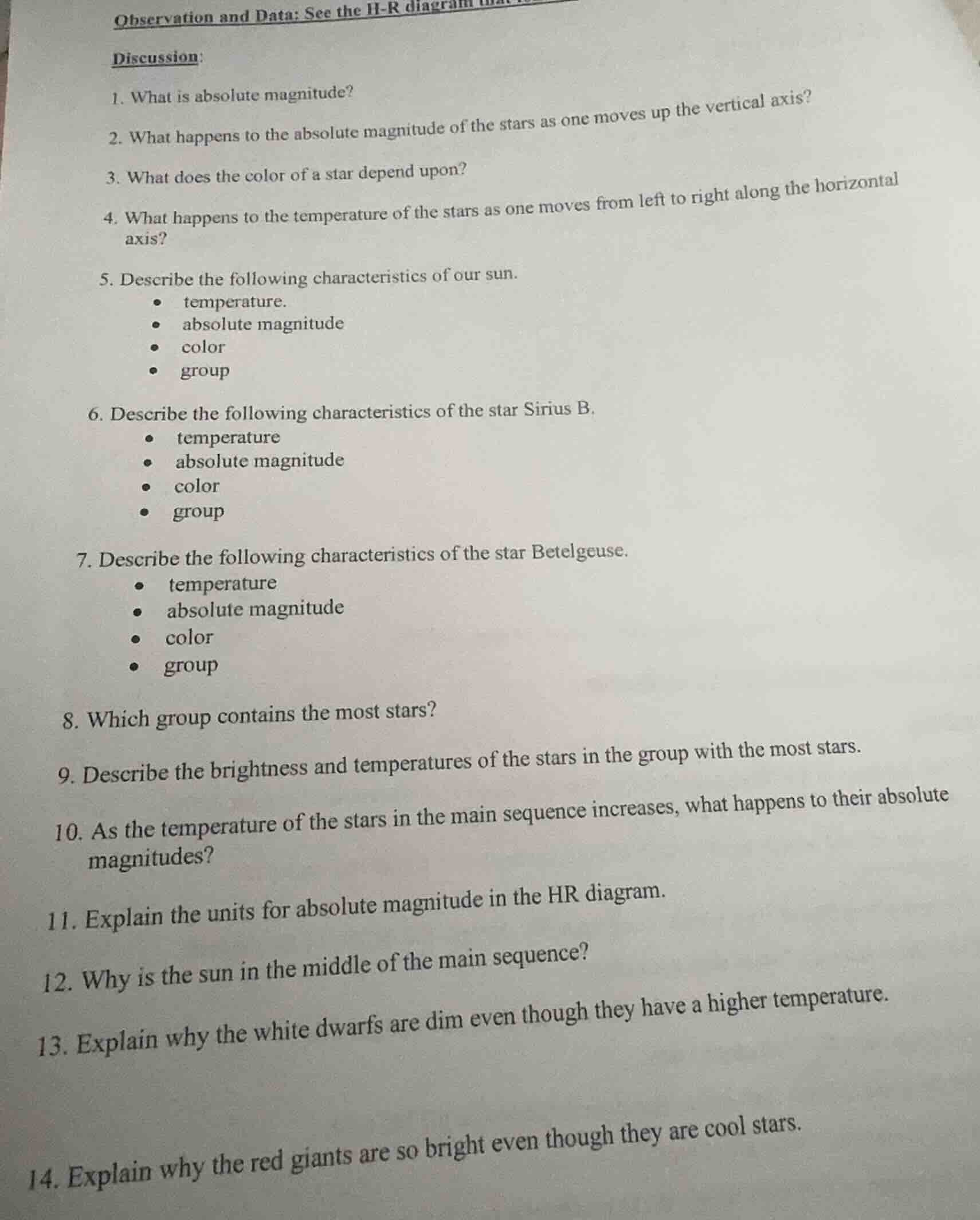
observation and data: see the h-r diagram
discussion:
- what is absolute magnitude?
- what happens to the absolute magnitude of the stars as one moves up the vertical axis?
- what does the color of a star depend upon?
- what happens to the temperature of the stars as one moves from left to right along the horizontal axis?
- describe the following characteristics of our sun.
- temperature.
- absolute magnitude
- color
- group
- describe the following characteristics of the star sirius b.
- temperature
- absolute magnitude
- color
- group
- describe the following characteristics of the star betelgeuse.
- temperature
- absolute magnitude
- color
- group
- which group contains the most stars?
- describe the brightness and temperatures of the stars in the group with the most stars.
- as the temperature of the stars in the main sequence increases, what happens to their absolute magnitudes?
- explain the units for absolute magnitude in the hr diagram.
- why is the sun in the middle of the main sequence?
- explain why the white dwarfs are dim even though they have a higher temperature.
- explain why the red giants are so bright even though they are cool stars.
Question 1: What is absolute magnitude?
Absolute magnitude is a measure of the intrinsic brightness of a celestial object (like a star) if it were placed at a standard distance of 10 parsecs (about 32.6 light - years) from Earth. It allows astronomers to compare the true brightness of different stars on an equal - distance basis, independent of their actual distance from Earth.
In an H - R (Hertzsprung - Russell) diagram, the vertical axis represents absolute magnitude (with a reverse - logarithmic scale, where lower numbers mean brighter). As one moves up the vertical axis, the absolute magnitude number decreases, which means the stars become intrinsically brighter. For example, a star with an absolute magnitude of - 2 is brighter than a star with an absolute magnitude of 3.
The color of a star depends primarily on its surface temperature. According to Wien's displacement law, hotter stars emit more radiation at shorter wavelengths. So, hot stars (with surface temperatures of around 10,000 K or more) appear blue or white, while cooler stars (with surface temperatures of around 3,000 - 4,000 K) appear red. Stars with intermediate temperatures (like the Sun, around 5,500 K) appear yellow.

Snap & solve any problem in the app
Get step-by-step solutions on Sovi AI
Photo-based solutions with guided steps
Explore more problems and detailed explanations
Absolute magnitude is a measure of a celestial object's (e.g., star) intrinsic brightness when it is at a standard distance of 10 parsecs from Earth, used to compare the true brightness of different celestial objects.