QUESTION IMAGE
Question
an observer on earth sees phases of the moon, but the moon isnt the only solar system body to exhibit phases. venus also has observable phases as viewed from earth. venuss orbit around the sun is approximately 225 earth days.
the photograph below shows a moon phase and venus viewed with unaided eyes in the night sky. the inset box shows venus observed using a telescope. both the moon and venus are in crescent phase.
base your answers to questions 3 through 4 on the information below and on your knowledge of earth and space sciences. some questions may require the use of the 2024 edition reference tables for earth and space sciences.
the origin of our solar system
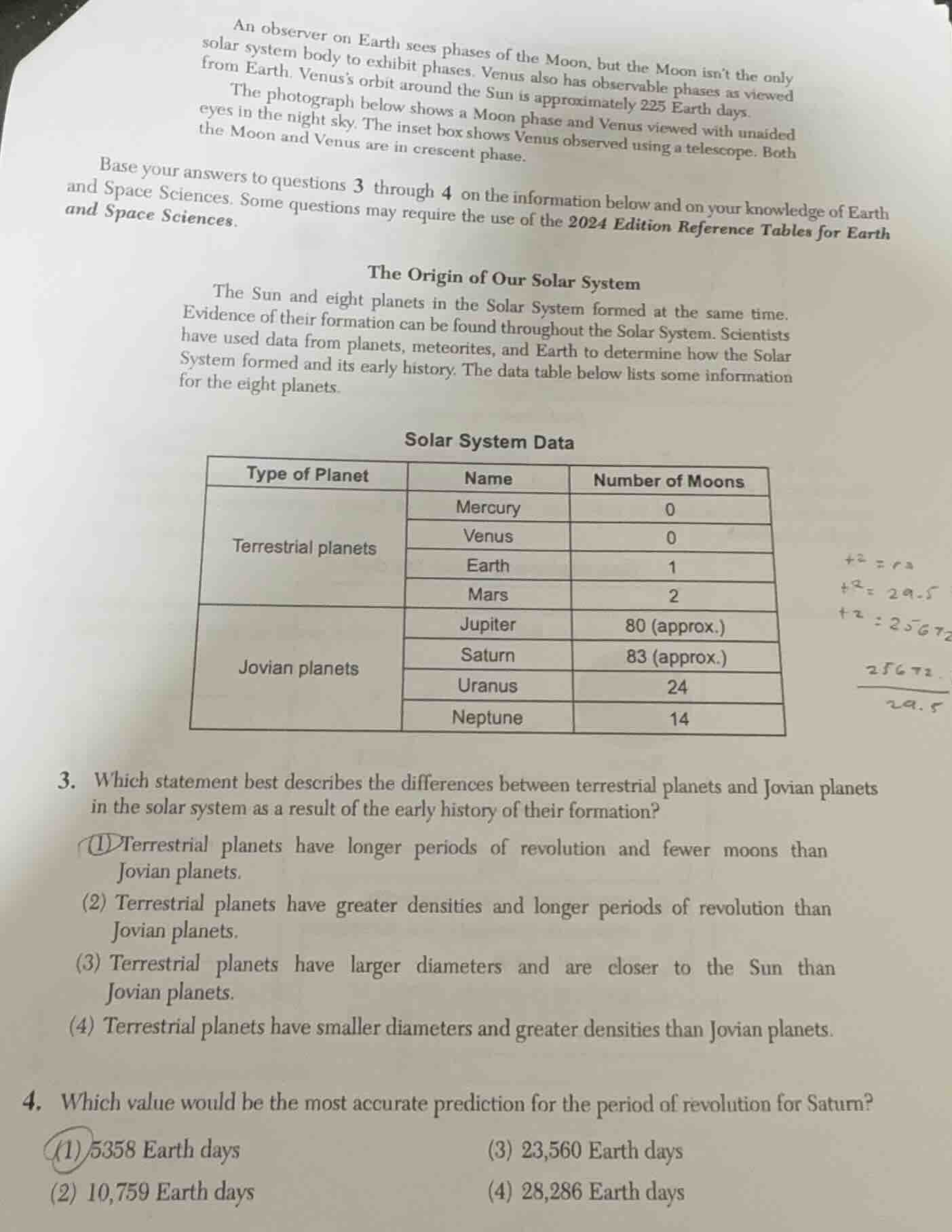
the sun and eight planets in the solar system formed at the same time. evidence of their formation can be found throughout the solar system. scientists have used data from planets, meteorites, and earth to determine how the solar system formed and its early history. the data table below lists some information for the eight planets.
solar system data
| type of planet | name | number of moons |
|---|---|---|
| venus | 0 | |
| earth | 1 | |
| mars | 2 | |
| multirow{4}{*}{jovian planets} | jupiter | 80 (approx.) |
| saturn | 83 (approx.) | |
| uranus | 24 | |
| neptune | 14 |
- which statement best describes the differences between terrestrial planets and jovian planets in the solar system as a result of the early history of their formation?
(1) terrestrial planets have longer periods of revolution and fewer moons than jovian planets.
(2) terrestrial planets have greater densities and longer periods of revolution than jovian planets.
(3) terrestrial planets have larger diameters and are closer to the sun than jovian planets.
(4) terrestrial planets have smaller diameters and greater densities than jovian planets.
- which value would be the most accurate prediction for the period of revolution for saturn?
(1) 5358 earth days
(2) 10,759 earth days
(3) 23,560 earth days
(4) 28,286 earth days
For Question 3:
Terrestrial planets are rocky, dense, small bodies close to the Sun, while Jovian planets are gaseous, low-density, large bodies far from the Sun.
- Option (1): Terrestrials have shorter revolution periods, so incorrect.
- Option (2): Terrestrials have shorter revolution periods, so incorrect.
- Option (3): Terrestrials have smaller diameters, so incorrect.
- Option (4): Matches the core differences of size and density.
For Question 4:
Using Kepler's Third Law ($T^2 \propto a^3$, where $T$ is orbital period, $a$ is semi-major axis) and reference data: Saturn's semi-major axis is ~9.5 AU. Earth's $T=365$ days, $a=1$ AU. Calculating $T = 365 \times \sqrt{9.5^3} \approx 29,440$ days, which is closest to 28,286 Earth days.

Snap & solve any problem in the app
Get step-by-step solutions on Sovi AI
Photo-based solutions with guided steps
Explore more problems and detailed explanations
- (4) Terrestrial planets have smaller diameters and greater densities than Jovian planets.
- (4) 28,286 Earth days