QUESTION IMAGE
Question
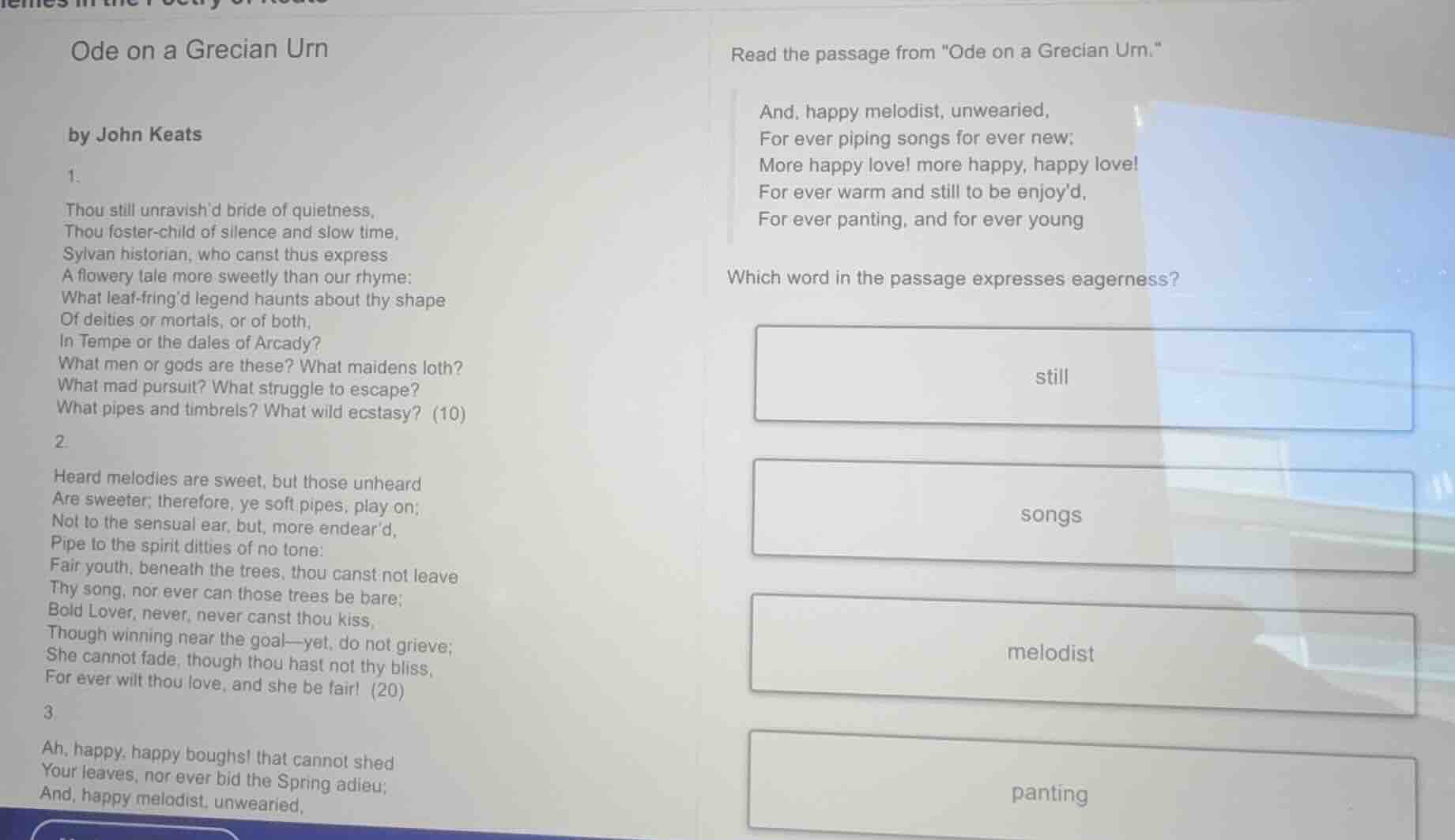
ode on a grecian urn by john keats 1. thou still unravishd bride of quietness, thou foster - child of silence and slow time, sylvan historian, who canst thus express a flowery tale more sweetly than our rhyme: what leaf - fringd legend haunts about thy shape of deities or mortals, or of both, in tempe or the dales of arcady? what men or gods are these? what maidens loth? what mad pursuit? what struggle to escape? what pipes and timbrels? what wild ecstasy? (10) 2. heard melodies are sweet, but those unheard are sweeter; therefore, ye soft pipes, play on; not to the sensual ear, but, more endeard, pipe to the spirit ditties of no tone: fair youth, beneath the trees, thou canst not leave thy song, nor ever can those trees be bare; bold lover, never, never canst thou kiss, though winning near the goal—yet, do not grieve; she cannot fade, though thou hast not thy bliss, for ever wilt thou love, and she be fair! (20) 3. ah, happy, happy boughs! that cannot shed your leaves, nor ever bid the spring adieu; and, happy melodist, unwearied, read the passage from \ode on a grecian urn.\ and, happy melodist, unwearied, for ever piping songs for ever new; more happy love! more happy, happy love! for ever warm and still to be enjoyd, for ever panting, and for ever young which word in the passage expresses eagerness? still songs melodist panting
- "still" means unchanging, not eager.
- "songs" refers to musical pieces, no eagerness.
- "melodist" is a musician, no eagerness.
- "panting" conveys breathless, eager longing, matching the question's request for a word expressing eagerness.

Snap & solve any problem in the app
Get step-by-step solutions on Sovi AI
Photo-based solutions with guided steps
Explore more problems and detailed explanations
panting