QUESTION IMAGE
Question
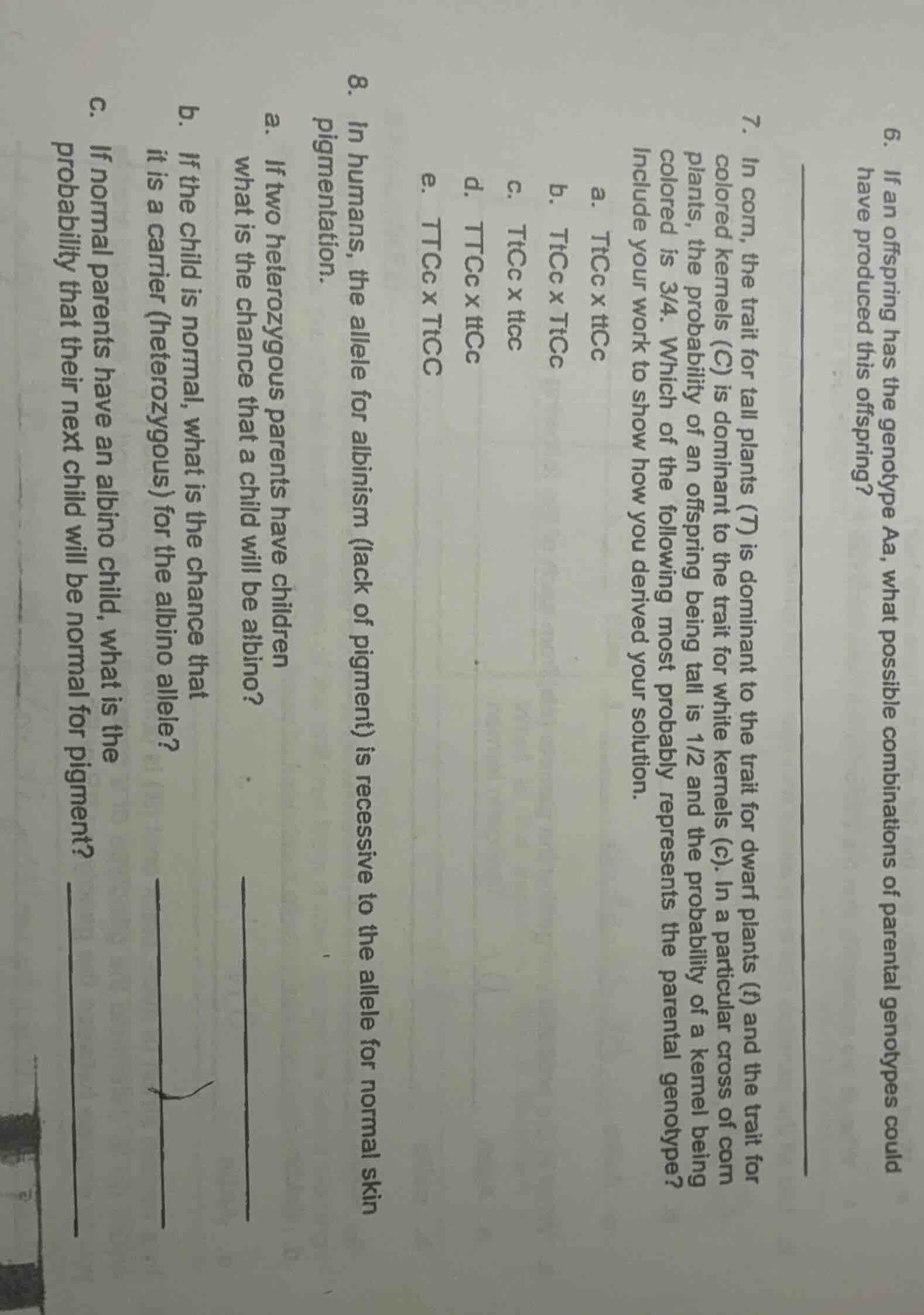
- if an offspring has the genotype aa, what possible combinations of parental genotypes could have produced this offspring?
- in corn, the trait for tall plants (t) is dominant to the trait for dwarf plants (t) and the trait for colored kernels (c) is dominant to the trait for white kernels (c). in a particular cross of corn plants, the probability of an offspring being tall is 1/2 and the probability of a kernel being colored is 3/4. which of the following most probably represents the parental genotype? include your work to show how you derived your solution.
a. ttcc x ttcc
b. ttcc x ttcc
c. ttcc x ttcc
d. ttcc x ttcc
e. ttcc x ttcc
- in humans, the allele for albinism (lack of pigment) is recessive to the allele for normal skin pigmentation.
a. if two heterozygous parents have children what is the chance that a child will be albino?
b. if the child is normal, what is the chance that it is a carrier (heterozygous) for the albino allele?
c. if normal parents have an albino child, what is the probability that their next child will be normal for pigment?
Question 6
Step 1: Recall Genotype Inheritance
For an offspring with genotype \( Aa \), we consider possible parental genotype combinations. The principle of segregation (Mendel's law) states that alleles separate during gamete formation. Possible parental crosses that can produce \( Aa \) are:
- \( AA \times aa \): All offspring will be \( Aa \) (since \( AA \) produces \( A \) gametes and \( aa \) produces \( a \) gametes, so \( A \times a = Aa \)).
- \( Aa \times aa \): Using Punnett square, gametes from \( Aa \) are \( A \) and \( a \), from \( aa \) are \( a \). Offspring genotypes: \( Aa \) (50%) and \( aa \) (50%).
- \( Aa \times Aa \): Gametes from each \( Aa \) are \( A \) and \( a \). Offspring genotypes: \( AA \) (25%), \( Aa \) (50%), \( aa \) (25%).
- \( AA \times Aa \): Gametes from \( AA \) are \( A \), from \( Aa \) are \( A \) and \( a \). Offspring genotypes: \( AA \) (50%) and \( Aa \) (50%).
Step 2: List Possible Combinations
So the possible parental genotype combinations are:
- \( AA \) (parent 1) and \( aa \) (parent 2)
- \( Aa \) (parent 1) and \( aa \) (parent 2)
- \( Aa \) (parent 1) and \( Aa \) (parent 2)
- \( AA \) (parent 1) and \( Aa \) (parent 2)
Step 1: Analyze Traits and Probabilities
We have two traits: tall ( \( T \), dominant) vs. dwarf ( \( t \), recessive) and colored ( \( C \), dominant) vs. white ( \( c \), recessive) kernels. The probability of tall ( \( T\_ \)) is \( \frac{1}{2} \) and colored ( \( C\_ \)) is \( \frac{3}{4} \). We analyze each cross:
Option a: \( TtCc \times ttCc \)
- For height ( \( T/t \)): \( Tt \times tt \). Gametes: \( T, t \) (from \( Tt \)) and \( t, t \) (from \( tt \)). Offspring: \( Tt \) (50%, tall) and \( tt \) (50%, dwarf). So \( P(\text{tall}) = \frac{1}{2} \).
- For color ( \( C/c \)): \( Cc \times Cc \). Gametes: \( C, c \) (from each \( Cc \)). Offspring: \( CC \) (25%), \( Cc \) (50%), \( cc \) (25%). So \( P(\text{colored}) = \frac{3}{4} \) ( \( CC + Cc \) ). This matches the given probabilities.
Option b: \( TtCc \times TtCc \)
- Height: \( Tt \times Tt \). Offspring: \( TT \) (25%), \( Tt \) (50%), \( tt \) (25%). \( P(\text{tall}) = \frac{3}{4} \) (not \( \frac{1}{2} \)). Eliminate.
Option c: \( TtCc \times ttcc \)
- Color: \( Cc \times cc \). Offspring: \( Cc \) (50%), \( cc \) (50%). \( P(\text{colored}) = \frac{1}{2} \) (not \( \frac{3}{4} \)). Eliminate.
Option d: \( TTCc \times ttCc \)
- Height: \( TT \times tt \). Offspring: \( Tt \) (100%, tall). \( P(\text{tall}) = 1 \) (not \( \frac{1}{2} \)). Eliminate.
Option e: \( TTCc \times TtCC \)
- Height: \( TT \times Tt \). Offspring: \( TT, Tt \) (100%, tall). \( P(\text{tall}) = 1 \) (not \( \frac{1}{2} \)). Eliminate.
Step 1: Define Alleles
Let \( A \) be normal allele, \( a \) be albinism allele (recessive). Heterozygous parents: \( Aa \times Aa \).
Step 2: Punnett Square
Gametes: \( A, a \) (from each \( Aa \)).
Offspring genotypes:
- \( AA \): 25% (normal, non - carrier)
- \( Aa \): 50% (normal, carrier)
- \( aa \): 25% (albino)
So \( P(\text{albino})=\frac{1}{4} \).

Snap & solve any problem in the app
Get step-by-step solutions on Sovi AI
Photo-based solutions with guided steps
Explore more problems and detailed explanations
Possible parental genotype combinations: \( AA \times aa \), \( Aa \times aa \), \( Aa \times Aa \), \( AA \times Aa \)