QUESTION IMAGE
Question
- one action taken by both v. i. lenin and joseph stalin was
a) supporting the russian orthodox church
b) attempting to bring democracy to russia
c) jailing or murdering potential opponents
d) providing economic aid to japan after world war
i and world war ii
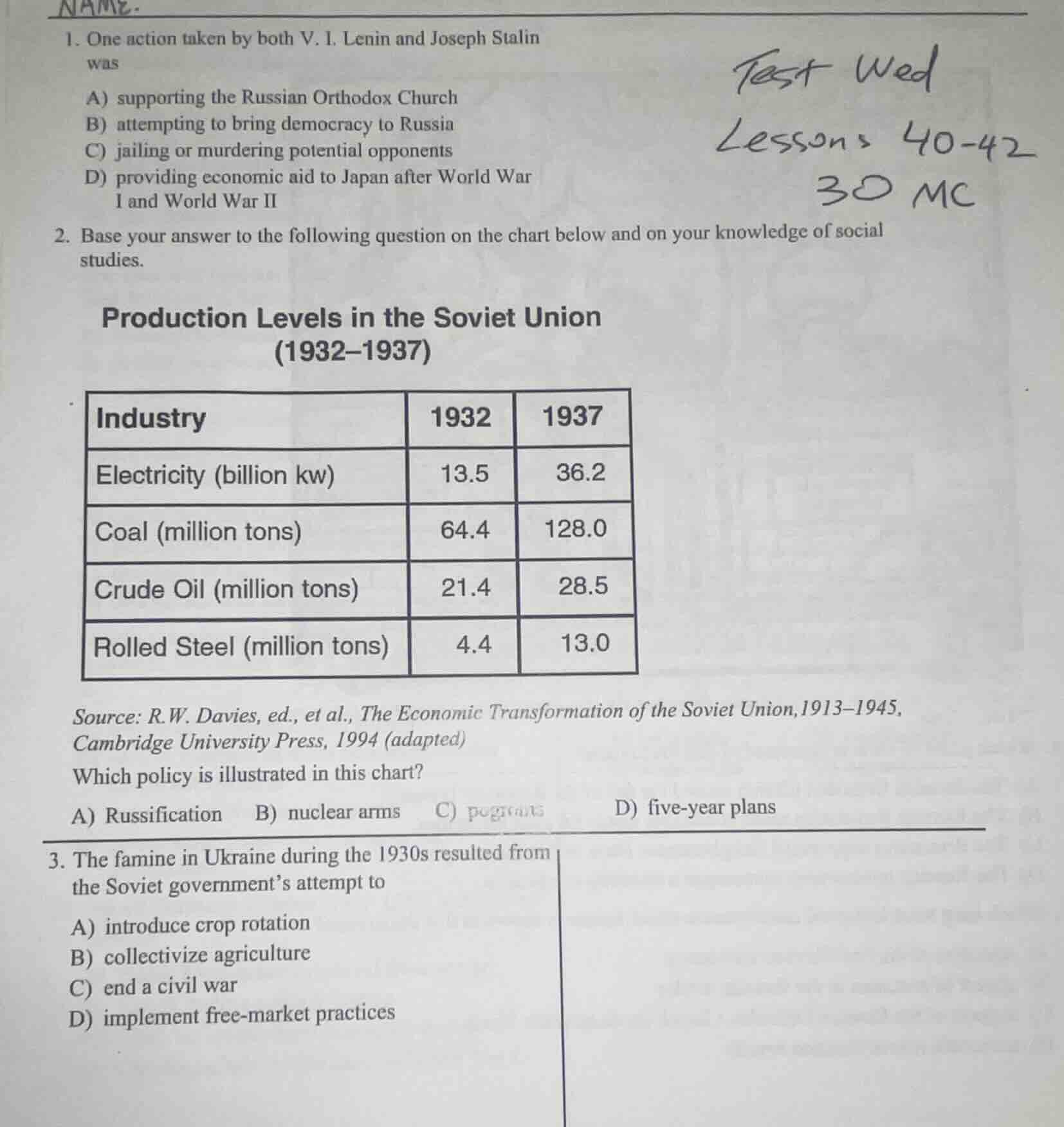
- base your answer to the following question on the chart below and on your knowledge of social studies.
production levels in the soviet union
(1932–1937)
industry | 1932 | 1937
electricity (billion kw) | 13.5 | 36.2
coal (million tons) | 64.4 | 128.0
crude oil (million tons) | 21.4 | 28.5
rolled steel (million tons) | 4.4 | 13.0
source: r.w. davies, ed., et al., the economic transformation of the soviet union,1913–1945,
cambridge university press, 1994 (adapted)
which policy is illustrated in this chart?
a) russification b) nuclear arms c) pogroms d) five - year plans
- the famine in ukraine during the 1930s resulted from
the soviet government’s attempt to
a) introduce crop rotation
b) collectivize agriculture
c) end a civil war
d) implement free - market practices
Question 1
- Option A: Lenin and Stalin were against the Russian Orthodox Church, so this is incorrect.
- Option B: Neither Lenin nor Stalin aimed to bring democracy to Russia; they established a socialist/communist system.
- Option C: Both Lenin and Stalin used repressive measures against potential opponents to maintain power.
- Option D: Providing economic aid to Japan was not an action of Lenin or Stalin.
- The chart shows increased industrial production in the Soviet Union from 1932 to 1937.
- The five - year plans were Stalin's economic plans to rapidly industrialize the Soviet Union, which matches the industrial growth shown.
- Russification is about cultural assimilation, nuclear arms development was later, and pogroms are anti - Jewish riots, none of which relate to industrial production.
- Option A: Crop rotation is a farming technique, not related to the Ukrainian famine.
- Option B: The Soviet government's collectivization of agriculture in the 1930s disrupted traditional farming, led to resistance, and mismanagement, causing the famine in Ukraine.
- Option C: The civil war in the Soviet Union was in the 1910s - 1920s, not the 1930s.
- Option D: The Soviet Union had a command economy, not free - market practices.

Snap & solve any problem in the app
Get step-by-step solutions on Sovi AI
Photo-based solutions with guided steps
Explore more problems and detailed explanations
C) jailing or murdering potential opponents