QUESTION IMAGE
Question
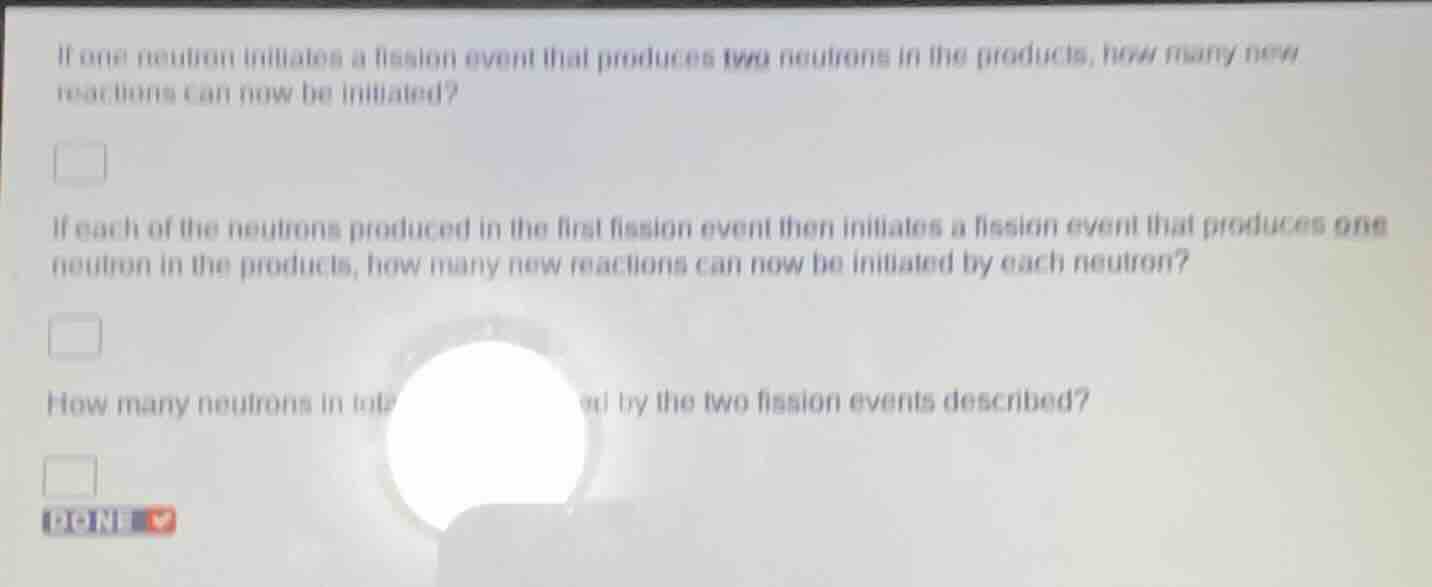
if one neutron initiates a fission event that produces two neutrons in the products, how many new reactions can now be initiated?
if each of the neutrons produced in the first fission event then initiates a fission event that produces one neutron in the products, how many new reactions can now be initiated by each neutron?
how many neutrons in total are produced by the two fission events described?
First Sub - Question
Step 1: Understand the fission event
One neutron initiates a fission event that produces two neutrons. Each of these new neutrons can initiate a new reaction.
So the number of new reactions is equal to the number of neutrons produced in the fission event, which is 2.
Step 1: Analyze the fission event for each neutron
Each neutron from the first fission event initiates a fission event that produces one neutron. So each of these neutrons can initiate 1 new reaction.
Step 1: Neutrons from the first fission
The first fission event starts with 1 neutron and produces 2 neutrons. So the number of neutrons produced in the first fission (excluding the initial one) is \(2 - 1=1\) (if we consider net production), but if we consider total neutrons after first fission: initial 1, produces 2, so total after first fission is 2 (the two produced).
Step 2: Neutrons from the second fission events
Each of the 2 neutrons from the first fission initiates a fission that produces 1 neutron. So each of these fissions produces 1 neutron, and for 2 fissions, the number of neutrons produced is \(2\times1 = 2\). But we also have to consider the neutrons from the first fission. Wait, maybe a better way:
First fission: 1 neutron in, 2 neutrons out.
Second fission: each of the 2 neutrons from first fission undergoes fission, each producing 1 neutron. So each second - stage fission: 1 in, 1 out (net production 0, but total neutrons from second fission: 2 (since 2 fissions, each producing 1)).
Total neutrons produced: from first fission: \(2-1 = 1\) (net), from second fission: \(2\times(1 - 1)=0\) (net). But if we consider total neutrons after two fissions:
Start with 1.
After first fission: 2 (the two produced).
After second fission: each of the 2 neutrons fissions, each producing 1, so we have 2 (from second fission) + the 2 from first fission? No, wait, when a neutron fissions, it is consumed and produces new neutrons. So first fission: 1 neutron is used, produces 2. So neutrons after first fission: 2.
Then each of the 2 neutrons is used in a fission, each producing 1. So for each of the 2 fissions: 1 neutron in, 1 neutron out. So after second fission, the number of neutrons is 2 (from the two second - stage fissions).
But maybe the question is about total neutrons produced (excluding the initial one). First fission: produces 2 (so 2 - 1=1 net production). Second fission: each of the 2 neutrons fissions, each producing 1, so total produced in second fission: 2, and used 2, so net production 0. But total neutrons produced (all neutrons from fissions, not counting initial): first fission produces 2, second fission produces 2, so total \(2 + 2=4\)? Wait, no. Let's re - express:
First fission:
Input: 1 neutron.
Output: 2 neutrons.
Second fission:
Input: 2 neutrons (from first fission output).
Each input neutron fissions, output: 1 neutron per fission. So total output from second fission: \(2\times1 = 2\) neutrons.
Total neutrons produced (excluding the initial 1): from first fission: 2, from second fission: 2. But the initial neutron is consumed in the first fission. Wait, maybe the question is "How many neutrons are there after two fission events?".
First fission: 1→2.
Second fission: 2→2 (since each of the 2 fissions produces 1, so 2 fissions, each with 1 out, so 2 out).
But maybe a simpler approach:
First fission: produces 2 neutrons.
Second fission: each of the 2 neutrons produces 1 neutron, so 2 neutrons.
Total neutrons produced (the ones that can initiate new reactions or are the result): Let's count all neutrons after both fissions.
Start with 1.
After first fission: 2 (the two produced, the initial one is used up).
After second fission: each of the 2 neutrons is used, each producing 1, so we have 2 (the ones produced in the second fission).
But if we consider the total number of neutrons produced (the sum of all neutrons from fissions):
First fission: 2 neutrons.
Second fission: 2 neutrons (since 2 fissions, each producing 1).
Total neutrons produced: \(2 + 2=4\). But if we consider the initial neutron, maybe the…

Snap & solve any problem in the app
Get step-by-step solutions on Sovi AI
Photo-based solutions with guided steps
Explore more problems and detailed explanations
2