QUESTION IMAGE
Question
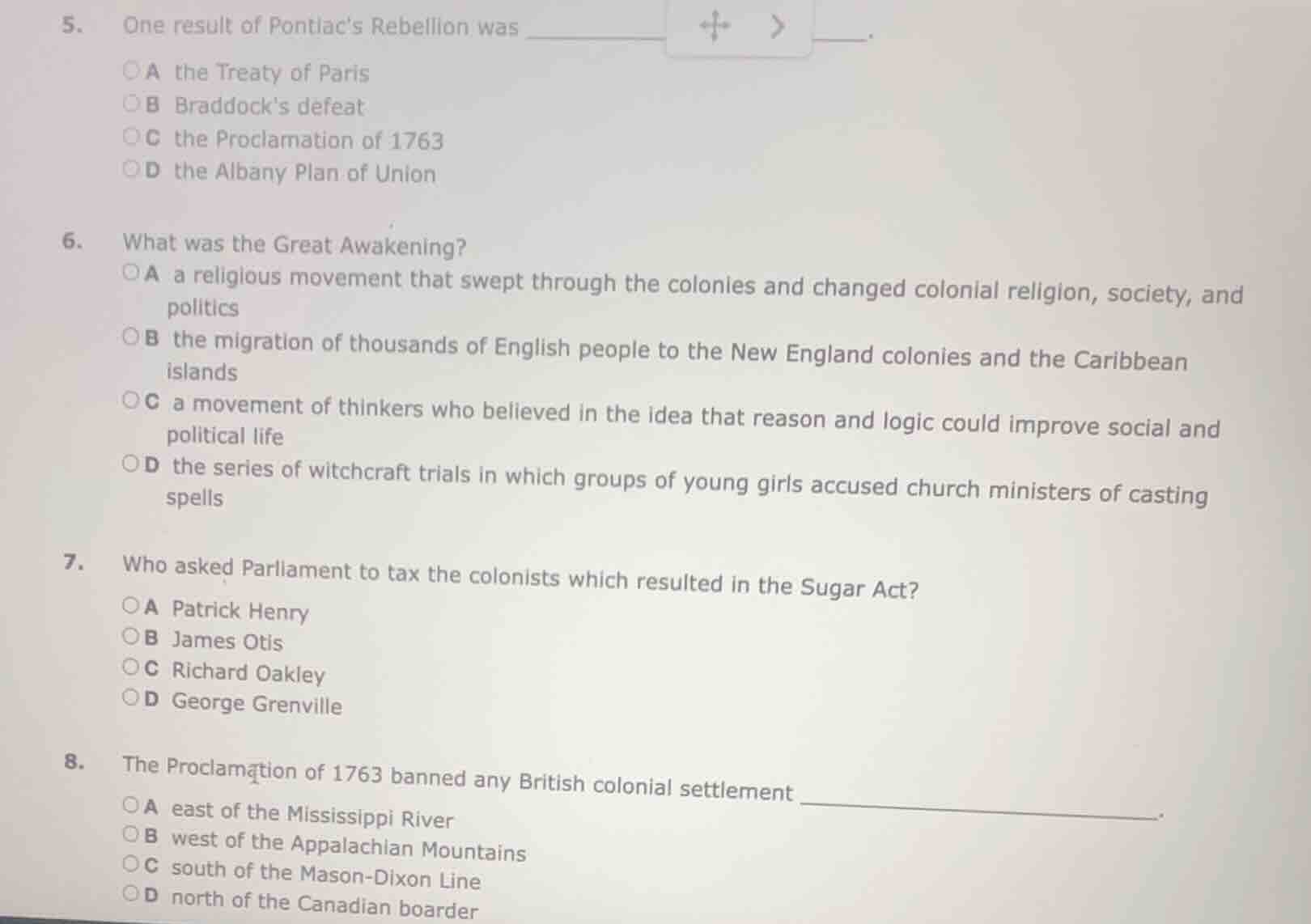
- one result of pontiacs rebellion was ______.
a the treaty of paris
b braddocks defeat
c the proclamation of 1763
d the albany plan of union
- what was the great awakening?
a a religious movement that swept through the colonies and changed colonial religion, society, and politics
b the migration of thousands of english people to the new england colonies and the caribbean islands
c a movement of thinkers who believed in the idea that reason and logic could improve social and political life
d the series of witchcraft trials in which groups of young girls accused church ministers of casting spells
- who asked parliament to tax the colonists which resulted in the sugar act?
a patrick henry
b james otis
c richard oakley
d george grenville
- the proclamation of 1763 banned any british colonial settlement ______.
a east of the mississippi river
b west of the appalachian mountains
c south of the mason - dixon line
d north of the canadian boarder
- For question 5: Pontiac's Rebellion, an uprising of Indigenous groups against British control, led the British to issue the Proclamation of 1763 to avoid further conflict. The Treaty of Paris ended the French and Indian War, Braddock's defeat was an earlier battle in that war, and the Albany Plan was a pre-war unification proposal.
- For question 6: The Great Awakening was a widespread religious revival movement in the American colonies that altered religious practices, social dynamics, and political engagement. Option B describes English migration, option C refers to the Enlightenment, and option D describes the Salem Witch Trials.
- For question 7: George Grenville, British Prime Minister, pushed Parliament to pass the Sugar Act to raise revenue from the colonies after the French and Indian War. Patrick Henry and James Otis were colonial figures opposing British taxes, and Richard Oakley is not associated with this act.
- For question 8: The Proclamation of 1763 prohibited colonial settlement west of the Appalachian Mountains to stabilize relations with Indigenous peoples after Pontiac's Rebellion. The other geographic options do not match the terms of the proclamation.

Snap & solve any problem in the app
Get step-by-step solutions on Sovi AI
Photo-based solutions with guided steps
Explore more problems and detailed explanations
- C the Proclamation of 1763
- A a religious movement that swept through the colonies and changed colonial religion, society, and politics
- D George Grenville
- B west of the Appalachian Mountains