QUESTION IMAGE
Question
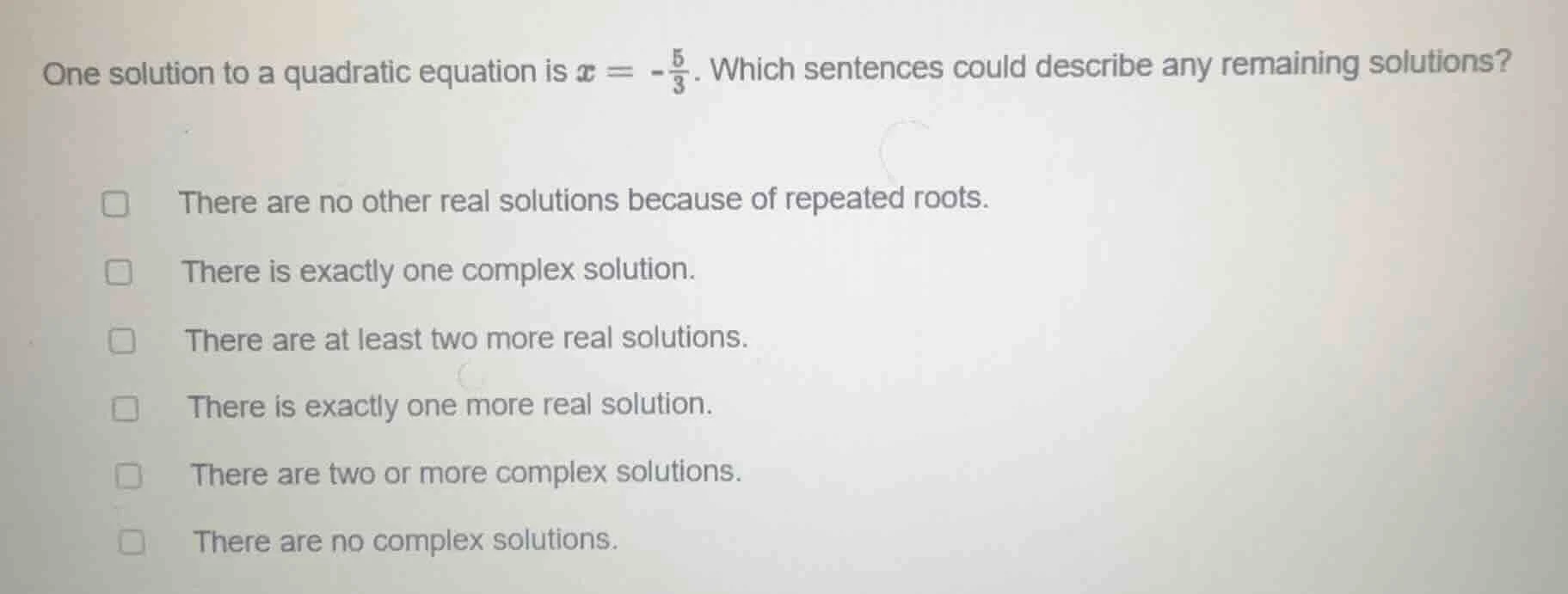
one solution to a quadratic equation is $x = -\frac{5}{3}$. which sentences could describe any remaining solutions?
- there are no other real solutions because of repeated roots.
- there is exactly one complex solution.
- there are at least two more real solutions.
- there is exactly one more real solution.
- there are two or more complex solutions.
- there are no complex solutions.
Step1: Recall quadratic root properties
A quadratic equation $ax^2+bx+c=0$ has exactly 2 roots (counting multiplicities) by the Fundamental Theorem of Algebra. Complex roots come in conjugate pairs.
Step2: Analyze repeated real roots
If $x=-\frac{5}{3}$ is a repeated root, there are no other distinct real roots, matching the first option.
Step3: Analyze distinct real roots
If the root is not repeated, there must be exactly one other distinct real root, matching the fourth option.
Step4: Analyze complex root case
If there is a complex root, its conjugate must also be a root. But since we already have one real root, we cannot have exactly one complex root (they come in pairs). We also cannot have two or more complex roots (that would make total roots >2). If the quadratic has only real roots, there are no complex solutions, matching the sixth option.

Snap & solve any problem in the app
Get step-by-step solutions on Sovi AI
Photo-based solutions with guided steps
Explore more problems and detailed explanations
- There are no other real solutions because of repeated roots.
- There is exactly one more real solution.
- There are no complex solutions.