QUESTION IMAGE
Question
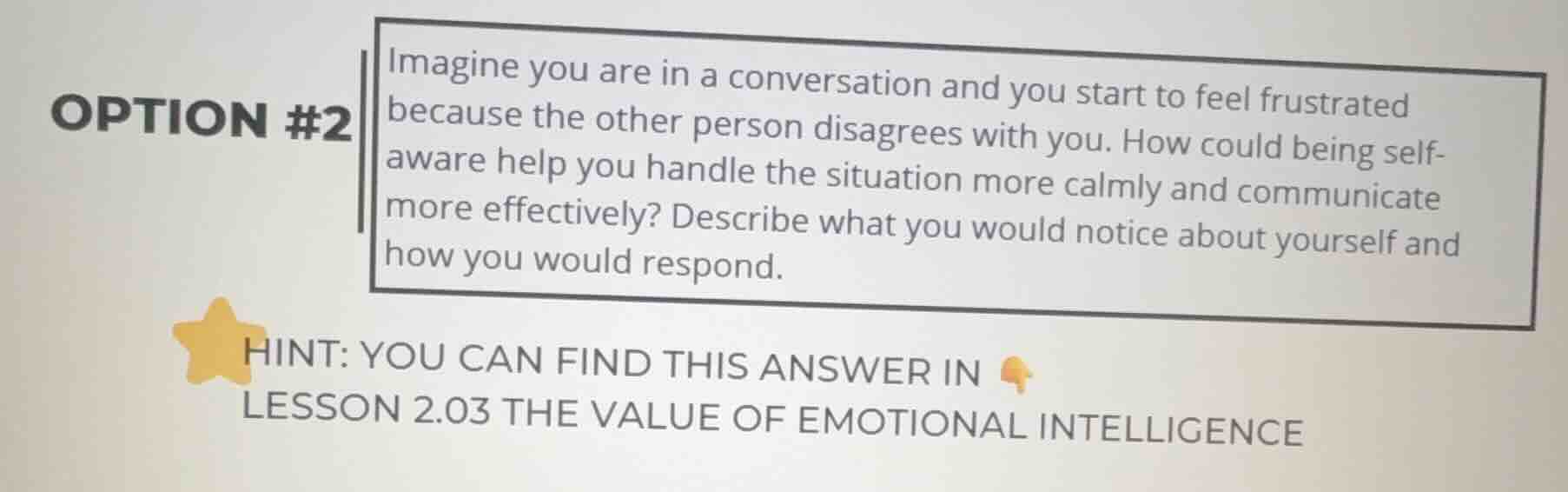
option #2 imagine you are in a conversation and you start to feel frustrated because the other person disagrees with you. how could being self - aware help you handle the situation more calmly and communicate more effectively? describe what you would notice about yourself and how you would respond. hint: you can find this answer in lesson 2.03 the value of emotional intelligence
Brief Explanations
- Self - Awareness of Emotions: When frustrated, self - awareness helps notice physical signs like increased heart rate, tense muscles, or a rising voice. Emotionally, one can identify the feeling of irritation or anger.
- Cognitive Self - Awareness: Notice if thoughts become judgmental (e.g., “They’re wrong!”) or if there's a desire to dominate the conversation.
- Response Based on Self - Awareness: Physically, take a deep breath to calm the body. Emotionally, acknowledge the frustration without acting on it immediately. Cognitively, reframe the situation to be open to the other’s perspective, like asking “Can you explain your view more?” to communicate effectively and stay calm.

Snap & solve any problem in the app
Get step-by-step solutions on Sovi AI
Photo-based solutions with guided steps
Explore more problems and detailed explanations
- Noticing about oneself:
- Physical: Increased heart rate, clenched fists, or a tightening in the chest.
- Emotional: Feelings of irritation, anger, or defensiveness rising.
- Cognitive: Having thoughts like “I’m right, they’re wrong” or a urge to interrupt.
- Response:
- Physically: Take a slow, deep breath to relax the body and lower the heart rate.
- Emotionally: Acknowledge the frustration (e.g., “I feel frustrated, but I want to understand your point”).
- Cognitively: Shift from a “winning” mindset to a learning mindset, ask open - ended questions (e.g., “What makes you think that way?”) to communicate more effectively and stay calm.