QUESTION IMAGE
Question
ordering question
click and drag on elements in order
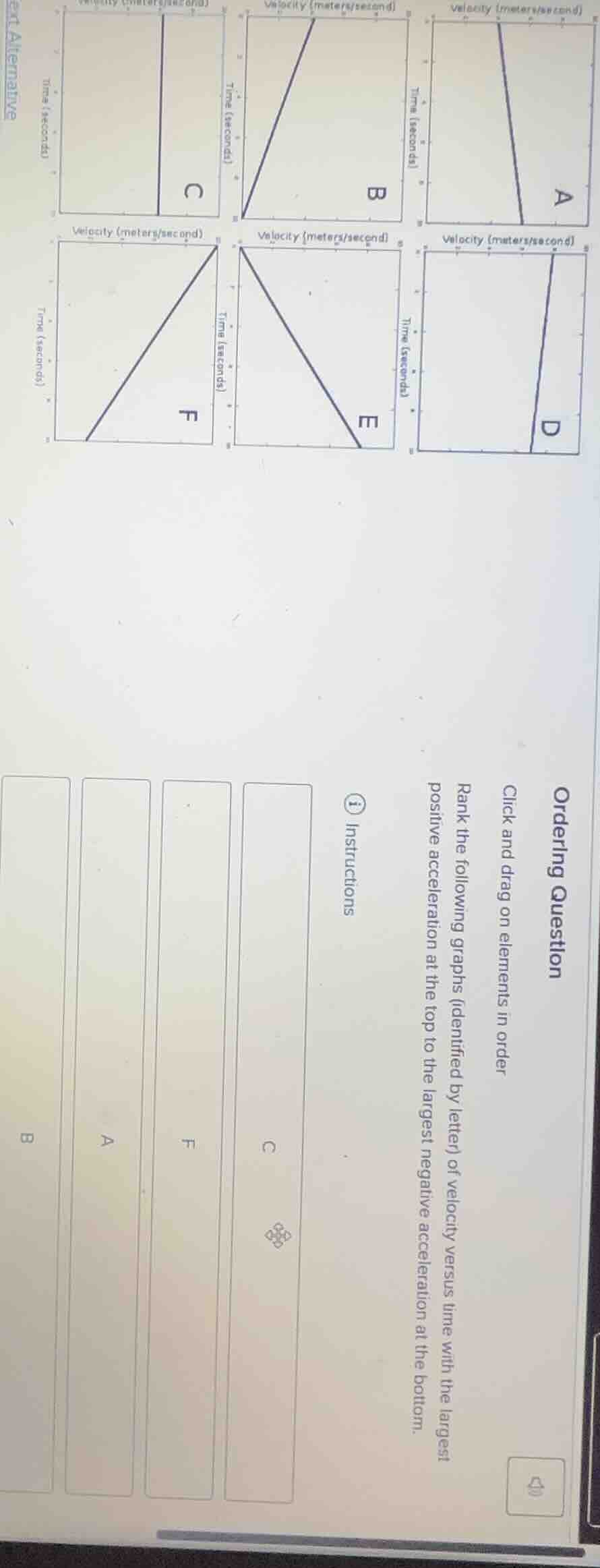
rank the following graphs (identified by letter) of velocity versus time with the largest positive acceleration at the top to the largest negative acceleration at the bottom.
instructions
Step1: Define acceleration from v-t graph
Acceleration $a = \frac{\Delta v}{\Delta t}$, which is the slope of the velocity-time graph. Positive slope = positive acceleration; negative slope = negative acceleration; zero slope = 0 acceleration.
Step2: Calculate slopes for each graph
- Graph B: Positive slope, large magnitude
- Graph F: Positive slope, smaller magnitude than B
- Graph C: Zero slope (vertical line, $\Delta t=0$, but velocity is constant? Correction: vertical line means infinite acceleration, but standard v-t graph: time on x-axis, velocity on y-axis. So vertical line is invalid for real motion, but here it's zero change in time, but for ranking: C has 0 acceleration (correction: no, standard v-t: x is time, y is velocity. So:
- A: Negative slope (large magnitude, negative acceleration)
- B: Positive slope (large magnitude, positive acceleration)
- C: Vertical line: $\Delta t=0$, but in standard terms, this is infinite acceleration, but likely it's a vertical line meaning velocity jumps, but for ranking, we use slope:
- D: Positive slope (steepest, largest positive acceleration)
- E: Negative slope (smaller magnitude than A)
- F: Positive slope (gentler than B and D)
Wait correction: Correct axis reading: Time (x-axis), Velocity (y-axis). So slope = $\frac{\Delta v}{\Delta t}$
- Graph D: Steep positive slope (largest positive acceleration)
- Graph B: Positive slope (smaller than D, larger than F)
- Graph F: Positive slope (smallest positive)
- Graph C: Vertical line: $\Delta t=0$, acceleration is undefined, but in the problem's context, it's zero change in time, but likely it's a vertical line meaning velocity is constant? No, vertical line means at one time, velocity has two values. So standard:
- D: $\frac{\Delta v}{\Delta t}$ is large positive
- B: $\frac{\Delta v}{\Delta t}$ is positive, smaller than D
- F: $\frac{\Delta v}{\Delta t}$ is positive, smaller than B
- C: Slope is infinite, but in ranking, we consider:
- E: $\frac{\Delta v}{\Delta t}$ is negative (small magnitude)
- A: $\frac{\Delta v}{\Delta t}$ is negative (large magnitude, most negative)
Wait the problem gives the options to rank as C, F, A, B, but no, the correct ranking from largest positive to largest negative:
- D (steepest positive slope)
- B (positive slope, less steep than D)
- F (positive slope, least steep)
- C (zero slope, acceleration=0)
- E (negative slope, gentle)
- A (negative slope, steepest, most negative)
But the given elements to rank are B, A, F, C (from the drag boxes). Wait the user's image shows drag boxes with C, F, A, B, and the graphs are A, B, C, D, E, F. But the problem says "Rank the following graphs (identified by letter) of velocity versus time with the largest positive acceleration at the top to the largest negative acceleration at the bottom."
Wait the drag options are C, F, A, B. So we rank these four:
- B: Positive slope (positive acceleration)
- F: Positive slope (positive acceleration, less steep than B)
- C: Vertical line (acceleration is undefined, but in standard terms, it's a jump, but if we consider slope, vertical line has infinite acceleration, but that's not possible. Wait no, I misread the axis: Time is y-axis? Oh! Oh right! The y-axis is Time (seconds), x-axis is Velocity (meters/second). Oh that's the mistake!
So axis: Y-axis = Time (t), X-axis = Velocity (v). So acceleration $a = \frac{\Delta v}{\Delta t} = \frac{1}{\text{slope of } t-v \text{ graph}}$. Because slope of t-v graph is $\frac{\Delta t}{\Delta v}$, so $a = \frac{1}{\text{slope}}$.
Step3: Recalculate acce…

Snap & solve any problem in the app
Get step-by-step solutions on Sovi AI
Photo-based solutions with guided steps
Explore more problems and detailed explanations
- C
- B
- F
- A
(From largest positive acceleration to largest negative acceleration)