QUESTION IMAGE
Question
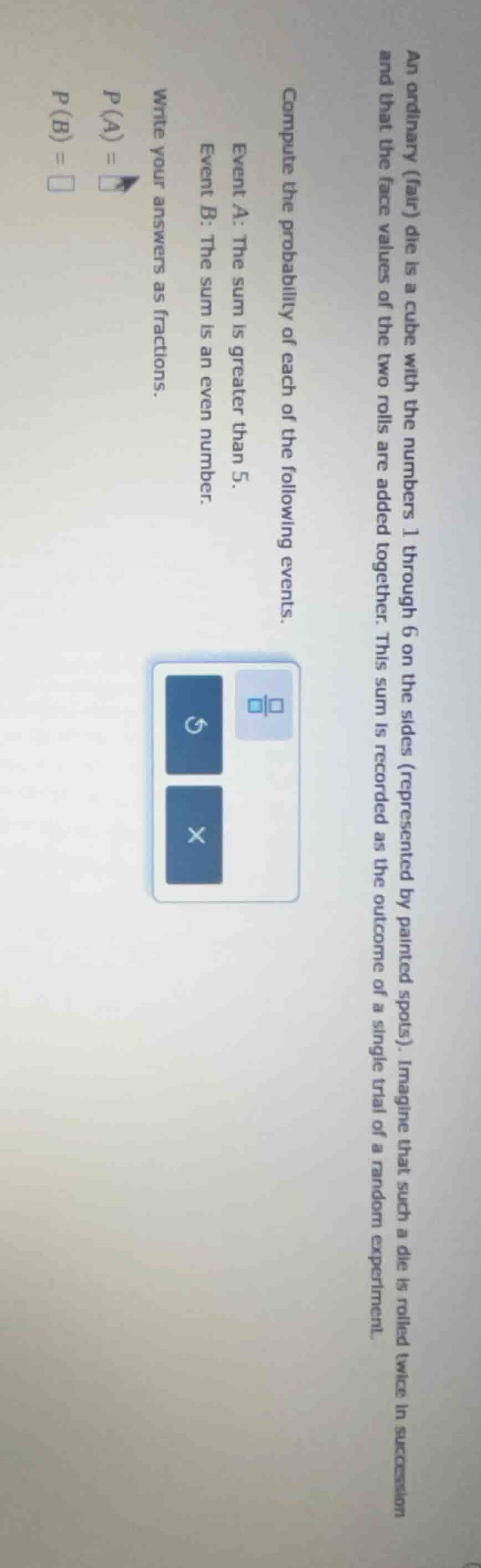
an ordinary (fair) die is a cube with the numbers 1 through 6 on the sides (represented by painted spots). imagine that such a die is rolled twice in succession and that the face values of the two rolls are added together. this sum is recorded as the outcome of a single trial of a random experiment. compute the probability of each of the following events. event a: the sum is greater than 5. event b: the sum is an even number. write your answers as fractions. p(a) = \\(\square\\) p(b) = \\(\square\\)
Step1: Determine total outcomes
When rolling a die twice, each roll has 6 outcomes. So total outcomes = \(6\times6 = 36\).
Step2: Find favorable for Event A
Event A: Sum > 5. Let's list sums ≤5: (1,1)=2, (1,2)=3, (1,3)=4, (1,4)=5, (2,1)=3, (2,2)=4, (2,3)=5, (3,1)=4, (3,2)=5, (4,1)=5. That's 10 outcomes. So favorable for A: \(36 - 10 = 26\)? Wait, no. Wait, sum >5 means sum ≥6. Wait, let's recalculate. Sums:
Sum 2: (1,1) - 1
Sum 3: (1,2),(2,1) - 2
Sum 4: (1,3),(2,2),(3,1) - 3
Sum 5: (1,4),(2,3),(3,2),(4,1) - 4
Total ≤5: 1+2+3+4=10. So sum >5: 36 - 10 = 26? Wait no, sum >5 is sum ≥6. Wait, sum 6: (1,5),(2,4),(3,3),(4,2),(5,1) - 5
Sum 7: (1,6),(2,5),(3,4),(4,3),(5,2),(6,1) - 6
Sum 8: (2,6),(3,5),(4,4),(5,3),(6,2) - 5
Sum 9: (3,6),(4,5),(5,4),(6,3) - 4
Sum 10: (4,6),(5,5),(6,4) - 3
Sum 11: (5,6),(6,5) - 2
Sum 12: (6,6) - 1
Total for sum ≥6: 5+6+5+4+3+2+1=26. So P(A) = 26/36 = 13/18. Wait, no, wait 5+6=11, +5=16, +4=20, +3=23, +2=25, +1=26. Yes. So P(A) = 26/36 = 13/18? Wait no, wait 36 total. Wait, maybe I made a mistake. Wait, sum >5: sum is 6,7,8,9,10,11,12. Let's count:
Sum 6: 5 outcomes (1,5),(2,4),(3,3),(4,2),(5,1)
Sum 7: 6 outcomes (1,6),(2,5),(3,4),(4,3),(5,2),(6,1)
Sum 8: 5 outcomes (2,6),(3,5),(4,4),(5,3),(6,2)
Sum 9: 4 outcomes (3,6),(4,5),(5,4),(6,3)
Sum 10: 3 outcomes (4,6),(5,5),(6,4)
Sum 11: 2 outcomes (5,6),(6,5)
Sum 12: 1 outcome (6,6)
Total: 5+6=11, +5=16, +4=20, +3=23, +2=25, +1=26. So 26/36 = 13/18. Wait, but let's check sum ≤5:
Sum 2: 1
Sum 3: 2
Sum 4: 3
Sum 5: 4
Total: 1+2+3+4=10. 36-10=26. Correct. So P(A)=26/36=13/18.
Step3: Find favorable for Event B
Event B: Sum is even. Even sums: 2,4,6,8,10,12.
Sum 2: 1 (1,1)
Sum 4: 3 (1,3),(2,2),(3,1)
Sum 6: 5 (1,5),(2,4),(3,3),(4,2),(5,1)
Sum 8: 5 (2,6),(3,5),(4,4),(5,3),(6,2)
Sum 10: 3 (4,6),(5,5),(6,4)
Sum 12: 1 (6,6)
Total favorable: 1+3=4, +5=9, +5=14, +3=17, +1=18. So 18 outcomes. So P(B)=18/36=1/2.

Snap & solve any problem in the app
Get step-by-step solutions on Sovi AI
Photo-based solutions with guided steps
Explore more problems and detailed explanations
For \( P(A) \): \(\frac{13}{18}\) (Wait, no, wait 26/36 simplifies to 13/18? Wait 26 divided by 2 is 13, 36 divided by 2 is 18. Yes. For \( P(B) \): \(\frac{1}{2}\)
Wait, but let's recheck Event B. When rolling two dice, the number of even sums: since the sum is even if both dice are even or both are odd. Number of odd numbers on a die: 3 (1,3,5), even: 3 (2,4,6). So number of ways both odd: 33=9, both even: 33=9. Total even sums: 9+9=18. So 18/36=1/2. Correct.
For Event A: sum >5. Total outcomes 36. Sum ≤5: as before, 10. So sum >5: 36-10=26. So 26/36=13/18. Yes.
So:
\( P(A) = \frac{13}{18} \)
\( P(B) = \frac{1}{2} \)