QUESTION IMAGE
Question
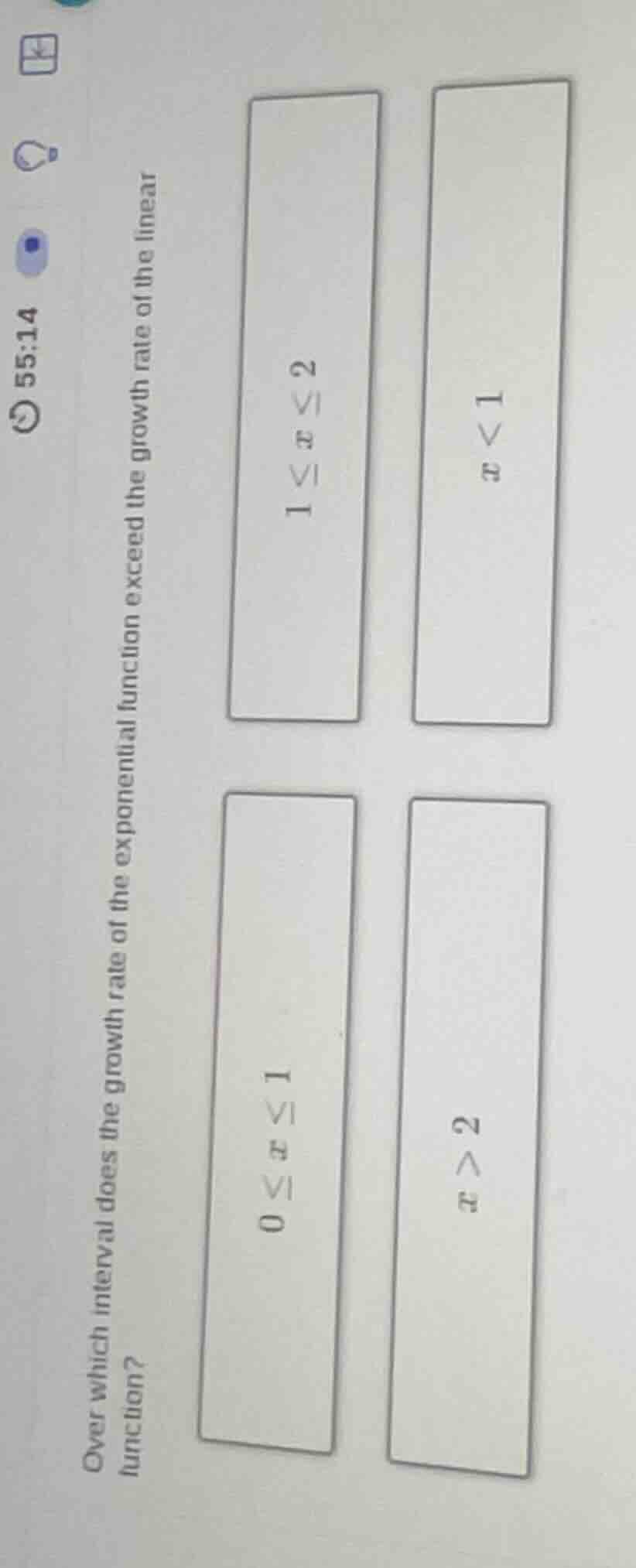
over which interval does the growth rate of the exponential function exceed the growth rate of the linear function? \\(0\leq x < 1\\) \\(1\leq x < 2\\) \\(x > 2\\) \\(x < 1\\)
Response
To determine when the growth rate of an exponential function exceeds that of a linear function, we analyze the properties of exponential (\(y = a^x, a>1\)) and linear (\(y = mx + b, m>0\)) functions:
Key Concept:
- Linear growth has a constant rate (\(m\), the slope).
- Exponential growth has a increasing rate (its derivative, \(y' = \ln(a) \cdot a^x\), grows with \(x\) for \(a>1\)).
Interval Analysis:
- For \(x < 1\) or \(0 \leq x < 1\) or \(1 \leq x < 2\): The exponential function’s rate (derivative) is still relatively small and may not exceed the linear rate.
- For \(x > 2\): As \(x\) becomes sufficiently large, the exponential function’s growth rate (which accelerates) will surpass the linear function’s constant growth rate.

Snap & solve any problem in the app
Get step-by-step solutions on Sovi AI
Photo-based solutions with guided steps
Explore more problems and detailed explanations
\(x > 2\)